
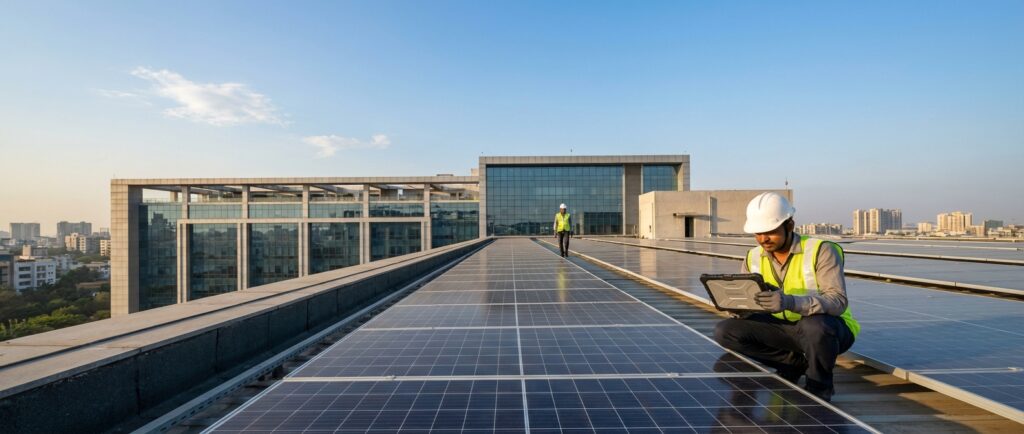
Solar energy has transformed India’s power landscape, with over 70 GW of installed solar capacity as of 2026. However, installing solar panels is just the beginning of your solar journey. Without proper operations and maintenance, even the most advanced solar installations can lose 15-25% of their potential energy output. Professional solar O&M India services ensure your solar investment delivers maximum returns year after year, protecting your assets from the harsh Indian climate and operational challenges.
This comprehensive guide walks you through everything you need to know about solar operations and maintenance services in India—from understanding what’s included in professional O&M packages to choosing the right provider and maximizing your solar ROI.
What is Solar O&M and Why It Matters in India
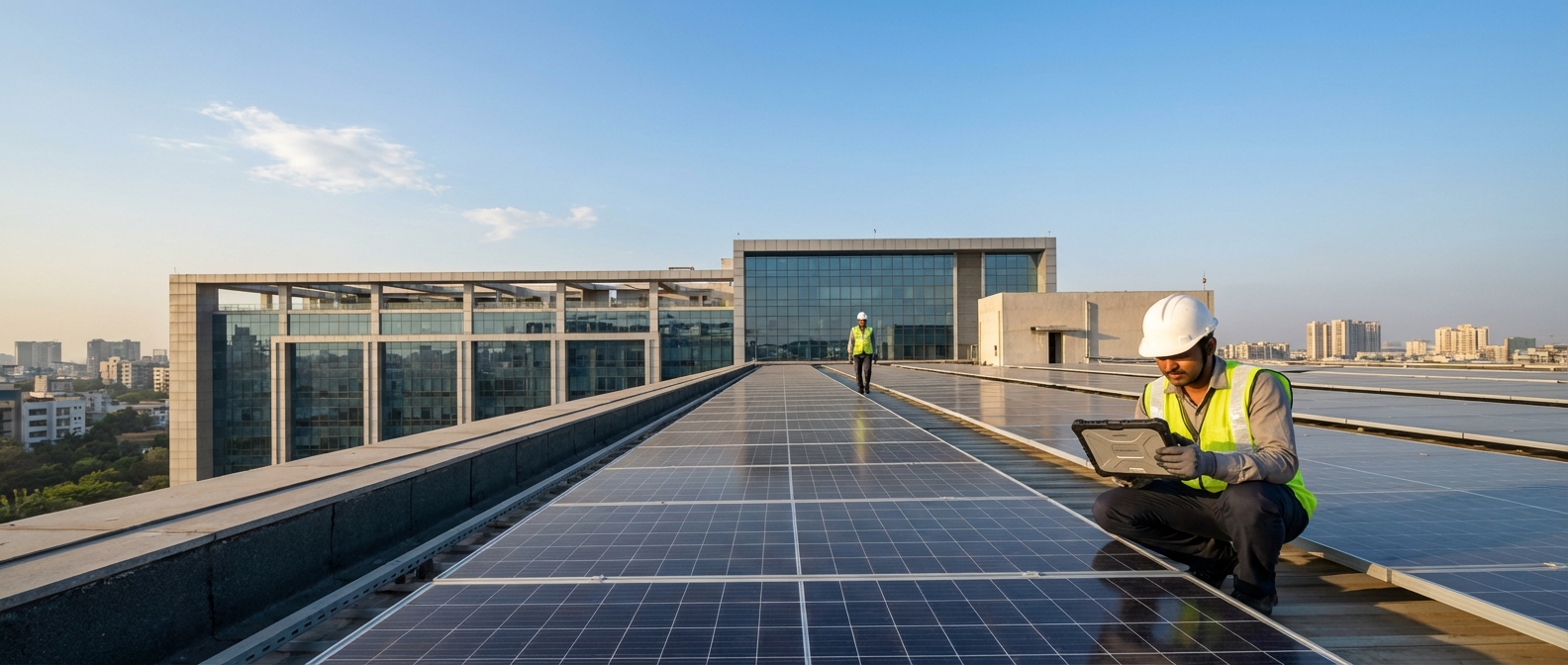
Solar Operations and Maintenance (O&M) encompasses all activities required to keep your solar installation running at peak performance. This includes remote monitoring, preventive maintenance, cleaning, repairs, and performance optimization. In India’s challenging environmental conditions, professional O&M isn’t optional—it’s essential for protecting your solar investment.
India’s diverse climate presents unique challenges for solar installations. Dust storms in northern regions, heavy monsoons in coastal areas, and extreme summer temperatures across the country all impact solar panel efficiency. Studies by the National Renewable Energy Laboratory show that dust accumulation alone can reduce solar panel output by 20-50% in arid regions without regular cleaning.
The financial impact of neglected maintenance is significant. A 100 kW commercial solar installation generating ₹15 lakhs annually in energy savings could lose ₹3-4 lakhs per year due to poor maintenance. Over a 25-year system lifespan, this represents a potential loss of ₹75 lakhs or more—far exceeding the cost of professional solar O&M India services.
Professional O&M services address several critical needs:
- Performance monitoring: Continuous tracking identifies issues before they become costly problems
- Preventive care: Scheduled maintenance prevents equipment failures and extends system life
- Quick response: Rapid fault detection and repair minimizes downtime and revenue loss
- Warranty protection: Proper maintenance ensures manufacturer warranties remain valid
- Compliance: Documentation and reporting meet regulatory and financing requirements
For commercial solar asset owners managing multiple sites, professional O&M becomes even more critical. Without centralized monitoring and maintenance, tracking performance across locations becomes nearly impossible, and small issues can cascade into major failures.
Complete Scope of Solar O&M Services in India
Understanding what’s included in comprehensive solar O&M India packages helps you evaluate providers and ensure you’re getting complete coverage. Professional O&M services typically encompass both remote monitoring and on-ground maintenance activities.
Remote Monitoring and Performance Tracking
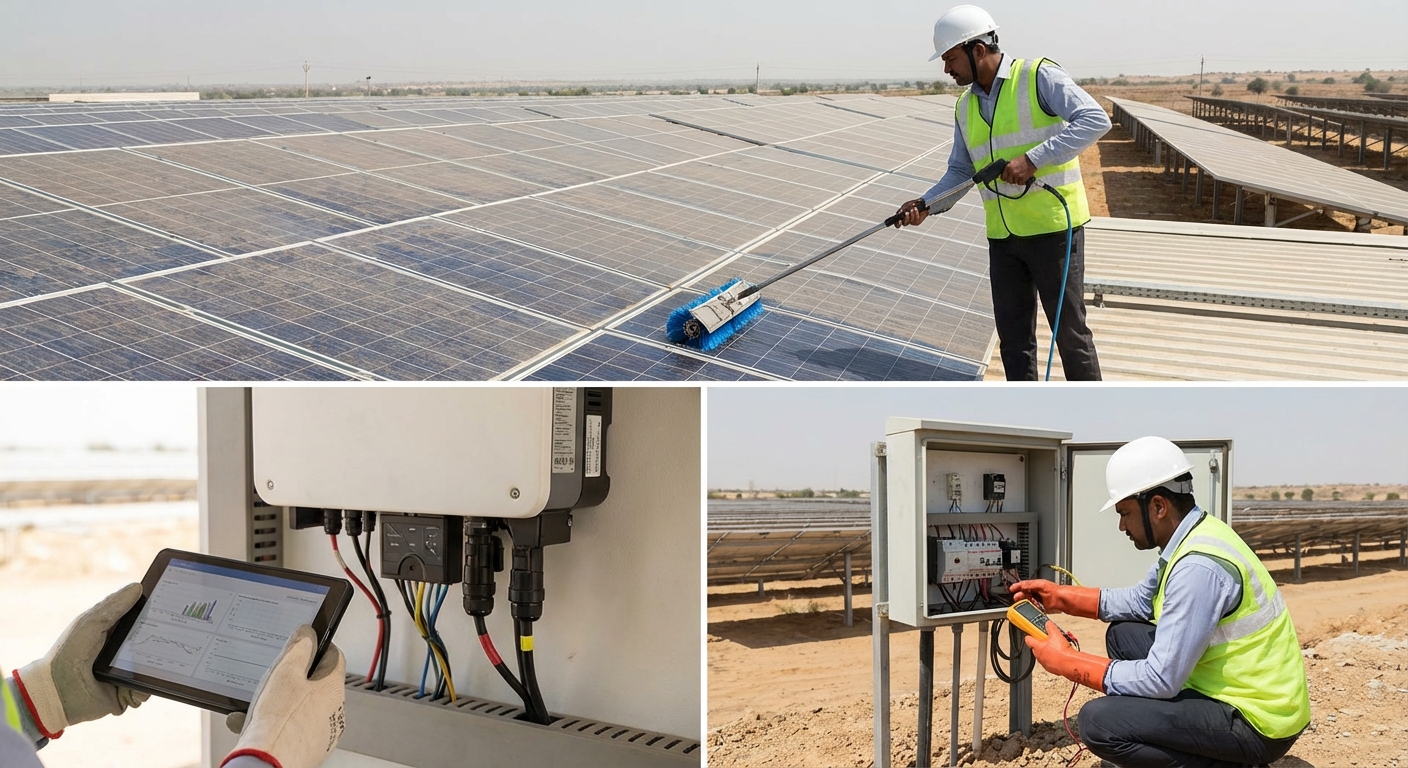
Modern solar O&M begins with continuous remote monitoring. Advanced monitoring systems track your installation 24/7, collecting data on energy production, inverter performance, string-level output, and environmental conditions. This real-time visibility allows O&M providers to detect faults immediately, often before you notice any performance drop.
Quality monitoring systems provide:
- Real-time energy generation data and performance metrics
- Inverter status monitoring and fault alerts
- String-level monitoring to identify underperforming panels
- Weather data correlation for performance analysis
- Automated alerts for system faults or performance deviations
- Historical data analysis and performance reporting
Preventive Maintenance Services
Scheduled preventive maintenance forms the backbone of effective solar O&M. These regular service visits keep your system running optimally and prevent costly breakdowns. Preventive maintenance typically includes:
- Solar panel cleaning and wiping: Removal of dust, bird droppings, and debris that reduce efficiency
- Inverter servicing: Inspection, cleaning, and testing of inverter components
- String balancing: Ensuring balanced current flow across all strings
- Hardware inspection: Checking and tightening all electrical connections and mounting hardware
- Thermal imaging: Identifying hot spots and potential failures before they occur
- Electrical testing: Measuring voltage, current, and resistance to verify proper operation
- Vegetation management: Trimming plants that could shade panels or damage equipment
Corrective Maintenance and Repairs
When issues arise, professional solar O&M India services provide rapid corrective maintenance. This includes diagnosing problems, sourcing replacement parts, performing repairs, and verifying system restoration. Common corrective maintenance activities include:
- Inverter repairs and component replacement
- Panel replacement for damaged or failed modules
- Cable and connector repairs
- Mounting structure repairs and reinforcement
- Earthing and lightning protection system maintenance
- SCADA and monitoring system troubleshooting
Warranty and Claims Management
Professional O&M providers handle the complex process of warranty claims for failed equipment. This includes documentation, coordination with manufacturers, and ensuring repairs meet warranty requirements. Proper maintenance records are essential for warranty validity, another reason professional O&M pays for itself.
Reporting and Documentation
Comprehensive reporting keeps you informed about your solar asset performance. Quality O&M services provide:
- Monthly performance reports with energy generation data
- Maintenance activity logs with photographic documentation
- Fault reports and resolution timelines
- Annual performance analysis and recommendations
- Compliance documentation for regulatory requirements
Remote Monitoring Systems: The Foundation of Modern Solar O&M
Remote monitoring has revolutionized solar O&M India services, transforming maintenance from reactive to proactive. Advanced monitoring platforms provide unprecedented visibility into solar system performance, enabling rapid issue detection and data-driven decision making.
How IoT-Enabled Monitoring Works
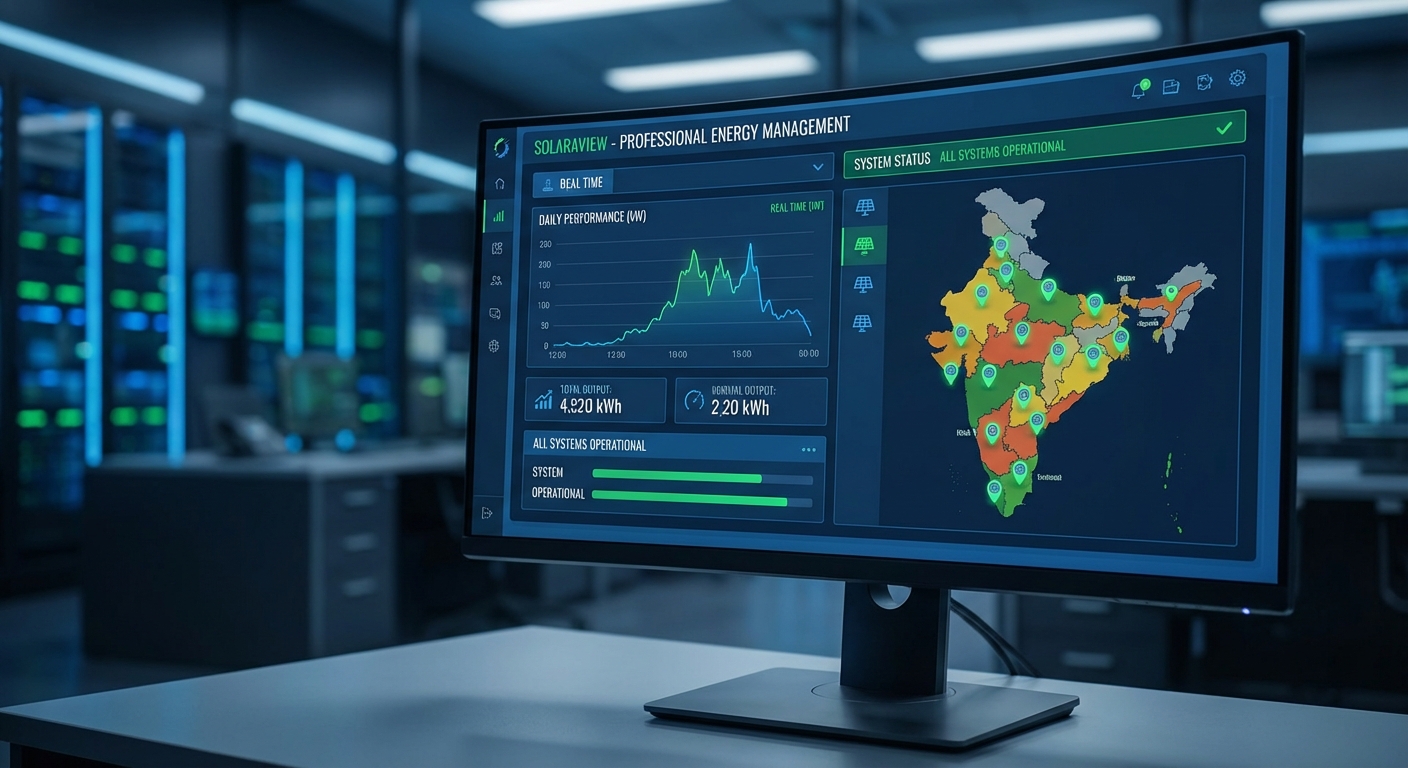
Modern solar monitoring systems use IoT (Internet of Things) technology to collect and transmit data from your solar installation. Custom-designed Remote Terminal Units (RTUs) connect to your inverters, weather stations, and other sensors, gathering performance data every few seconds. This data flows to cloud-based platforms where sophisticated algorithms analyze performance and identify anomalies.
The monitoring infrastructure typically includes:
- Data loggers and RTUs: Hardware devices that collect data from inverters and sensors
- Communication systems: 4G/WiFi connectivity for data transmission
- Cloud platform: Centralized database and analytics engine
- User interfaces: Web dashboards and mobile apps for data visualization
- Alert systems: Automated notifications via SMS, email, or app notifications
Key Performance Metrics Tracked
Comprehensive monitoring systems track dozens of performance indicators, providing complete visibility into system health. Critical metrics include:
- Energy generation: Real-time and cumulative kWh production
- Performance ratio: Actual vs. expected output based on irradiance
- Inverter efficiency: DC to AC conversion performance
- String current and voltage: Individual string performance for fault detection
- Irradiance and temperature: Environmental conditions affecting performance
- Grid parameters: Voltage, frequency, and power quality
- System availability: Uptime percentage and downtime analysis
Multi-Site Management Capabilities
For organizations with solar installations across multiple locations, centralized monitoring becomes invaluable. Modern platforms allow you to view all your sites from a single dashboard, compare performance across locations, and identify systemic issues. This capability is particularly valuable for commercial solar asset owners managing rooftop installations across different cities or states.
Mobile App Features
Leading solar O&M India providers offer mobile applications that put monitoring data in your pocket. These apps typically include:
- Real-time performance dashboards
- Site-wise energy generation reports
- Alert notifications and fault status
- Maintenance activity tracking with photos and timestamps
- Customer signature capture for service verification
- Historical data analysis and trend visualization
According to the International Energy Agency, solar installations with advanced monitoring systems achieve 5-8% higher energy yields compared to systems with basic or no monitoring, purely through faster fault detection and resolution.
Preventive Maintenance: What’s Included and When
Preventive maintenance schedules for solar O&M India services must account for India’s diverse climate zones and seasonal variations. The frequency and intensity of maintenance activities vary based on location, installation type, and environmental conditions.
Recommended Maintenance Schedules
Most professional O&M providers structure preventive maintenance around quarterly, bi-annual, and annual service visits:
Quarterly Maintenance (Every 3 Months):
- Visual inspection of panels, mounting structures, and electrical equipment
- Panel cleaning and debris removal
- Inverter inspection and cleaning
- Vegetation trimming if required
- Basic electrical measurements
- Performance data review and analysis
Bi-Annual Maintenance (Every 6 Months):
- Comprehensive panel cleaning with specialized equipment
- Detailed inverter servicing and testing
- String-level voltage and current measurements
- Hardware tightening and connection inspection
- Earthing system testing
- Lightning protection system inspection
- Cable and conduit inspection
Annual Comprehensive Maintenance:
- Complete system audit and performance assessment
- Thermal imaging of all panels and electrical components
- Insulation resistance testing
- Inverter calibration and firmware updates
- Mounting structure integrity assessment
- Waterproofing inspection and repairs
- Comprehensive performance report with recommendations
Panel Cleaning Frequency
Cleaning frequency varies significantly based on location and environmental conditions. In dusty northern regions like Delhi, Rajasthan, or Gujarat, monthly cleaning may be necessary during dry seasons. Coastal areas with higher humidity but less dust might require cleaning every 2-3 months. Monsoon seasons often provide natural cleaning, but post-monsoon inspection and cleaning are essential to remove water spots and debris.
Professional solar O&M India services adjust cleaning schedules based on actual performance data. If monitoring shows performance degradation due to soiling, cleaning frequency increases. This data-driven approach optimizes cleaning costs while maximizing energy output.
Seasonal Considerations
India’s distinct seasons require adapted maintenance approaches:
- Summer (March-June): Increased cleaning frequency due to dust, thermal imaging to identify heat-related issues, inverter cooling system inspection
- Monsoon (July-September): Waterproofing inspection, drainage system checks, post-storm damage assessment, lightning protection verification
- Post-Monsoon (October-November): Comprehensive cleaning, corrosion inspection, electrical connection tightening after thermal expansion/contraction
- Winter (December-February): Standard maintenance schedule, fog/dew impact assessment in northern regions
Understanding Solar O&M Pricing and AMC Contracts in India
Pricing for solar O&M India services varies based on installation size, location, service scope, and contract terms. Understanding typical pricing models and what’s included helps you evaluate proposals and budget appropriately.
Common Pricing Models
Solar O&M services in India typically follow one of these pricing structures:
Per kW Annual Fee: The most common model charges a fixed annual fee per kilowatt of installed capacity. This provides predictable costs and typically includes all standard preventive maintenance, monitoring, and minor repairs. Pricing varies based on installation type and location, with commercial rooftop systems generally commanding different rates than ground-mounted installations.
Fixed Annual Contract: Some providers offer fixed annual fees regardless of system size, particularly for smaller residential installations. This simplifies budgeting but may not scale efficiently for larger systems.
Performance-Based Contracts: Advanced O&M agreements tie fees to guaranteed performance levels. The provider commits to maintaining minimum energy generation thresholds, with financial penalties if targets aren’t met. These contracts align provider incentives with your performance goals but typically cost more upfront.
Hybrid Models: Many providers combine a base annual fee with additional charges for major repairs, component replacements, or services beyond standard scope.
What’s Typically Included in AMC Packages
Annual Maintenance Contracts (AMC) for solar installations generally include:
- Remote monitoring with 24/7 system tracking
- Scheduled preventive maintenance visits (quarterly or bi-annual)
- Panel cleaning services (frequency specified in contract)
- Inverter servicing and routine maintenance
- Minor repairs and component adjustments
- Performance reporting and documentation
- Technical support and helpdesk access
- Warranty claim assistance
Additional Costs to Expect
Most AMC contracts exclude certain major expenses:
- Component replacement: Failed inverters, panels, or major electrical components typically incur additional charges
- Structural repairs: Mounting structure damage or major waterproofing work
- System upgrades: Capacity additions or technology improvements
- Force majeure damage: Repairs due to natural disasters, vandalism, or accidents
- Out-of-scope services: Additional cleaning visits, emergency callouts beyond contracted response times
Reputable providers clearly specify inclusions and exclusions in contracts. Always review the fine print to understand what’s covered and what incurs additional charges.
Contract Duration and Terms
Solar O&M contracts typically run for 1-5 years, with longer contracts often offering better per-year pricing. Multi-year contracts provide stability but should include performance review clauses and clear exit terms. Key contract terms to evaluate include:
- Service level agreements (SLAs) for response times and resolution
- Performance guarantees and penalty clauses
- Payment terms and escalation clauses
- Renewal terms and price adjustment mechanisms
- Termination clauses and notice periods
- Liability and insurance coverage
Evaluating Value vs. Cost
The cheapest solar O&M India provider isn’t always the best value. Consider the total cost of ownership, including potential revenue loss from poor maintenance. A provider charging slightly more but delivering superior monitoring, faster response times, and better performance optimization often delivers better ROI.
Calculate the value of improved performance: if professional O&M increases your energy output by just 5% compared to basic maintenance, the additional revenue often exceeds the O&M cost difference. For a 100 kW system generating ₹15 lakhs annually, a 5% improvement adds ₹75,000 in annual value.
How to Choose the Right Solar O&M Provider in India
Selecting the right solar O&M India partner significantly impacts your solar investment’s long-term performance and profitability. The provider you choose becomes responsible for protecting assets worth lakhs or crores of rupees, making this decision critical.

Experience and Track Record
Prioritize providers with substantial experience in the Indian solar market. Look for companies with at least 3-5 years of operational history and a proven track record managing installations similar to yours. Ask for:
- Number of years in solar O&M business
- Total capacity under management (MW)
- Number of sites currently serviced
- Client references you can contact
- Case studies demonstrating performance improvements
Providers managing 50+ MW across diverse installation types demonstrate the operational maturity needed for reliable service delivery.
Technical Team and Resources
The quality of on-ground service depends directly on the provider’s technical team. Evaluate:
- Team size: Adequate staffing ensures prompt service across all sites
- Technical qualifications: Certified electricians and solar technicians
- Geographic coverage: Local presence in your installation areas for rapid response
- Equipment and tools: Professional testing equipment, cleaning systems, safety gear
- Training programs: Ongoing technical training and certification
Providers with 100+ trained technicians on payroll can deliver consistent service quality across multiple locations simultaneously.
Monitoring Platform Capabilities
The monitoring system forms the foundation of modern solar O&M. Evaluate the platform’s capabilities:
- Real-time monitoring: Live data updates, not delayed reporting
- Granular visibility: String-level monitoring, not just inverter-level data
- Custom RTU design: Proprietary hardware designed for Indian conditions
- Mobile app: User-friendly apps for iOS and Android
- Alert systems: Configurable alerts via multiple channels
- Reporting tools: Customizable reports and data export capabilities
- Multi-site management: Centralized dashboard for all installations
Request a demo of the monitoring platform before committing. The interface should be intuitive, responsive, and provide the visibility you need.
Service Level Agreements and Response Times
Clear SLAs protect your interests and ensure accountability. Key SLA components include:
- Response time: How quickly the provider acknowledges and responds to issues (typically 4-24 hours)
- Resolution time: Maximum time to resolve different issue categories
- Uptime guarantees: Minimum system availability percentages
- Scheduled maintenance windows: Frequency and duration of preventive maintenance
- Reporting timelines: When you receive performance reports
Providers confident in their capabilities offer strong SLAs with financial penalties for non-compliance.
Integration and Compatibility
Ensure the O&M provider can work with your existing equipment and systems. Ask about:
- Compatibility with your inverter brands and models
- Ability to integrate with existing monitoring systems if present
- Support for different installation types (rooftop, ground-mounted, carports)
- Experience with your system size and configuration
Certifications and Compliance
Professional solar O&M India providers maintain relevant certifications and comply with industry standards:
- ISO certifications for quality management
- Safety certifications and training
- Insurance coverage for liability and equipment damage
- Compliance with electrical safety regulations
- Environmental and waste disposal compliance
Financial Stability
Your O&M provider should be financially stable enough to support your installation throughout the contract period. Multi-year contracts with financially unstable providers risk service disruption. Review the company’s background, funding, and growth trajectory.
Customer Support and Communication
Ongoing communication quality matters as much as technical capability. Evaluate:
- Dedicated account management
- Helpdesk availability and responsiveness
- Communication channels (phone, email, app, portal)
- Escalation procedures for urgent issues
- Transparency in reporting and issue resolution
Request references from current clients and ask about their experience with communication and support.
ROI Benefits of Professional Solar O&M Services
Professional solar O&M India services deliver measurable financial returns that typically exceed their cost. Understanding these benefits helps justify the investment and set appropriate performance expectations.
Performance Improvement and Energy Yield
The most direct benefit of professional O&M is increased energy generation. Studies consistently show that well-maintained solar installations outperform neglected systems by 10-20%. This improvement comes from:
- Cleaner panels: Regular cleaning maintains optimal light absorption
- Faster fault resolution: Monitoring detects and resolves issues within hours instead of days or weeks
- Optimized performance: String balancing and inverter optimization maximize conversion efficiency
- Reduced downtime: Preventive maintenance prevents failures that cause extended outages
For a 100 kW commercial installation generating ₹15 lakhs annually, a 10% performance improvement adds ₹1.5 lakhs in annual value, often exceeding the annual O&M cost.
Extended Equipment Lifespan
Proper maintenance significantly extends the operational life of solar equipment. Inverters typically last 10-15 years with good maintenance but may fail in 5-7 years without proper care. Solar panels maintain higher efficiency longer when properly maintained, with well-maintained systems showing less degradation over 25-year lifespans.
Replacing a 100 kW inverter costs ₹5-8 lakhs. Extending inverter life by even 2-3 years through proper maintenance delivers substantial savings.
Warranty Protection
Most solar equipment warranties require documented maintenance to remain valid. Professional O&M ensures you maintain proper records and follow manufacturer requirements. When equipment fails under warranty, professional O&M providers handle the claim process, ensuring you receive replacements without out-of-pocket costs.
A single warranty claim for failed panels or inverters can save lakhs of rupees, but only if your maintenance documentation supports the claim.
Reduced Emergency Repair Costs
Preventive maintenance identifies and addresses small issues before they become expensive failures. A loose connection detected during routine inspection costs nothing to tighten. The same connection left unaddressed can cause arcing, equipment damage, and fire risk, potentially costing lakhs in repairs and lost production.
Emergency repairs typically cost 2-3 times more than planned maintenance due to urgency, after-hours labor, and expedited parts procurement. Professional O&M minimizes these costly emergencies.
Revenue Protection Through Uptime
Every hour your solar system is down represents lost revenue. For a 100 kW system generating ₹15 lakhs annually, each day of downtime costs approximately ₹4,100 in lost generation. Professional monitoring and rapid response minimize downtime, protecting your revenue stream.
Systems with professional O&M typically achieve 98-99% uptime compared to 90-95% for poorly maintained systems. This 4-9% uptime improvement directly translates to additional revenue.
Compliance and Reporting Benefits
Many solar installations require performance reporting for financing agreements, renewable energy certificates, or corporate sustainability reporting. Professional O&M provides the documentation and reporting needed for compliance, avoiding penalties and maintaining access to incentive programs.
Common Solar O&M Challenges and Solutions
Understanding common challenges in solar O&M India helps you appreciate the value professional services provide and set realistic expectations.
Dust and Soiling
Challenge: India’s dusty conditions, particularly in northern and western regions, cause rapid soiling that can reduce output by 20-50% between cleanings. Dust composition varies by region, with some areas experiencing sticky, difficult-to-remove soiling.
Solution: Professional O&M providers use specialized cleaning equipment and techniques appropriate for local conditions. They adjust cleaning frequency based on actual performance data, optimizing the balance between cleaning costs and energy recovery. Advanced providers use water-efficient cleaning methods critical in water-scarce regions.
Monsoon-Related Issues
Challenge: Heavy monsoon rains cause waterproofing failures, drainage problems, and potential electrical hazards. Lightning strikes during monsoons can damage inverters and electrical systems. Post-monsoon, water spots and debris accumulation reduce performance.
Solution: Pre-monsoon inspections identify and address waterproofing vulnerabilities. Professional O&M includes drainage system maintenance and lightning protection verification. Post-monsoon cleaning and inspection restore performance and identify any storm damage requiring repair.
String Faults and DC Losses
Challenge: Individual panel failures, shading issues, or connection problems cause string-level faults that reduce overall system performance. Without string-level monitoring, these issues often go undetected for months.
Solution: Advanced monitoring systems track string-level performance, immediately identifying underperforming strings. Regular thermal imaging during maintenance visits detects hot spots and failing panels before complete failure. String balancing during maintenance ensures optimal current distribution.
Inverter Failures and Component Degradation
Challenge: Inverters are the most failure-prone components in solar systems. Dust accumulation, heat, and electrical stress cause component degradation. Inverter failures halt energy generation entirely until repaired.
Solution: Regular inverter servicing includes cleaning, cooling system inspection, and electrical testing. Monitoring systems track inverter performance parameters, identifying degradation before failure. Professional O&M providers maintain relationships with inverter manufacturers for rapid parts procurement and warranty support.
Multi-Site Management Complexity
Challenge: Organizations with solar installations across multiple locations struggle to track performance, coordinate maintenance, and ensure consistent service quality. Travel costs and logistics complicate maintenance scheduling.
Solution: Centralized monitoring platforms provide single-dashboard visibility across all sites. Professional O&M providers with national presence can service multiple locations efficiently. Standardized maintenance procedures ensure consistent quality regardless of location. Mobile apps enable real-time tracking of maintenance activities across all sites.
Vegetation and Shading
Challenge: Growing vegetation can shade panels, reducing output. In some locations, bird nesting and droppings create persistent soiling issues.
Solution: Regular site inspections identify vegetation growth requiring trimming. Professional O&M includes vegetation management in maintenance schedules. Bird deterrent installation prevents nesting in problem areas.
Getting Started with Solar O&M Services
Transitioning to professional solar O&M India services involves several steps to ensure smooth onboarding and optimal results.
Initial System Assessment
Professional O&M providers begin with a comprehensive assessment of your solar installation. This audit evaluates:
- Current system performance and efficiency
- Equipment condition and maintenance history
- Existing monitoring systems and data availability
- Immediate maintenance needs or issues
- Performance optimization opportunities
- Safety and compliance status
This assessment establishes a performance baseline and identifies priority actions. It typically takes 1-2 days for commercial installations and provides a detailed report with recommendations.
Monitoring System Installation
If your installation lacks adequate monitoring or the provider uses proprietary systems, monitoring hardware installation is the next step. This typically involves:
- Installing RTUs and data loggers
- Configuring communication systems
- Integrating with inverters and sensors
- Setting up cloud platform and user accounts
- Configuring alerts and reporting
- Training your team on platform usage
Monitoring installation usually takes 1-3 days depending on system complexity and typically requires minimal system downtime.
Establishing Performance Benchmarks
Professional O&M requires clear performance expectations. Work with your provider to establish:
- Expected energy generation based on system capacity and location
- Performance ratio targets accounting for losses
- Uptime and availability goals
- Response time expectations for different issue types
- Reporting frequency and format preferences
These benchmarks provide objective measures for evaluating O&M effectiveness and holding providers accountable.
Scheduling Initial Maintenance
Most providers schedule comprehensive maintenance shortly after onboarding to address any deferred maintenance and establish a clean baseline. This initial service typically includes:
- Thorough panel cleaning
- Complete electrical inspection and testing
- Hardware tightening and adjustment
- Inverter servicing
- Thermal imaging
- Detailed documentation of system condition
Transitioning from Previous Providers
If you’re switching from another O&M provider or self-maintenance, ensure smooth transition by:
- Providing all available maintenance records and system documentation
- Sharing historical performance data
- Identifying known issues or concerns
- Coordinating timing to avoid service gaps
- Clarifying warranty status and documentation requirements
What to Prepare
Before engaging an O&M provider, gather:
- System design documents and as-built drawings
- Equipment specifications and warranty information
- Historical performance data if available
- Previous maintenance records
- Site access information and safety requirements
- Contact information for key stakeholders
Having this information ready accelerates onboarding and helps providers deliver better service from day one.
Maximize Your Solar Investment with Professional O&M
Professional solar O&M India services transform solar installations from passive assets into actively managed, optimized energy systems. The difference between basic maintenance and comprehensive O&M often represents 10-20% of your solar system’s revenue potential, far exceeding the cost of professional services.
As India’s solar capacity continues growing, the importance of professional operations and maintenance grows with it. Solar installations represent significant capital investments that deserve the same level of professional management as any other business asset. With proper O&M, your solar system will deliver maximum returns throughout its 25-year lifespan, protecting your investment and contributing to India’s clean energy future.
Whether you’re managing a single commercial rooftop installation or a portfolio of solar assets across multiple locations, partnering with an experienced O&M provider ensures optimal performance, minimizes downtime, and maximizes your solar ROI. The monitoring visibility, technical expertise, and proactive maintenance that professional services provide simply cannot be replicated through self-maintenance or basic service contracts.
Ready to optimize your solar asset performance? Intello’s integrated monitoring and maintenance platform combines advanced IoT technology with over 150 trained solar experts to deliver comprehensive solar O&M India services. With 5+ years of experience managing solar installations across India, Intello provides the visibility, responsiveness, and technical expertise needed to maximize your solar investment. Request a quote today to learn how professional O&M can increase your energy output and protect your solar assets, or learn more about Intello’s comprehensive approach to solar operations and maintenance.
This blog post was written using thestacc.com
