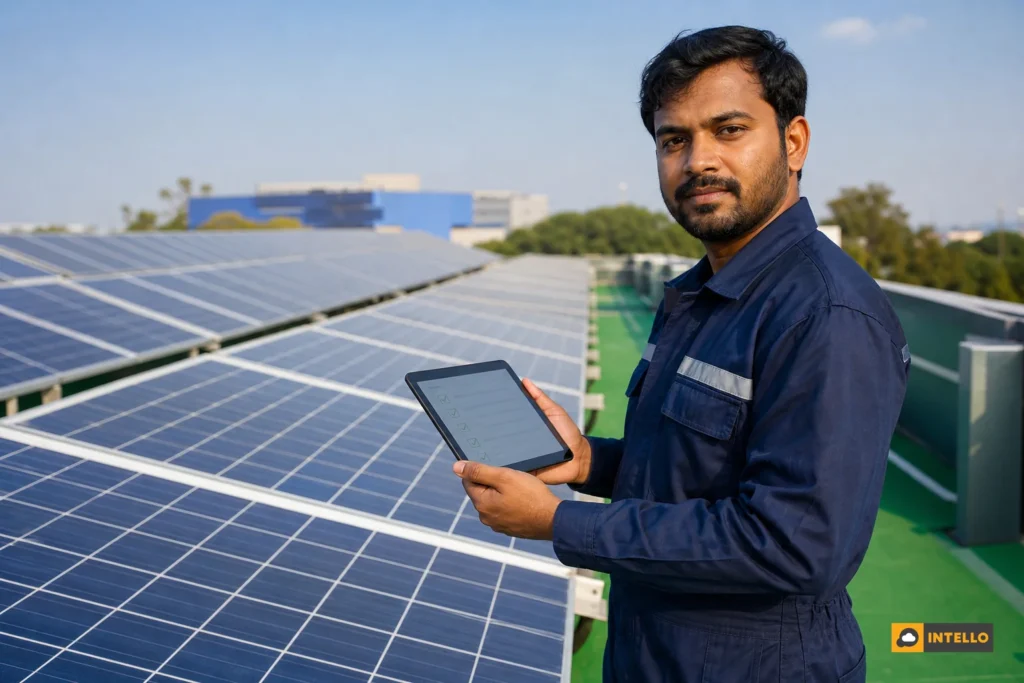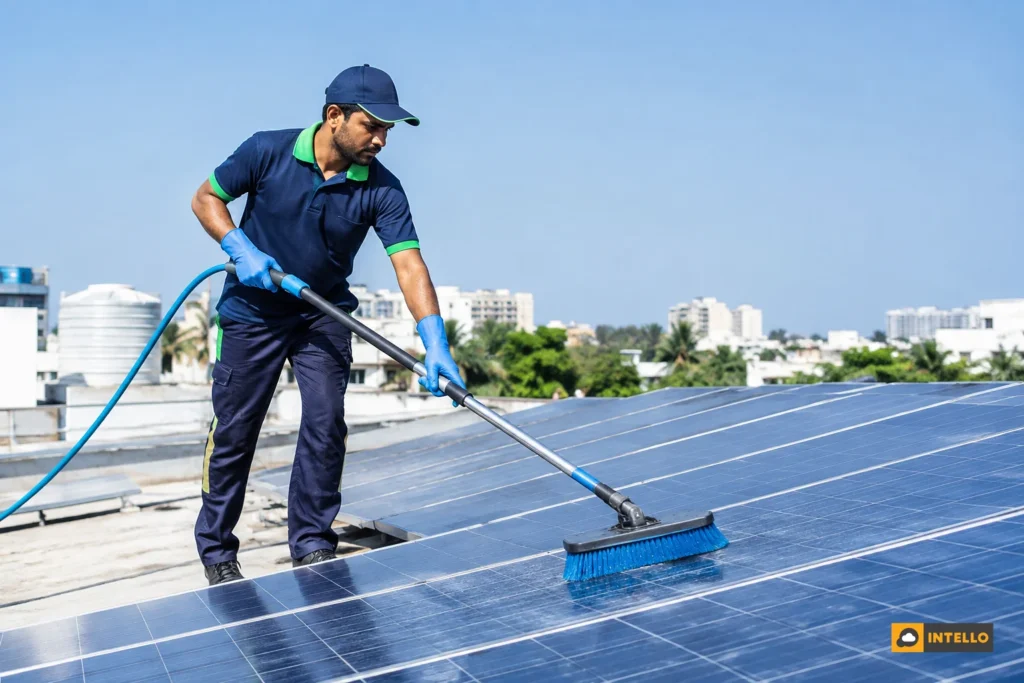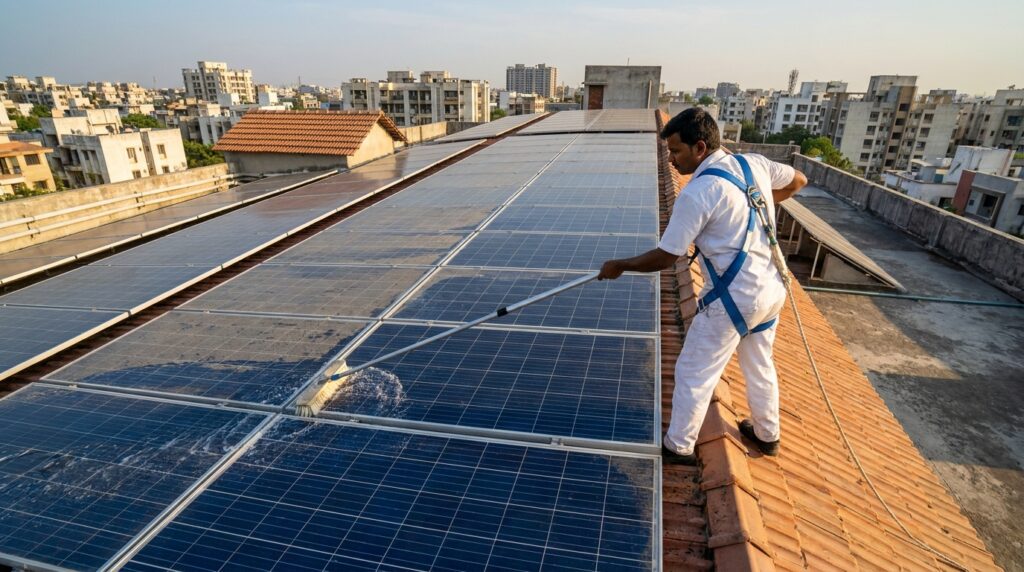
India generates more solar energy than almost any other country in the world, yet a significant portion of that potential is lost every single day to one simple problem: dirty panels. Solar cleaning India is not a luxury maintenance task. It is a direct driver of energy output, system longevity, and return on investment. Across India’s vastly different geographies, from the salt-laden coastal air of Kerala to the relentless dust storms of Rajasthan, the soiling challenge is real, measurable, and entirely manageable with the right approach.
This guide is built for solar asset owners, facility managers, and EPC companies who want a clear, location-specific answer to the question: how often should I clean my solar panels, what method should I use, and what will it cost? We cover all of India’s major climate zones, provide state-wise cost benchmarks for 2026, and lay out a seasonal cleaning calendar you can put to use immediately.
Why Solar Cleaning India Is a Critical Maintenance Priority
Studies from the National Renewable Energy Laboratory and field data from Indian solar installations consistently show that soiling losses in India range from 15% to 35% depending on location and season. In high-dust zones like Rajasthan and Gujarat, panels left uncleaned for just two weeks can lose up to 25% of their rated output. That is not a minor inefficiency. For a 100 kWp commercial rooftop system, that translates to thousands of rupees in lost generation every month.
The problem is compounded by India’s diversity. A solar asset in Chennai faces entirely different soiling conditions than one in Ludhiana or Pune. Salt aerosols, industrial particulate matter, agricultural pollen, and monsoon mud each require different cleaning frequencies and methods. A one-size-fits-all cleaning schedule simply does not work across Indian geography.
Beyond energy loss, neglected panels face long-term risks. Accumulated soiling causes hot spots, which degrade cells permanently. Biological growth from algae and moss in humid coastal regions can etch into panel surfaces. Bird droppings, which are highly acidic, can cause micro-cracks if left unattended. All of these issues affect solar panel efficiency and can shorten the operational life of your system well before the 25-year warranty period ends.
Effective solar cleaning India practices, when integrated into a broader solar O&M India strategy, protect your asset, maximize generation, and ensure your solar investment delivers the ROI it was designed to achieve.
How India’s Climate Zones Affect Solar Panel Soiling
Understanding your climate zone is the first step toward building an effective solar cleaning India schedule. India’s solar installations span five distinct soiling environments, each with its own challenges.
Coastal Zones (Kerala, Tamil Nadu, Andhra Pradesh, Goa, Maharashtra Coast)
Coastal installations face a combination of salt spray, high humidity, and biological growth. Salt deposits form a thin, sticky film on panel surfaces that attracts more dust and is harder to remove than dry particulate matter. Humidity above 70% accelerates algae and moss growth, particularly on panel frames and edges. Panels in these regions require more frequent cleaning and specialized wet-cleaning methods to prevent salt crystallization.
Desert and Arid Zones (Rajasthan, Gujarat, Parts of Maharashtra)
This is India’s most demanding soiling environment. Dust storms (andhi) can deposit millimeters of fine sand on panels overnight. The combination of high irradiance, low humidity, and constant wind-driven particulate makes this the highest-frequency cleaning zone in the country. Rajasthan’s solar parks, which host some of India’s largest utility-scale installations, require cleaning as often as twice a week during peak dust season.
Industrial Corridors (NCR, Pune, Surat, Ahmedabad, Nagpur)
Industrial zones present a different kind of soiling challenge. Particulate matter (PM2.5 and PM10), soot, and chemical deposits from nearby factories and heavy traffic create a greasy, adhesive layer on panel surfaces. This type of soiling is denser than dust and requires wet cleaning with appropriate cleaning agents. Industrial soiling also tends to be uneven, creating shading patterns that cause string imbalances and DC losses.
Agricultural Belts (Punjab, Haryana, Uttar Pradesh, Madhya Pradesh)
Agricultural regions face seasonal soiling spikes. Crop residue burning in Punjab and Haryana (October-November) deposits a fine carbon layer on panels across a wide area. During sowing and harvesting seasons, pollen, chaff, and pesticide mist accumulate on panel surfaces. Post-harvest stubble burning is particularly damaging and requires immediate cleaning response.
Hilly and Moderate Climate Zones (Himachal Pradesh, Uttarakhand, Northeast India)
These regions generally have lower soiling rates due to regular rainfall and lower dust levels. However, biological growth, leaf litter, and snow accumulation (in higher altitudes) are the primary concerns. Cleaning frequency is lower, but inspections after heavy rainfall or snowfall are essential to check for physical damage and drainage issues.
Recommended Solar Cleaning Frequency by Region
The table below provides evidence-based cleaning frequency recommendations for solar cleaning India across major states and regions. These are starting points. Your actual schedule should be refined using performance monitoring data, which can reveal soiling-related generation drops in real time.
| Region / State | Climate Type | Recommended Frequency | Peak Soiling Season |
|---|---|---|---|
| Rajasthan, Gujarat | Desert / Arid | Weekly to fortnightly | March – June |
| Kerala, Goa, Coastal TN, Coastal AP | Coastal / Humid | Every 2–3 weeks | Year-round (post-monsoon spike) |
| NCR, Pune, Surat, Ahmedabad | Industrial / Urban | Every 2 weeks | October – February (smog season) |
| Punjab, Haryana, UP, MP | Agricultural | Monthly (fortnightly Oct, Nov) | October, November (stubble burning) |
| Himachal, Uttarakhand, Northeast | Hilly / Moderate | Every 4, 6 weeks | Post-monsoon (September, October) |
| Maharashtra (non-coastal), Karnataka, Telangana | Semi-arid / Mixed | Every 2, 3 weeks | March, May, October, November |
These frequencies assume standard commercial or residential rooftop installations. Ground-mounted utility-scale systems in open terrain may require more frequent cleaning due to greater exposure to wind-driven soiling.
Solar Panel Cleaning Methods: What Works in Each Climate
Choosing the right cleaning method is just as important as cleaning frequency. The wrong technique can scratch panel surfaces, leave mineral deposits, or even void your manufacturer warranty. Here is a breakdown of the methods used in professional solar cleaning India operations and where each one is most appropriate.
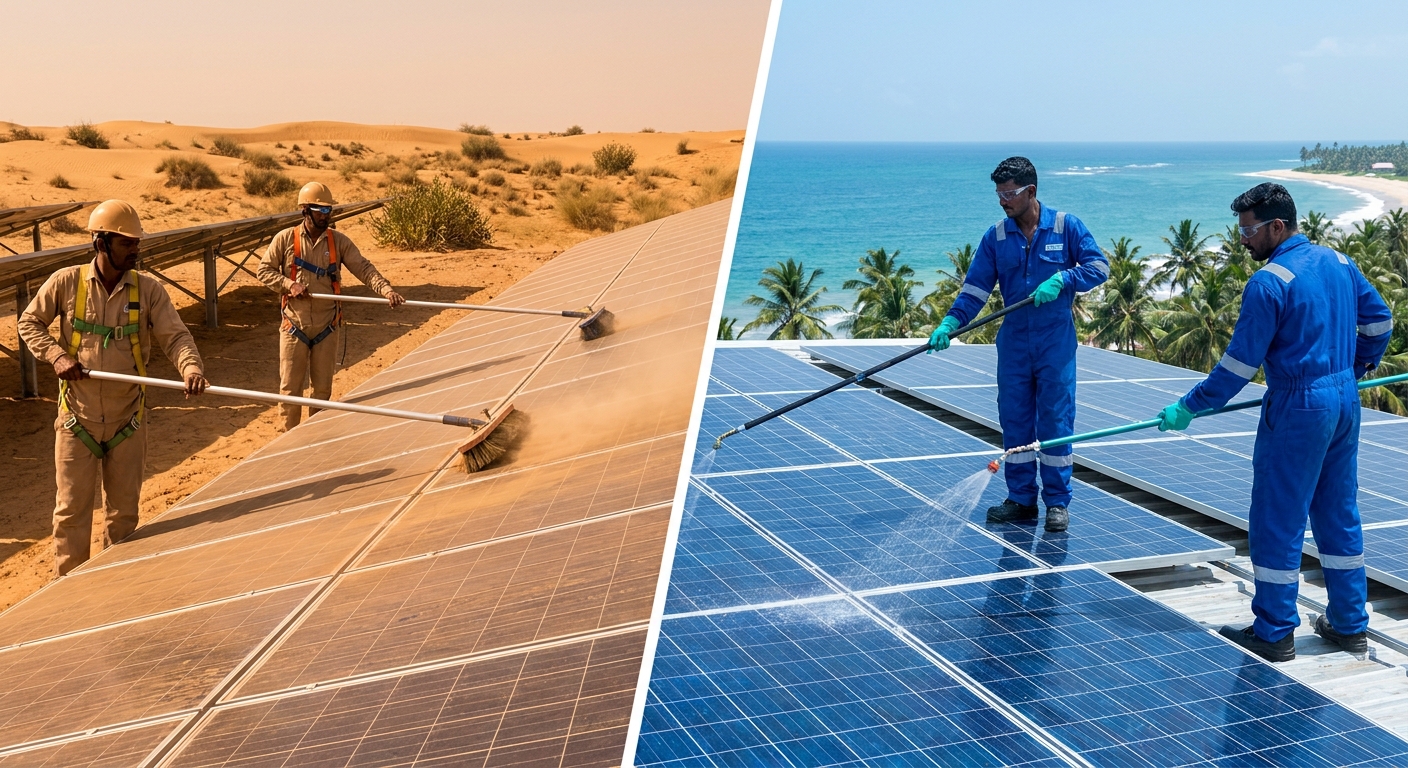
Dry Brushing (Suitable for Desert Zones)
In low-humidity, high-dust environments like Rajasthan and Gujarat, dry brushing with soft microfiber or nylon brushes is often the first-line cleaning method. It removes loose dust without using water, which is both scarce and expensive in these regions. Dry brushing is most effective when done early morning before the day’s heat causes dust to bond more firmly to the panel surface. It is not suitable for sticky soiling types like salt deposits or industrial soot.
Wet Cleaning with Deionized or Purified Water
This is the gold standard for most Indian climate zones, particularly coastal and industrial regions. Deionized (DI) water leaves no mineral residue after drying, unlike tap water, which can leave calcium and magnesium deposits that reduce light transmission over time. Professional O&M teams use water-fed pole systems with soft brushes to apply DI water at low pressure. This method is effective against salt deposits, industrial soot, and biological growth.
Important: Tap water in many Indian cities has a Total Dissolved Solids (TDS) level above 500 ppm. Using such water for solar panel cleaning leaves mineral streaks that can reduce panel output by 3-5% even after cleaning. Always verify water quality before use.
Automated Robotic Cleaning Systems
For large ground-mounted installations (typically above 500 kWp), robotic cleaning systems offer a compelling ROI. These systems operate on rails along panel rows and can clean an entire array overnight without water or manual labor. The upfront investment is significant, but for utility-scale plants in high-frequency cleaning zones like Rajasthan, the labor cost savings over 5-7 years typically justify the investment. Several Indian solar parks have adopted robotic cleaning as part of their standard solar O&M India protocols.
Manual Professional Cleaning
The most common method for commercial rooftop systems across India. Trained technicians use soft brushes, squeegees, and purified water to clean panels systematically. A key advantage of professional cleaning over DIY is that technicians simultaneously inspect panels for micro-cracks, delamination, hot spots, and loose connections, catching issues before they become costly repairs.
What NOT to Do
- High-pressure water jets: Can damage panel seals, connectors, and junction boxes
- Abrasive scrubbers or steel wool: Scratch anti-reflective coatings permanently
- Harsh chemical detergents: Can degrade EVA encapsulant and void warranties
- Cleaning during peak sun hours: Thermal shock from cold water on hot panels can cause micro-cracks
- Unfiltered tap water in hard water zones: Leaves TDS deposits that compound over time
DIY vs Professional Solar Cleaning in India: A Region-by-Region Comparison
The DIY vs professional debate is one of the most common questions in solar cleaning India discussions. The honest answer depends on your system size, location, and risk tolerance.
When DIY Is Feasible
For small residential systems (up to 5 kWp) in moderate climate zones like Himachal Pradesh, Uttarakhand, or parts of Karnataka, DIY cleaning with a soft brush and purified water is manageable. The system is small enough to clean safely from ground level or with a short ladder, and the soiling rate is low enough that monthly cleaning is sufficient.
The Real Risks of DIY Solar Cleaning
DIY cleaning carries risks that are often underestimated by system owners:
- Warranty voidance: Many panel manufacturers specify that cleaning must be performed by trained personnel using approved methods. DIY cleaning with incorrect materials can void your solar warranty India coverage.
- Safety hazards: Rooftop work without proper safety harnesses and equipment is a leading cause of serious injuries. This risk is amplified on wet, sloped rooftops.
- Missed inspection: DIY cleaning does not include the technical inspection that professional teams provide. String faults, loose MC4 connectors, and early-stage delamination go undetected.
- Improper technique: Incorrect brush pressure or the wrong cleaning agent can cause surface scratches that permanently reduce panel efficiency.
The Professional Advantage
Professional solar cleaning India services, especially when bundled with a solar AMC India plan, deliver value well beyond clean panels. Intello’s maintenance teams, for example, combine every cleaning visit with a visual inspection, performance data review, and a photographic report with timestamps and technician signatures delivered through their mobile app. This means every cleaning visit also functions as a preventive maintenance check, catching issues like inverter faults, string imbalances, and DC losses before they escalate into costly repairs.
For commercial asset owners managing multiple sites, the ability to track cleaning history, performance trends, and maintenance records through a centralized monitoring dashboard is a significant operational advantage. You can explore how this integrated approach works by learning more about Intello’s O&M platform.
State-Wise Solar Cleaning Cost Benchmarks in India (2026)
Solar cleaning India costs vary significantly based on system size, location, accessibility, cleaning frequency, and whether you opt for per-visit pricing or an annual maintenance contract. The figures below represent approximate market benchmarks for 2026 and should be used as a starting reference when evaluating service proposals.
Key Cost Factors
- System size (kWp): Larger systems benefit from economies of scale in per-kWp cost
- Accessibility: High-rise rooftops or systems with complex mounting structures cost more to service
- Cleaning frequency: Higher frequency zones (Rajasthan, Gujarat) have higher annual cleaning costs
- Water quality requirements: Coastal and industrial zones requiring DI water add to per-visit cost
- Bundled vs standalone: Cleaning bundled within a solar AMC India plan is typically more cost-effective than standalone per-visit pricing
Approximate Annual Cleaning Cost Ranges by Region
For a standard commercial rooftop system of 50, 100 kWp, annual cleaning costs (standalone, not bundled with AMC) typically fall in these ranges:
- Rajasthan / Gujarat (desert zone): Higher annual cost due to weekly/fortnightly frequency requirements. Robotic cleaning systems can reduce long-term costs for large installations.
- Kerala / Coastal Tamil Nadu / Goa: Moderate-to-high cost due to specialized wet cleaning requirements and salt deposit management.
- NCR / Pune / Surat (industrial zones): Moderate cost with a premium for specialized cleaning agents and more thorough post-cleaning inspection.
- Punjab / Haryana / UP (agricultural belts): Lower base cost with a seasonal spike during October, November stubble burning period.
- Himachal / Uttarakhand / Northeast: Lowest cleaning frequency and cost, but inspection costs may be higher due to remote access.
For accurate pricing tailored to your system size, location, and cleaning requirements, request a quote from Intello’s O&M team. Bundling cleaning with a comprehensive solar AMC India plan almost always delivers better value than standalone cleaning contracts.
It is also worth comparing the cost of cleaning against the cost of not cleaning. A 100 kWp system generating 140,000 units annually at ₹7/unit generates ₹9.8 lakh per year. A 20% soiling loss means ₹1.96 lakh in lost generation annually. Professional cleaning costs are a fraction of this figure, making the ROI case straightforward. For a deeper look at how O&M decisions affect solar ROI, see our guide on in-house vs outsourced solar O&M in India.
Seasonal Solar Cleaning Schedule for India
India’s four seasons create distinct soiling patterns that should drive your solar cleaning India calendar. A static monthly schedule misses the peaks and valleys of soiling intensity across the year. Here is how to think about each season.

Pre-Monsoon / Summer (March, May): Critical Cleaning Window
This is the highest-generation period for most of India, and also the peak dust season. March through May is the most important cleaning window of the year. Panels should be cleaned at the start of March to maximize generation during peak irradiance months. In desert zones, cleaning frequency should increase to weekly during April and May when dust storms are most frequent. A thorough pre-summer cleaning also includes inspection of mounting hardware, which expands and contracts significantly in extreme heat.
Monsoon Season (June, September): Inspection Over Cleaning
Monsoon rains provide some natural cleaning, but they also create new problems. Mud streaks, biological growth, and standing water in panel frames are the primary concerns. Rain does not clean panels effectively because it deposits dissolved minerals and organic matter as it evaporates. Post-rain inspections should check for mud accumulation at panel edges, water ingress in junction boxes, and any physical damage from heavy rainfall or hail. In coastal regions, the monsoon season accelerates algae growth significantly.
Post-Monsoon (October, November): Thorough Cleaning Required
October and November require the most thorough cleaning of the year in most Indian regions. Biological growth accumulated during monsoon, combined with stubble burning deposits in agricultural states and the onset of industrial smog season in northern India, creates a heavy soiling load. A comprehensive post-monsoon cleaning and inspection sets up your system for optimal winter generation and should include a full performance audit to identify any issues that developed during the monsoon period.
Winter (December, February): Fog and Dew Management
In northern India, dense winter fog deposits a fine layer of moisture and particulate matter on panel surfaces. This fog residue, combined with low sun angles, can reduce winter generation significantly. Morning cleaning before peak generation hours is particularly effective in fog-prone regions like Punjab, Haryana, and the NCR. In coastal regions, winter dew creates similar issues. Southern India generally has lower soiling rates in winter, allowing for extended cleaning intervals.
Using Monitoring Data to Drive Cleaning Decisions
The most sophisticated approach to solar cleaning India scheduling is data-driven. Remote monitoring systems that track Performance Ratio (PR) and specific yield in real time can detect soiling-related generation drops as they happen. When your monitoring dashboard shows a PR drop that is not explained by weather or equipment faults, it is a reliable signal that cleaning is needed. This approach eliminates both under-cleaning (which costs generation) and over-cleaning (which costs money and labor). Intello’s IoT-enabled monitoring platform provides exactly this capability, alerting asset owners and O&M teams when performance deviates from expected baselines. You can access your system’s performance data anytime through the Intello monitoring portal.
Integrating Solar Cleaning with Your O&M and AMC Plan
Solar cleaning India is most effective when it is not treated as a standalone task but as one component of a comprehensive operations and maintenance strategy. Standalone cleaning contracts often miss the broader picture: a clean panel on a system with a failing inverter or a string imbalance is still an underperforming system.

What a Comprehensive Solar AMC India Plan Should Include
A well-structured solar AMC India plan goes beyond cleaning to cover the full spectrum of preventive and corrective maintenance:
- Scheduled panel cleaning at region-appropriate frequency
- Inverter servicing and firmware updates
- String balancing and DC loss analysis
- Mounting hardware inspection and tightening
- Earthing and lightning protection checks
- Warranty claim management and coordination
- Performance reporting and generation analysis
- Emergency response for faults and failures
The Role of Remote Monitoring in Solar Cleaning Decisions
Remote monitoring transforms solar cleaning India from a calendar-based activity into a performance-driven one. When your O&M provider has visibility into your system’s real-time performance data, they can identify soiling-related losses, dispatch cleaning teams proactively, and verify that post-cleaning performance has returned to expected levels. This closed-loop approach ensures that every cleaning visit delivers measurable value.
Intello’s platform combines IoT-enabled remote monitoring with on-ground maintenance teams across India. Their custom-designed RTUs (Remote Terminal Units) provide granular performance data at the string and inverter level, enabling precise fault detection and soiling analysis. This integrated approach means that solar cleaning India decisions are always backed by data, not guesswork.
Choosing the Right O&M Provider for Your Region
When evaluating solar O&M providers for cleaning and maintenance services, consider these factors:
- Regional presence: Does the provider have trained technicians in your state? Response time matters for both scheduled cleaning and emergency repairs.
- Monitoring capability: Can they provide real-time performance data and soiling alerts, or do they operate on a fixed schedule regardless of actual soiling levels?
- Documentation: Do they provide photographic reports with timestamps and technician signatures for every visit?
- Warranty compliance: Are their cleaning methods and materials compliant with your panel manufacturer’s warranty requirements?
- Bundled services: Can they handle cleaning, preventive maintenance, repairs, and warranty claims under a single AMC, reducing coordination overhead?
For a detailed comparison of O&M service models, our guide on in-house vs outsourced solar O&M in India covers the decision framework in depth.
Frequently Asked Questions About Solar Cleaning in India
Does rain clean solar panels sufficiently in India?
No. While rain removes some loose dust, it also deposits dissolved minerals, organic matter, and pollutants that leave residue as the water evaporates. In industrial and coastal zones, rain can actually worsen soiling by creating a sticky film that attracts more particulate matter. Post-monsoon cleaning is essential in all Indian climate zones.
Will DIY cleaning void my solar panel warranty?
It depends on your panel manufacturer’s warranty terms. Many manufacturers specify that cleaning must be performed using approved methods and materials. Using abrasive tools, harsh chemicals, or high-pressure water can void your warranty. Always check your warranty documentation before cleaning, and consider professional cleaning to ensure compliance. Intello’s cleaning teams use manufacturer-approved methods and can provide documentation for warranty purposes.
What time of day is best for solar panel cleaning in India?
Early morning (before 8 AM) or late evening (after 5 PM) are the best times. Cleaning during peak sun hours causes rapid evaporation, leaving mineral streaks, and the thermal shock of cold water on hot panels can cause micro-cracks. Morning cleaning also removes overnight dew and fog deposits before they dry and bond to the surface.
How much efficiency is lost due to dirty panels in India?
Efficiency losses from soiling vary significantly by region. In desert zones like Rajasthan, panels left uncleaned for two weeks can lose 20-25% of their rated output. In moderate climate zones, monthly soiling losses typically range from 5-10%. Industrial zones see losses of 10-15% per month. Across India, the National Renewable Energy Laboratory estimates that soiling is one of the top three causes of solar generation loss globally.
Can I use a garden hose to clean solar panels?
A garden hose with a gentle spray setting can be used for light dust removal in moderate climate zones, but it is not recommended as a primary cleaning method. Garden hose water is typically unfiltered tap water with high TDS, which leaves mineral deposits. It also does not provide the mechanical action needed to remove sticky soiling types like salt deposits, industrial soot, or biological growth. For effective solar cleaning India results, purified or deionized water with a soft brush is the minimum standard.
How do I know when my panels need cleaning?
The most reliable indicator is a drop in your system’s Performance Ratio (PR) or specific yield that is not explained by weather conditions. If your monitoring system shows generation 10-15% below expected levels on a clear day, soiling is likely the cause. Visually, a dusty or discolored appearance on panel surfaces is an obvious indicator. With Intello’s remote monitoring platform, soiling-related performance drops trigger alerts automatically, so you never have to guess when cleaning is needed.
Take Control of Your Solar Panel Performance Today
Across every climate zone in India, from the dust-laden plains of Rajasthan to the salt-sprayed coastlines of Kerala, solar cleaning India is one of the highest-ROI maintenance activities available to solar asset owners. The data is clear: clean panels generate more energy, last longer, and deliver better returns. But effective solar cleaning is not just about frequency. It requires the right method for your climate, the right water quality, the right timing, and the right integration with your broader O&M strategy.
Intello’s team of 150+ solar experts operates across India with region-specific cleaning protocols, IoT-enabled performance monitoring, and comprehensive solar AMC India plans that ensure your system is always performing at its best. Whether you manage a single rooftop installation or a portfolio of commercial solar assets, Intello provides the integrated monitoring and maintenance platform that turns solar cleaning India from a reactive chore into a proactive, data-driven performance strategy.
Ready to stop losing generation to dirty panels? Request a customized cleaning and O&M quote from Intello and get a region-specific maintenance plan built for your solar asset’s location, size, and performance goals. Your panels work hard every day. Make sure they are clean enough to show it.