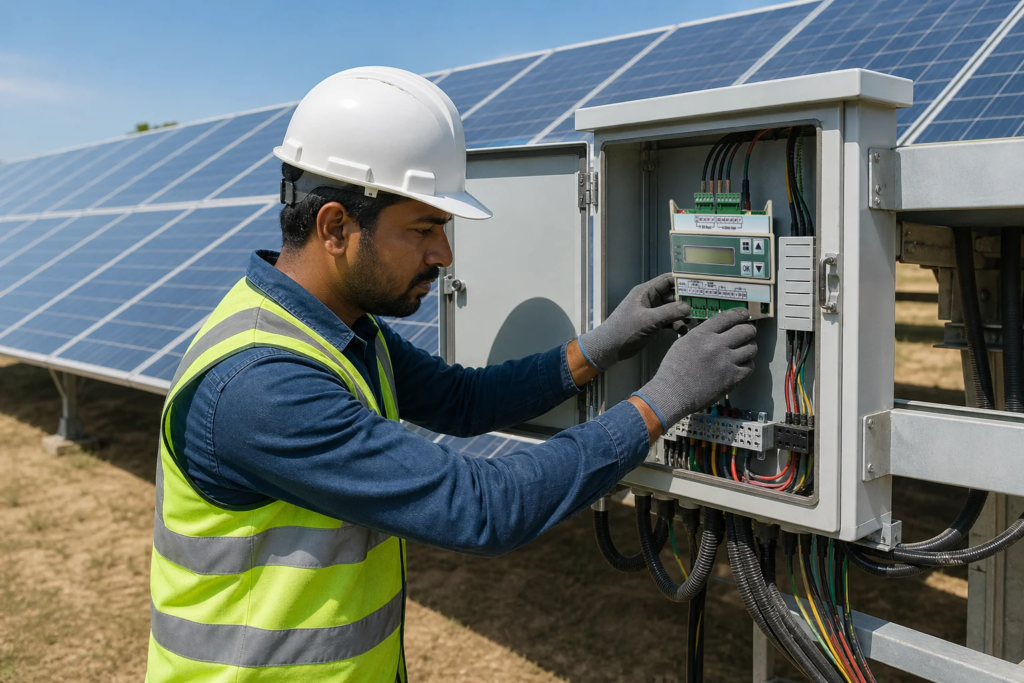
India’s commercial and industrial solar sector has grown at a remarkable pace. As of 2026, millions of kilowatts of rooftop and ground-mounted capacity are generating power across factories, warehouses, hospitals, and office complexes. But installing solar panels is only the beginning. The real question that determines your long-term returns is this: who manages your solar O&M?
Operations and maintenance is the backbone of solar asset performance. A well-maintained 200 kW rooftop system can consistently deliver 90%+ performance ratios. A neglected one can quietly bleed 15–20% of its energy yield every year through dust accumulation, undetected faults, and inverter inefficiencies. For asset owners in India, the choice between building an in-house O&M team and outsourcing to a professional provider is one of the most consequential decisions you’ll make after installation.
This guide breaks down both approaches across cost, performance, expertise, and ROI so you can make a confident, data-backed decision for your solar investment.
What Does Solar O&M Actually Involve?
Before comparing the two approaches, it’s worth understanding the full scope of solar O&M. Many asset owners underestimate how much is involved beyond occasional panel cleaning.
Preventive Maintenance
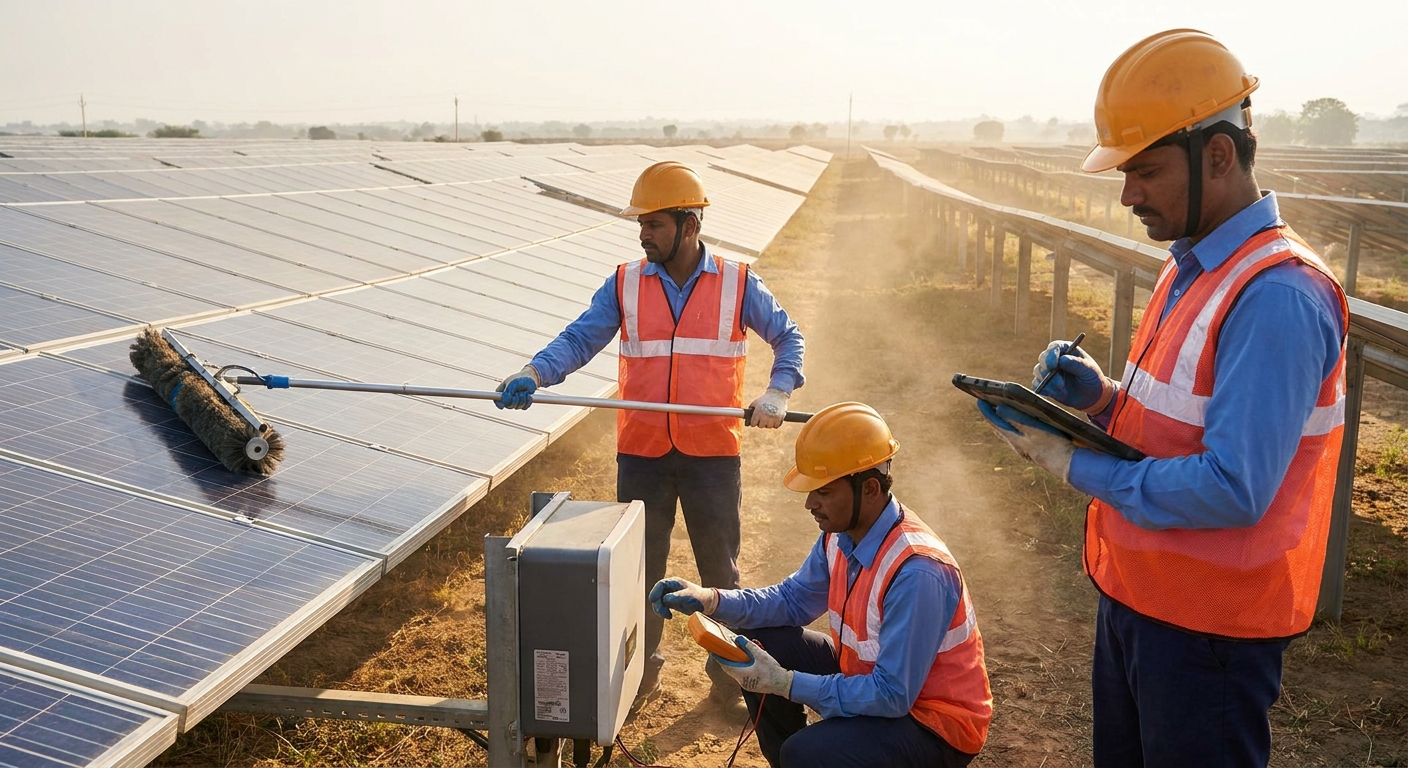
Preventive maintenance is the scheduled, proactive work that keeps your system running at peak efficiency. This includes solar panel cleaning to remove dust, bird droppings, and industrial particulate matter (a major issue across Indian industrial belts), inverter servicing, string balancing, DC cable inspections, hardware tightening, and earthing checks. In India’s climate, panel cleaning alone can recover 5–12% of lost energy yield depending on location and season.
Corrective Maintenance and Repairs
When faults occur, fast response is critical. Corrective maintenance covers fault diagnosis, component replacement, solar inverter India repairs, string fault rectification, and DC loss analysis. Delays in corrective action directly translate to lost generation and reduced solar ROI. Warranty claim management also falls under this category, requiring proper documentation and coordination with manufacturers.
Remote Monitoring
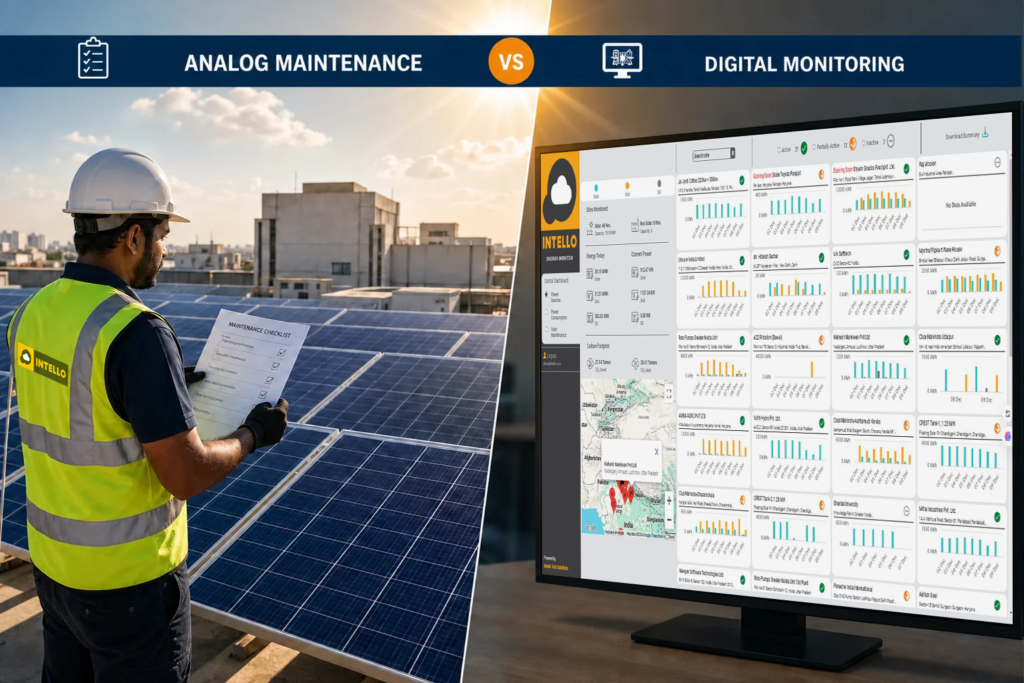
Modern solar monitoring India goes far beyond a basic meter reading. IoT-enabled monitoring platforms use Remote Telemetry Units (RTUs) to capture real-time data on energy output, string performance, inverter health, and environmental conditions. This data enables early fault detection, performance benchmarking, and informed maintenance scheduling. Without robust monitoring, problems can go undetected for weeks.
AMC Services and Reporting
A structured solar AMC India contract defines the scope, frequency, and accountability for all O&M activities. It includes scheduled site visits, detailed performance reports, and documentation that supports warranty claims and regulatory compliance. Good reporting also gives asset owners visibility into exactly what work was done, when, and with what outcome.
In-House Solar O&M: Costs, Capabilities & Challenges
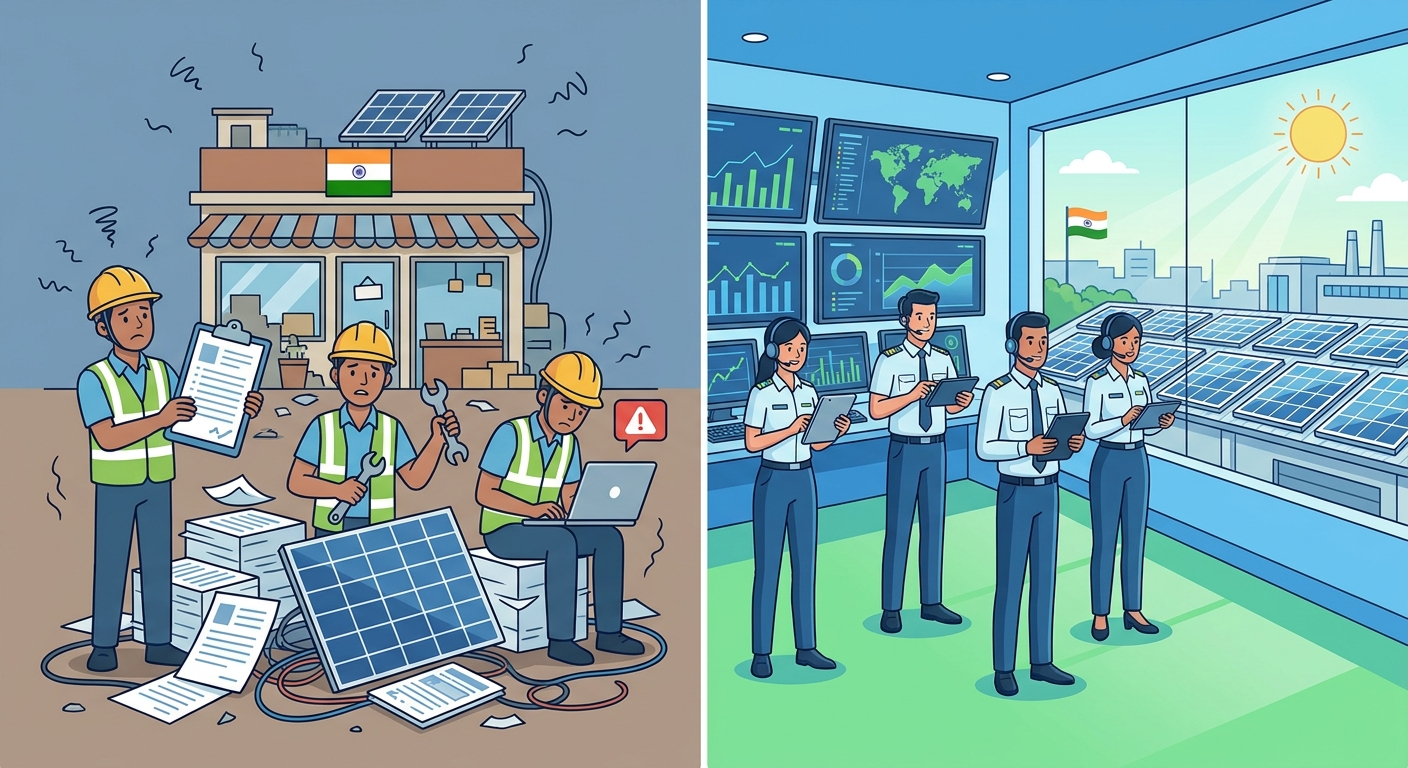
Building an in-house solar O&M team gives you direct control over your maintenance operations. For some organizations, this is genuinely the right choice. But the true cost and complexity are often higher than expected.
Building the Team
A functional in-house O&M team for a mid-sized commercial installation (100–500 kW) typically requires at least two to three trained solar technicians, a supervisor with electrical engineering background, and administrative support for documentation and reporting. Recruiting qualified solar technicians in India is increasingly competitive. Training them to handle inverter diagnostics, string fault analysis, and safety protocols adds time and cost before they’re fully productive.
Capital and Operational Expenditure
The upfront investment for in-house solar O&M includes monitoring hardware (data loggers, RTUs, sensors), diagnostic tools (IV curve tracers, thermal cameras, multimeters), cleaning equipment, safety gear, and potentially a dedicated vehicle for site access. For a 200 kW system, initial equipment investment can range from ₹3, 6 lakhs depending on monitoring sophistication. Annual operational costs include salaries (₹4, 8 lakhs per year for a two-person team), consumables, insurance, and training refreshers.
Expertise Gaps
The most significant challenge with in-house teams is expertise depth. Solar repair India scenarios often involve complex issues: multi-string DC faults, inverter IGBT failures, ground fault isolation, and performance degradation analysis. These require specialized knowledge that generalist electricians don’t always possess. Warranty claim management is another area where in-house teams frequently struggle, as manufacturers require specific documentation formats and fault evidence that untrained staff may not capture correctly.
Scalability Limitations
If you own solar assets across multiple locations, an in-house team becomes exponentially harder to manage. Coordinating site visits, maintaining consistent maintenance standards, and providing centralized visibility across sites requires significant management overhead. Multi-site solar O&M India is where in-house models most commonly break down.
In-House Solar O&M: Pros and Cons
- Pros: Direct operational control, immediate on-site availability for single-location assets, no dependency on third-party SLAs, potential cost efficiency at very large scale (1 MW+)
- Cons: High upfront investment, ongoing salary and training costs, expertise gaps in specialized diagnostics, scalability challenges, risk of staff turnover disrupting operations, no built-in monitoring technology
Outsourced Solar O&M: What Professional Providers Deliver
Professional solar O&M providers bring a fundamentally different value proposition: specialized expertise, purpose-built technology, and accountability through service-level agreements. Here’s what a quality outsourced provider delivers.
Specialized Expertise at Scale
A dedicated O&M provider like Intello maintains a team of 150+ trained solar experts with deep specialization across panel technologies, inverter brands, string configurations, and fault types. This expertise is simply not replicable with a small in-house team. When a complex fault occurs, a professional provider has seen it before and knows exactly how to resolve it quickly.
Integrated Monitoring Technology
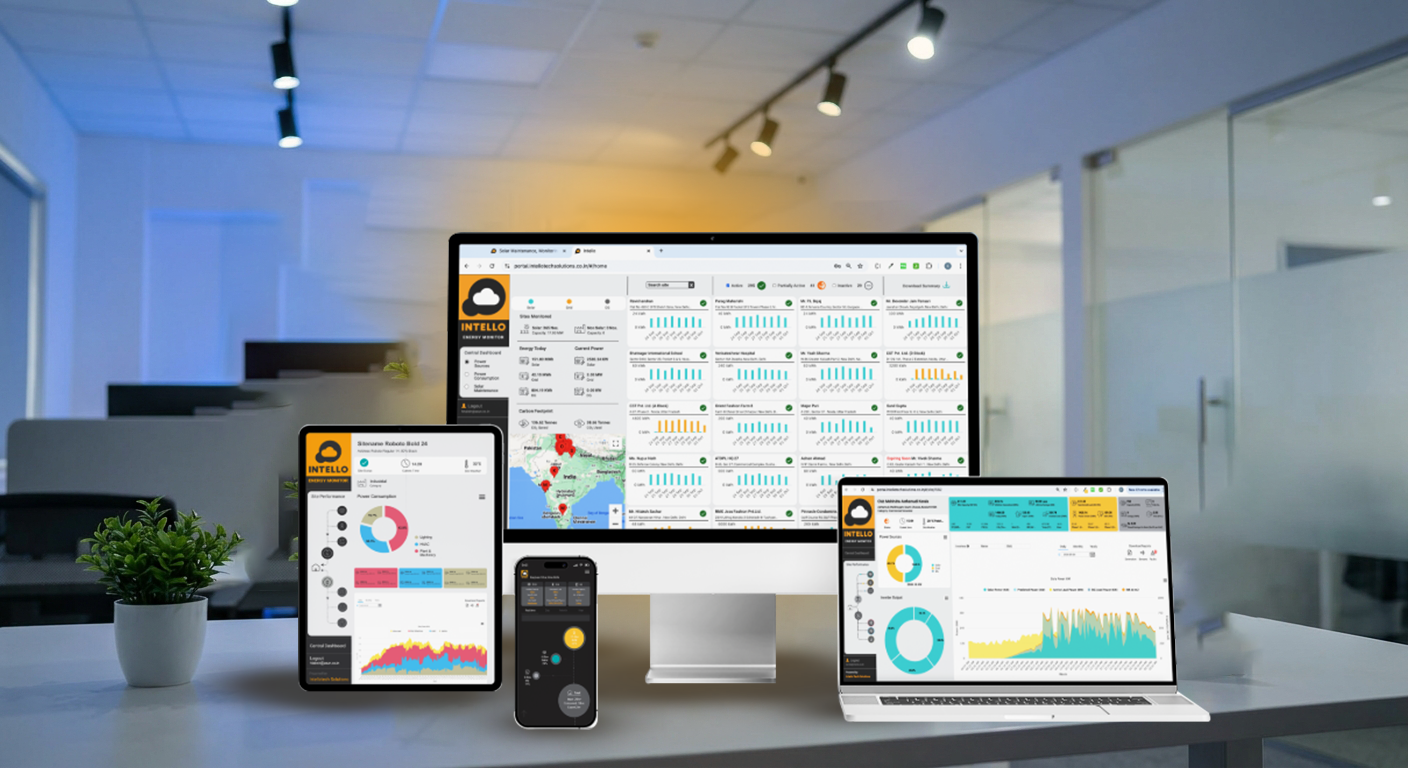
Leading providers deploy IoT-enabled monitoring platforms with custom-designed RTUs that capture granular performance data around the clock. Intello’s centralized dashboard gives asset owners real-time visibility into energy output, string health, inverter status, and performance ratios across all their sites from a single interface. The Intello monitoring portal provides live access to your solar system’s performance data, fault alerts, and maintenance history whenever you need it.
Structured Preventive Maintenance
Preventive maintenance solar schedules are built into professional AMC contracts. This means regular solar panel cleaning, inverter servicing, string balancing, hardware inspections, and earthing verification happen on a defined schedule, not reactively. SLA-backed response times ensure that when faults are detected, corrective action follows within agreed timeframes, minimizing solar downtime.
Warranty Claim Management
One of the most underappreciated benefits of outsourced solar O&M is professional warranty claim support. Providers maintain detailed documentation, photographic evidence, and performance logs that are essential for successful warranty claims. This protects your solar warranty India coverage and ensures you recover value from manufacturer guarantees when components fail prematurely.
Mobile App Reporting
Modern O&M providers deliver transparent, verifiable reporting through mobile applications. Intello’s mobile app captures location data, timestamps, customer signatures, and photographic evidence for every maintenance visit. This gives asset owners complete confidence that scheduled work was actually performed to standard.
Outsourced Solar O&M: Pros and Cons
- Pros: Immediate access to deep expertise, purpose-built monitoring technology, SLA accountability, scalable across multiple sites, structured preventive maintenance, warranty claim support, no hiring or training burden
- Cons: Less direct operational control, dependency on provider’s responsiveness, requires careful SLA negotiation, quality varies significantly between providers
Cost Comparison: In-House vs Outsourced Solar O&M
The cost comparison between in-house and outsourced solar O&M is more nuanced than a simple line-item comparison. You need to account for both visible costs and the hidden costs of underperformance.
Year 1 Costs: In-House Setup
For a 200 kW commercial rooftop installation, building an in-house solar O&M capability in Year 1 typically involves:
- Monitoring hardware and RTU installation: ₹2, 4 lakhs
- Diagnostic tools and cleaning equipment: ₹1, 2 lakhs
- Technician salaries (2 staff): ₹5, 8 lakhs per year
- Training and certification: ₹50,000, 1 lakh
- Consumables, safety gear, transport: ₹50,000, 1 lakh
- Total Year 1 estimate: ₹9, 16 lakhs
Ongoing Annual Costs: In-House
From Year 2 onwards, in-house costs stabilize somewhat, but remain significant. Salaries continue, equipment needs maintenance and occasional replacement, and training must be refreshed as technology evolves. Annual ongoing costs for a 200 kW system typically range from ₹6, 10 lakhs per year, excluding any major corrective repairs.
Outsourced Solar AMC Costs
Professional solar AMC India contracts for a 200 kW commercial system are typically structured as annual packages covering preventive maintenance visits, panel cleaning, inverter servicing, monitoring, and defined corrective maintenance scope. Pricing varies by provider, system complexity, and location, but outsourced O&M generally delivers significantly better cost efficiency for systems under 1 MW when total cost of ownership is calculated. Contact Intello for a customized quote based on your specific system size and requirements.
The Hidden Cost: Underperformance
The most significant cost in any solar O&M comparison is the one that doesn’t appear on any invoice: lost energy generation. Studies across Indian solar installations consistently show that poorly maintained systems underperform by 10-20% compared to professionally maintained equivalents. For a 200 kW system generating approximately 2.8 lakh units per year at ₹7/unit, a 15% performance gap represents nearly ₹3 lakhs in lost revenue annually. This hidden cost often makes outsourced O&M the more economical choice even when the AMC fee appears higher than in-house running costs.
Break-Even Analysis by System Size
- 50, 100 kW systems: Outsourced O&M almost always more cost-effective. In-house overhead cannot be justified at this scale.
- 100, 500 kW systems: Outsourced O&M typically delivers better ROI when monitoring technology and expertise depth are factored in.
- 500 kW, 1 MW systems: Hybrid models become viable. Outsourced monitoring and specialized services combined with a small in-house team for routine tasks.
- 1 MW+ systems: In-house teams become more justifiable, though outsourced monitoring and specialist support often remain cost-effective.
Performance & ROI: Which Approach Delivers Better Results?
Cost is only one dimension of the solar O&M decision. Performance outcomes and long-term solar ROI are equally important, especially for asset owners with 15-25 year investment horizons.
Performance Ratio Benchmarks
Performance Ratio (PR) is the standard metric for solar system efficiency. Industry benchmarks for well-maintained commercial systems in India target PR of 75-82%. Systems with inconsistent or reactive maintenance typically operate at PR of 65-72%. That 10-percentage-point gap compounds significantly over a 20-year asset life. Professional solar O&M providers with structured preventive maintenance schedules consistently achieve and maintain higher PR values through regular cleaning, proactive fault resolution, and continuous monitoring.
The Impact of Solar Panel Cleaning
India’s diverse geography creates highly variable soiling conditions. Industrial areas in Gujarat, Maharashtra, and Rajasthan experience heavy particulate deposition. Coastal installations face salt mist accumulation. Agricultural areas deal with dust storms and crop residue. Solar panel cleaning frequency directly impacts energy yield. Research across Indian installations shows that monthly cleaning in high-soiling environments can recover 8-12% of energy yield compared to quarterly cleaning. Professional O&M providers optimize cleaning schedules based on actual soiling data from monitoring systems, not arbitrary calendars.
Inverter Uptime and Fault Response
Inverter failures are the single largest cause of unplanned solar downtime in commercial installations. A professional O&M provider with remote monitoring detects inverter faults within minutes of occurrence and dispatches technicians under SLA commitments. An in-house team without 24/7 monitoring may not detect the same fault until the next scheduled site visit, potentially days later. For a 200 kW system, even two days of undetected inverter downtime can mean ₹25,000, 40,000 in lost generation.
Long-Term Panel Degradation
Solar panels degrade at approximately 0.5-0.7% per year under normal conditions. Poor maintenance accelerates this degradation through hotspot formation, micro-cracking from improper cleaning, and connection corrosion. Professional solar O&M practices, including thermal imaging inspections and proper cleaning techniques, protect panel longevity and preserve your solar warranty India coverage. This has measurable impact on system value over a 20-year asset life.
Real-World Scenario: 200 kW Commercial Rooftop
Consider a 200 kW rooftop installation in Pune generating approximately 2.8 lakh units annually. With professional solar O&M India services maintaining a PR of 80%, annual generation value at ₹7/unit is approximately ₹19.6 lakhs. The same system with inconsistent in-house maintenance at PR 70% generates approximately ₹17.2 lakhs. The ₹2.4 lakh annual performance gap, compounded over 10 years, represents over ₹24 lakhs in additional value from professional O&M, far exceeding the cost of a quality AMC contract.
For a deeper understanding of what comprehensive solar O&M services involve, read our Complete Guide to Solar O&M India: Services & Best Practices.
When In-House Solar O&M Makes Sense
In-house solar O&M is not always the wrong choice. There are specific scenarios where it makes genuine strategic sense.
- Utility-scale installations (5 MW+): At very large scale, the economics of a dedicated in-house team improve significantly. A 10 MW ground-mounted plant can justify a full-time O&M team with specialized equipment.
- Organizations with existing electrical engineering departments: Manufacturing facilities or utilities with qualified electrical engineers on staff can extend their capabilities to cover solar O&M with targeted training and monitoring tools.
- Regulatory or security requirements: Certain government or defense installations may have restrictions on third-party access that make in-house management a compliance necessity.
- Hybrid model: Many large asset owners find the best balance by maintaining a small in-house team for routine tasks while outsourcing monitoring technology, specialist diagnostics, and warranty management to a professional provider.
When Outsourced Solar O&M Is the Smarter Choice
For the majority of commercial and industrial solar asset owners in India, outsourced solar O&M delivers superior outcomes. Here’s when it’s clearly the right decision.
- Commercial and industrial rooftop owners (50 kW to 2 MW): This is the sweet spot for outsourced O&M. The scale doesn’t justify a full in-house team, but the investment is too significant to leave to ad-hoc maintenance.
- Multi-site asset owners: If you have solar installations across multiple facilities or locations, centralized monitoring and a professional O&M partner provide visibility and consistency that in-house teams cannot match.
- EPC companies needing post-installation support: Solar EPC companies that want to offer ongoing O&M services to their clients without building a large internal operations team benefit significantly from partnering with a specialist provider.
- Organizations without in-house electrical expertise: Businesses whose core competency is not electrical engineering should not attempt to manage complex solar diagnostics internally. The risk of missed faults and improper repairs is too high.
- Asset owners focused on core business: Managing solar maintenance cost, scheduling technicians, handling warranty claims, and interpreting performance data is a full-time job. Outsourcing frees your team to focus on what your business actually does.
Key Factors to Evaluate When Choosing a Solar O&M Provider in India
If you’ve decided that outsourced solar O&M is the right path, choosing the right provider is critical. Not all providers deliver the same quality of service. Here are the factors that matter most.
Monitoring Technology Quality
The foundation of effective solar O&M is real-time data. Evaluate whether the provider uses purpose-built RTUs or generic data loggers, whether their dashboard provides string-level visibility or only system-level data, and whether you have direct access to your performance data at any time. Intello’s custom-designed RTUs and centralized monitoring platform provide granular, real-time visibility that enables proactive fault detection rather than reactive repairs.
Team Size and Geographic Coverage
A provider’s on-ground team size directly determines their response capability. Ask specifically about technician coverage in your region, average response times for corrective maintenance, and how they handle simultaneous fault events across multiple client sites. With 150+ solar experts across India, Intello maintains the geographic coverage to serve commercial and industrial clients across major solar markets.
SLA Terms and Accountability
Service Level Agreements are your contractual protection. Review response time commitments for different fault severity levels, uptime guarantees, reporting frequency, and escalation procedures. Vague SLAs are a red flag. A quality O&M provider will commit to specific, measurable performance standards.
AMC Scope and Inclusions
Understand exactly what your solar AMC covers. Key questions include: How many preventive maintenance visits per year? Is panel cleaning included or charged separately? What corrective maintenance is covered within the AMC fee? Are spare parts included or billed additionally? Is warranty claim management part of the service? Clarity on scope prevents disputes and ensures you’re comparing providers on an equivalent basis.
Experience with Your System Type
Solar O&M requirements vary significantly between rooftop and ground-mounted systems, between different inverter brands, and between single-phase and three-phase configurations. Verify that your provider has documented experience with your specific system type and the inverter brands installed. Ask for references from clients with similar installations.
Reporting and Transparency
You should never have to wonder whether scheduled maintenance was actually performed. Look for providers that deliver photographic evidence, timestamped reports, and digital sign-off for every site visit. Intello’s mobile app captures location data, timestamps, customer signatures, and photographic documentation for complete transparency and accountability.
To learn more about Intello’s approach to solar O&M and the team behind the service, visit the Intello about page.
Frequently Asked Questions About Solar O&M in India
What is the typical cost of solar AMC in India?
Solar AMC India pricing varies based on system size, location, scope of services, and provider. Costs are typically structured as annual contracts with pricing per kWp of installed capacity. The scope significantly affects pricing: a basic AMC covering only preventive visits will cost less than a comprehensive contract including monitoring, cleaning, corrective maintenance, and warranty management. Contact providers directly for site-specific quotes rather than relying on generic benchmarks.
How often should solar panels be cleaned in India?
Cleaning frequency depends on your location and local soiling conditions. In high-dust industrial areas or near construction zones, monthly cleaning is often justified. In cleaner environments, quarterly cleaning may be sufficient. The most accurate approach is to use monitoring data to track soiling-related performance loss and schedule cleaning when yield drops below a defined threshold. Professional solar O&M providers use this data-driven approach to optimize cleaning schedules.
What does a solar O&M contract typically include?
A comprehensive solar O&M contract typically covers scheduled preventive maintenance visits, solar panel cleaning, inverter servicing, string balancing, hardware inspections, remote monitoring, performance reporting, corrective maintenance for covered faults, and warranty claim support. The specific scope varies by contract tier and provider. Always review the inclusions and exclusions carefully before signing.
Can I switch from in-house to outsourced solar O&M?
Yes, transitioning from in-house to outsourced solar O&M is straightforward. A professional provider will conduct an initial system audit to establish baseline performance, identify any existing issues, and document the current system state. This audit also helps identify any deferred maintenance that needs to be addressed. The transition can typically be completed within a few weeks without any disruption to system operation.
How does remote monitoring reduce solar downtime?
Remote solar monitoring India reduces downtime by detecting faults within minutes of occurrence rather than days or weeks later. IoT-enabled monitoring systems continuously track string performance, inverter status, and energy output. When parameters deviate from expected values, automated alerts trigger immediate investigation. This proactive approach means faults are diagnosed and corrective action is initiated before significant generation loss accumulates. Studies show that monitored systems experience 40-60% less unplanned downtime compared to unmonitored equivalents.
Making the Right Solar O&M Decision for Your Assets
The in-house vs outsourced solar O&M decision ultimately comes down to scale, expertise, and strategic priorities. For the vast majority of commercial and industrial solar asset owners in India operating systems between 50 kW and 2 MW, outsourced O&M with a professional provider delivers better performance, lower total cost of ownership, and significantly less management burden than building an in-house capability.
The key is choosing the right partner. Look for a provider with purpose-built monitoring technology, a large and geographically distributed team, transparent SLA commitments, and a track record with your system type. The difference between a good and a mediocre solar O&M India provider shows up directly in your energy bills and your system’s long-term performance.
Intello combines over 5 years of specialized solar O&M experience, 150+ trained solar experts, and an IoT-enabled monitoring platform to deliver measurable performance improvements for commercial and industrial solar assets across India. Whether you’re evaluating your first AMC contract or reconsidering an existing arrangement, a professional performance audit is the best starting point.
Maximize Your Solar ROI, Get Your Free Performance Audit Today. Discover exactly how your solar system is performing, where you’re losing yield, and what a professional solar O&M strategy can recover for your business. Request your free performance audit from Intello and take the first step toward optimizing your solar investment.