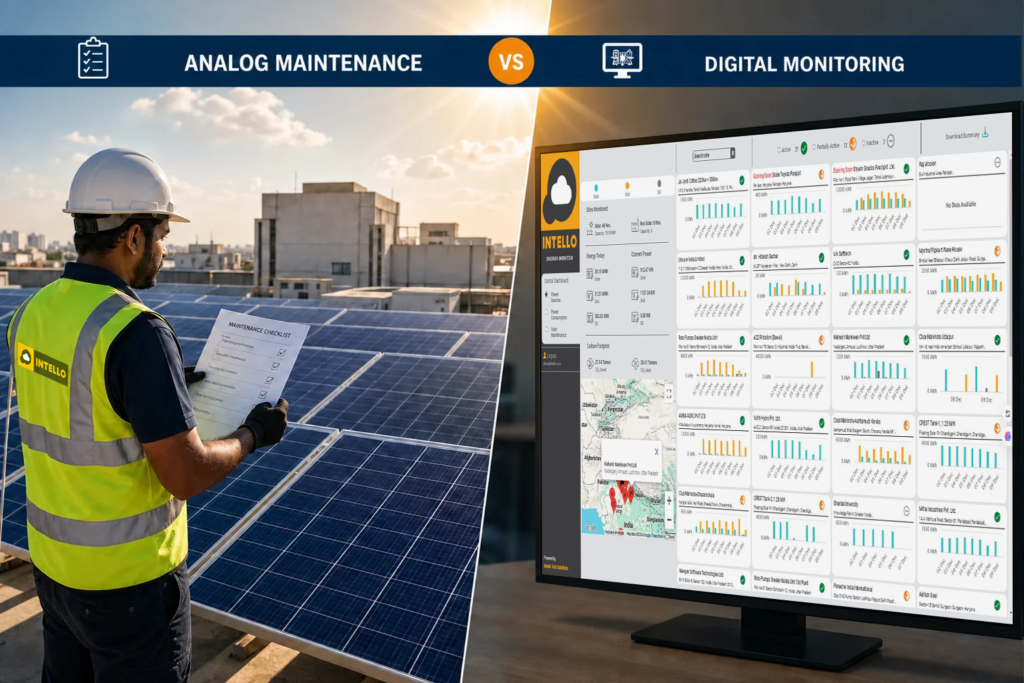
A factory owner in Chennai signs a solar AMC, pays the annual fee, and assumes his 200 kW rooftop system is covered. Eight months later, a string fault quietly cuts output by 18%. The AMC provider’s next scheduled visit is six weeks away. There is no monitoring, no SLA, and no clause that obligates the provider to respond faster. The asset owner had coverage — just not the kind that mattered.
This scenario plays out regularly across India. The confusion between a solar AMC (Annual Maintenance Contract) and a full solar O&M contract is one of the most expensive misunderstandings in solar asset management. Both agreements involve a service provider maintaining your solar installation. But the scope, liability, cost structure, and risk allocation are fundamentally different — and choosing the wrong one can quietly erode your solar ROI for years.
This guide breaks down the solar AMC vs O&M contract differences in India clearly, with a side-by-side comparison table and a practical decision framework to help you choose the right agreement for your system size and risk appetite.
Two Contracts, Very Different Promises
At a surface level, both contracts promise to keep your solar panels running. Both involve technicians visiting your site. Both are paid annually. That is roughly where the similarities end.
A solar AMC is a scheduled maintenance agreement. It defines a fixed number of visits per year, a list of tasks to be performed during each visit, and a labour commitment from the provider. Think of it as a service schedule, the provider shows up, does the agreed work, and leaves. What happens between visits is largely your problem.
A solar O&M contract is an operational responsibility agreement. The provider takes on ongoing accountability for your system’s performance. This includes remote monitoring, fault detection, preventive maintenance, emergency response, and in many cases, performance guarantees tied to contractual SLAs. The provider is not just visiting, they are watching, responding, and accountable.
Understanding this distinction is not just academic. It determines who bears the financial risk when your system underperforms, how quickly faults get resolved, and whether you have any contractual recourse when generation falls short.
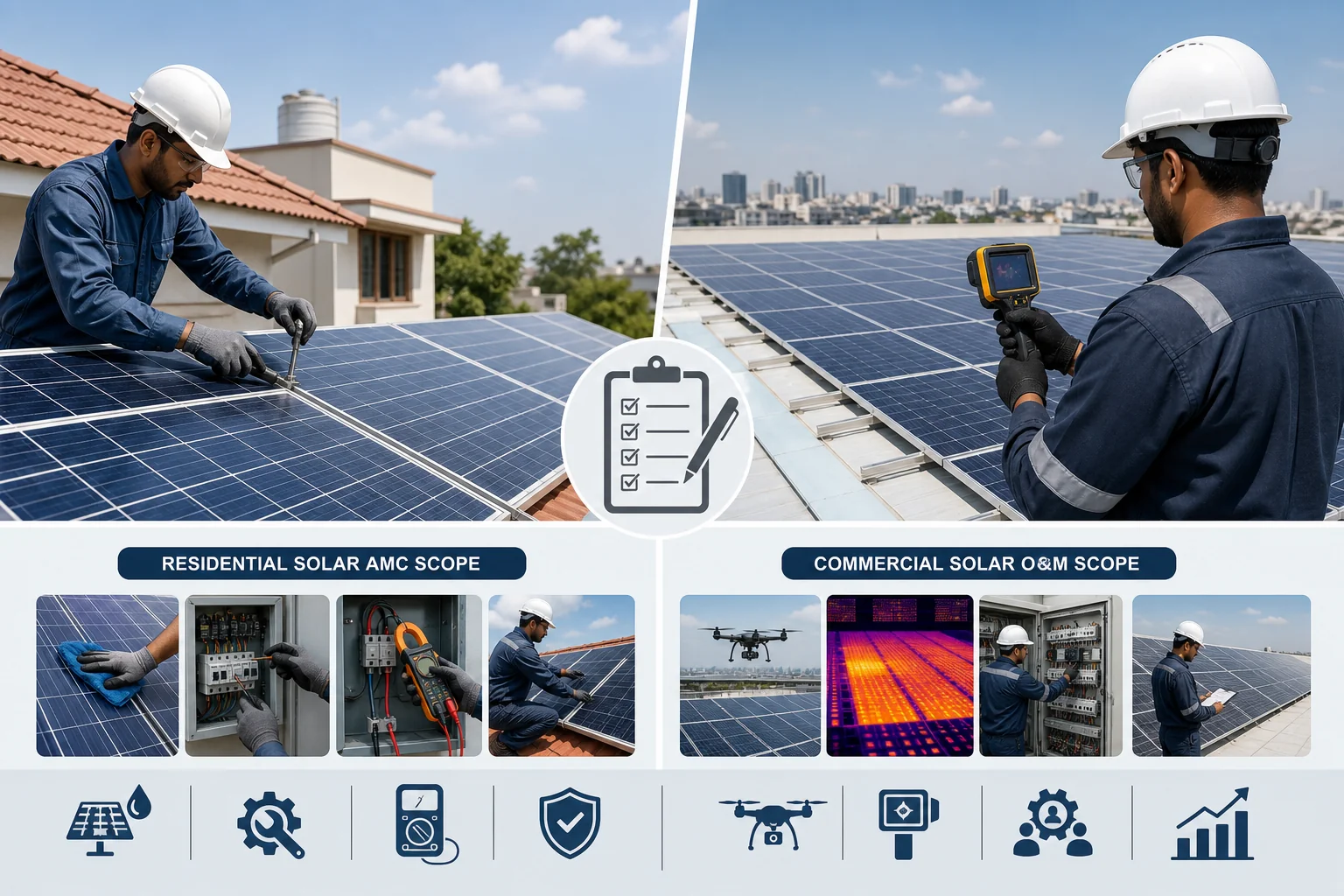
What a Solar AMC Actually Covers
An Annual Maintenance Contract for solar in India typically covers a defined set of scheduled activities. The exact scope varies by provider, but most AMCs include the following:
- Scheduled site visits, usually 2 to 4 times per year
- Panel cleaning and wiping, manual or semi-automated, depending on the contract tier
- Visual inspection of panels, mounting structures, and wiring
- Basic inverter checks, error log review, display checks, basic parameter verification
- Hardware tightening, junction boxes, cable management, earthing connections
- Report submission after each visit
What most AMCs do not include is equally important to understand:
- Remote monitoring or real-time fault detection
- Emergency or unscheduled call-out response (or these are billed separately)
- Inverter repairs or replacement
- String fault diagnosis and rectification
- Performance guarantees or generation benchmarks
- Warranty claim management
- DC loss analysis or thermal imaging
For a residential solar system of 3, 10 kW, a well-structured AMC is often sufficient. The system is small, the risk exposure is limited, and the cost of a full O&M contract may not be justified. For anything larger, particularly commercial rooftop systems above 50 kW or ground-mounted plants, the gaps in AMC coverage become financially significant.
It is also worth noting that many AMC contracts in India are offered by the original EPC installer. This creates a conflict of interest: the same company that installed the system is also the one certifying that it is performing correctly. An independent O&M provider with remote monitoring removes this ambiguity. For more on how to evaluate panel cleaning as part of a maintenance plan, the regional climate context matters significantly.
What a Full Solar O&M Contract Covers
A solar Operations & Maintenance contract is a broader, more accountable agreement. Where an AMC defines what the provider will do, an O&M contract defines what the provider is responsible for. That is a meaningful shift in risk allocation.
A comprehensive O&M contract typically includes everything in an AMC, plus:
- Continuous remote monitoring, IoT-enabled systems that track generation, string performance, inverter health, and environmental data in real time
- Fault detection and alerting, automated alerts when performance deviates from expected benchmarks
- Defined SLA response times, contractual obligations to respond to critical faults within a specified window (e.g., 24, 48 hours for major faults)
- Preventive maintenance schedules, structured programmes covering inverter servicing, string balancing, thermal imaging, and earthing checks
- Performance reporting, monthly or quarterly generation reports benchmarked against expected output
- Warranty claim management, the O&M provider handles manufacturer warranty claims on your behalf
- Emergency response, unscheduled visits triggered by monitoring alerts, not just calendar dates
Some O&M contracts also include performance guarantees, a contractual commitment that the system will generate above a defined threshold (e.g., a minimum Performance Ratio). If the system falls below that threshold due to provider negligence, financial penalties apply. This is a feature almost never found in standard AMC agreements.
For commercial and industrial solar asset owners managing systems above 100 kW, or for anyone with multiple sites, the monitoring and SLA components of an O&M contract are not optional extras, they are the mechanism by which you protect your investment. A well-configured solar monitoring dashboard is central to making this work effectively.
Solar AMC vs O&M Contract: Side-by-Side Comparison
The table below summarises the core differences between a solar AMC and a full O&M contract across the dimensions that matter most to asset owners in India.
| Feature | Solar AMC | Solar O&M Contract |
|---|---|---|
| Scope | Scheduled visits, defined task list | Full operational responsibility, ongoing |
| Remote Monitoring | Rarely included | Core component (IoT-enabled) |
| Fault Response | Next scheduled visit or extra charge | SLA-bound response (24, 72 hrs typical) |
| Performance Guarantee | Not included | Often included (PR-based benchmarks) |
| Preventive Maintenance | Basic (cleaning, visual checks) | Comprehensive (inverter, strings, thermal) |
| Warranty Management | Not included | Included |
| Liability | Limited to scheduled visit labour | Broader, may include downtime penalties |
| Reporting | Post-visit report only | Monthly/quarterly performance reports |
| Cost Structure | Lower annual fee, higher variable costs | Higher annual fee, more predictable total cost |
| Best Suited For | Residential, small commercial (<50 kW) | Commercial, industrial, ground-mounted (>50 kW) |
The single most important row in that table is fault response. An AMC provider has no contractual obligation to respond between scheduled visits. An O&M provider does. For a 500 kW commercial plant, a 10-day undetected string fault can represent a significant generation loss, and that loss is entirely preventable with the right contract in place.
Cost Structures: How Each Contract Is Priced
Price is often the first reason asset owners choose an AMC over a full O&M contract. The upfront annual fee is lower. But the total cost of ownership tells a different story.
Solar AMC Pricing
AMC contracts in India are typically priced on a per-kW-per-year basis or as a flat annual fee. The headline number looks attractive. The catch is in what is excluded. Most AMCs charge separately for:
- Emergency or unscheduled call-out visits
- Parts and components (inverter boards, fuses, connectors)
- Repairs beyond basic labour
- Additional cleaning visits triggered by dust events or bird soiling
An asset owner who signs an AMC expecting comprehensive coverage and then faces a major inverter fault mid-year will discover that the “low-cost” contract has become considerably more expensive once emergency call-out fees and parts costs are added. This is a common pattern, particularly for commercial rooftop systems in high-dust regions like Rajasthan, Gujarat, and parts of Maharashtra.
Solar O&M Contract Pricing
O&M contracts carry a higher base fee, but they bundle monitoring, preventive maintenance, emergency response, and often warranty management into a single predictable cost. For asset owners managing systems above 100 kW, this predictability has real financial value, it removes the risk of large, unbudgeted repair bills.
Some O&M providers, including Intello, offer performance-linked pricing models where a portion of the fee is tied to system output. This aligns the provider’s incentives directly with the asset owner’s ROI, a structure that simply does not exist in standard AMC agreements. For a deeper look at how O&M pricing models compare, the in-house vs outsourced O&M analysis covers the cost trade-offs in detail.
Liability and SLA Clauses: Where the Real Difference Lies
Liability clauses are where the solar AMC vs O&M contract difference becomes most consequential, and where most asset owners do not read the fine print carefully enough.
AMC Liability
A standard solar AMC limits provider liability to the labour performed during scheduled visits. If the technician cleans the panels and checks the inverter display, the provider’s obligation is fulfilled, regardless of what happens to system performance between visits. There is no contractual mechanism to hold the provider accountable for generation losses caused by undetected faults.
This is not a criticism of AMC providers. It is simply the nature of the agreement. An AMC is a service schedule, not a performance guarantee.
O&M Liability and SLAs
A well-structured O&M contract defines liability more broadly. Key clauses typically include:
- Response time SLAs, e.g., critical faults acknowledged within 4 hours, on-site response within 48 hours
- Performance ratio benchmarks, minimum PR thresholds the provider is responsible for maintaining
- Downtime penalties, financial consequences if the system is offline beyond a defined period due to provider negligence
- Reporting obligations, regular performance reports with generation data benchmarked against expected output
Warranty claim management is another area where O&M contracts add significant value. When a panel or inverter fails within its warranty period, the O&M provider handles the claim process with the manufacturer, documentation, site visits, follow-up, and replacement coordination. This is time-consuming work that most asset owners are not equipped to manage themselves, and it is rarely included in an AMC. For context on how warranty claims work in practice, choosing the right monitoring system is often the first step in building the evidence trail a warranty claim requires.
Key insight: The difference between an AMC and an O&M contract is not just about what gets done, it is about who is accountable when things go wrong between visits.
Which Contract Is Right for Your Solar Installation?
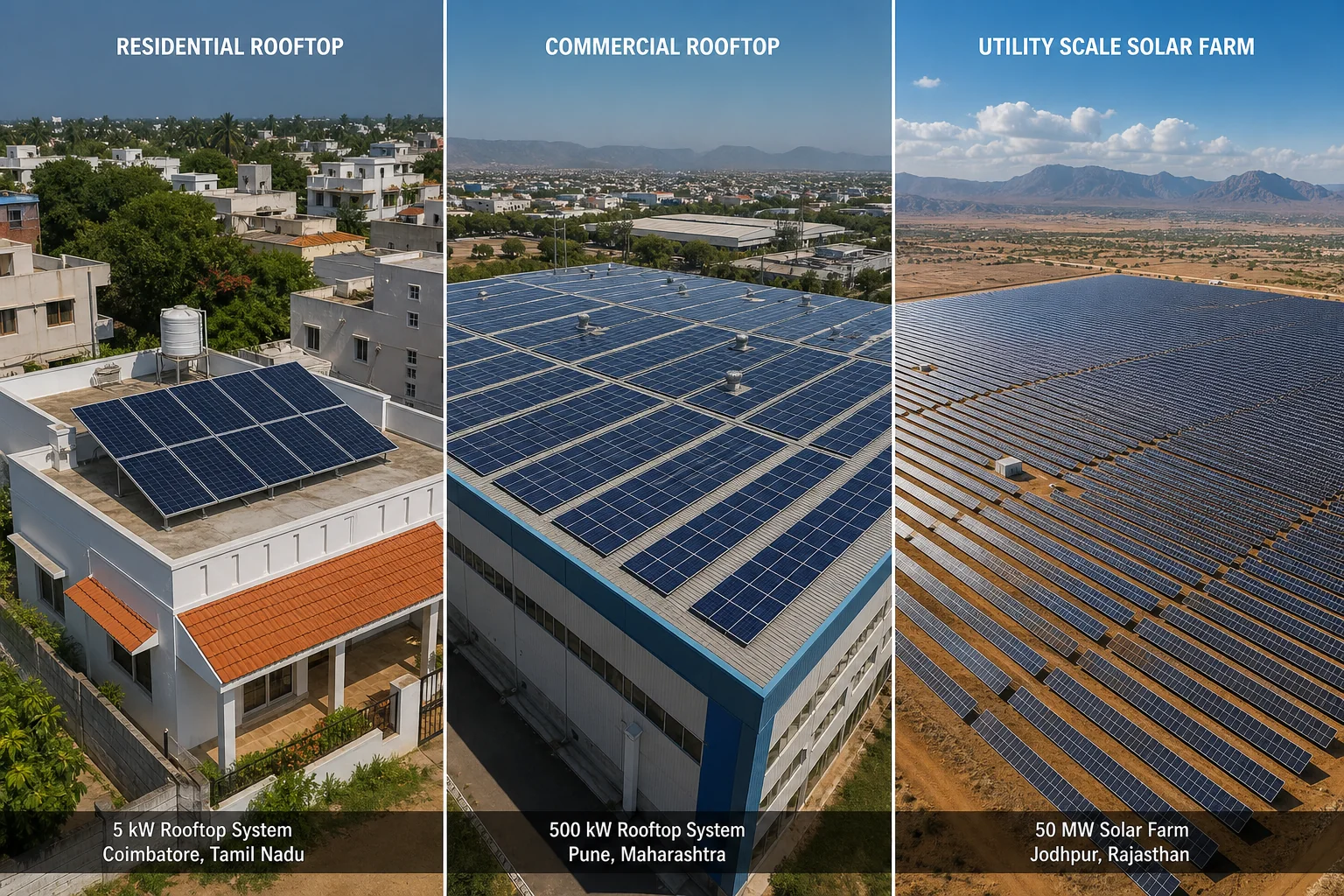
The right contract depends on three factors: system size, risk appetite, and the financial consequences of underperformance. Here is a practical decision guide.
Residential Solar Systems (3, 10 kW)
For homeowners with small rooftop systems, a well-structured AMC from a reputable provider is usually sufficient. The financial exposure from a few days of underperformance is limited, and the cost of a full O&M contract may not be proportionate to the system size. The priority here is choosing an AMC provider who includes at least basic monitoring, even a simple app-based view of daily generation is better than no visibility at all.
Commercial Rooftop Systems (50 kW, 500 kW)
This is the segment where the AMC vs O&M decision matters most. A 200 kW commercial rooftop system generating ₹15, 20 per unit can lose significant revenue from even a week of undetected underperformance. At this scale, the monitoring, SLA response, and performance accountability of an O&M contract are worth the additional cost. The break-even point, where the higher O&M fee is offset by avoided generation losses, is typically reached within the first year for systems above 100 kW.
Ground-Mounted and Industrial Plants (>500 kW)
For large ground-mounted plants, a full O&M contract is not optional, it is the standard. The complexity of these systems (multiple string combiners, central inverters, extensive DC cabling, large panel arrays) means that undetected faults can cause disproportionate losses. Remote monitoring with IoT-enabled RTUs, combined with structured preventive maintenance and defined SLAs, is the baseline expectation for professional O&M at this scale.
Questions to Ask Any Provider Before Signing
Regardless of which contract type you choose, ask these questions before signing:
- What is your response time commitment for critical faults, and is it contractually binding?
- Does this contract include remote monitoring, or only scheduled visits?
- What is excluded from the scope, and what are the call-out and parts charges?
- Do you provide monthly performance reports benchmarked against expected generation?
- How do you handle warranty claims on panels and inverters?
- What happens if my system consistently underperforms, what is your liability?
A provider who cannot answer these questions clearly is a provider whose contract will not protect you when it matters.
Frequently Asked Questions
Can I have both a solar AMC and an O&M contract at the same time?
Technically yes, but it is rarely practical or cost-effective. An O&M contract already includes everything an AMC covers, plus significantly more. Having both would mean paying twice for overlapping services. If you currently have an AMC and want to upgrade, the right approach is to transition to an O&M contract at renewal rather than layering contracts.
Does a solar AMC cover inverter replacement in India?
Standard AMC contracts do not cover inverter replacement. Most AMCs cover basic inverter checks and minor servicing, but component replacement, particularly for major components like the inverter itself, is almost always excluded and billed separately. Always check the exclusions list in your AMC document before signing.
What happens if my system underperforms under an AMC?
Under a standard AMC, the provider has no contractual obligation to compensate you for generation losses caused by faults that occurred between scheduled visits. You may be able to raise a complaint and request an unscheduled visit, but this is typically at additional cost and at the provider’s discretion. This is one of the primary reasons commercial asset owners are better served by an O&M contract with defined performance benchmarks.
Is remote monitoring included in solar AMC contracts in India?
Rarely. Most standard AMC contracts in India do not include remote monitoring. Some providers offer monitoring as an add-on at additional cost. A full O&M contract, by contrast, treats remote monitoring as a core component, it is the mechanism by which the provider detects faults between visits and fulfils their SLA obligations. If monitoring matters to you (and for any system above 50 kW, it should), either choose an O&M contract or specifically negotiate monitoring into your AMC terms.
How do solar O&M companies in India structure their contracts?
Most professional solar O&M companies in India structure contracts on an annual basis with a per-kW pricing model. The scope typically includes remote monitoring, preventive maintenance visits (quarterly or bi-annual), emergency response with defined SLAs, performance reporting, and warranty management. Some providers offer multi-year contracts with locked-in pricing, which can provide cost predictability for asset owners managing large portfolios.
Choosing between a solar AMC and a full O&M contract is ultimately a question of how much risk you are willing to carry yourself. An AMC transfers the cost of scheduled maintenance to a provider. An O&M contract transfers the responsibility for your system’s performance. For residential systems, an AMC is often the right fit. For commercial and industrial solar assets in India, where every percentage point of Performance Ratio translates directly into revenue, the accountability structure of a full O&M contract is what protects your investment.
Intello’s integrated O&M platform combines IoT-enabled remote monitoring, structured preventive maintenance, and defined SLA commitments into a single contract designed for commercial and ground-mounted solar assets across India. With over 150 solar experts and more than five years of operational experience, Intello takes full responsibility for your system’s performance, not just its scheduled upkeep.
If you are reviewing your current maintenance agreement or evaluating providers for a new installation, request a quote from Intello to understand exactly what a professional O&M contract covers for your system size and location. You can also log in to the Intello portal to see how real-time monitoring integrates with your maintenance contract.