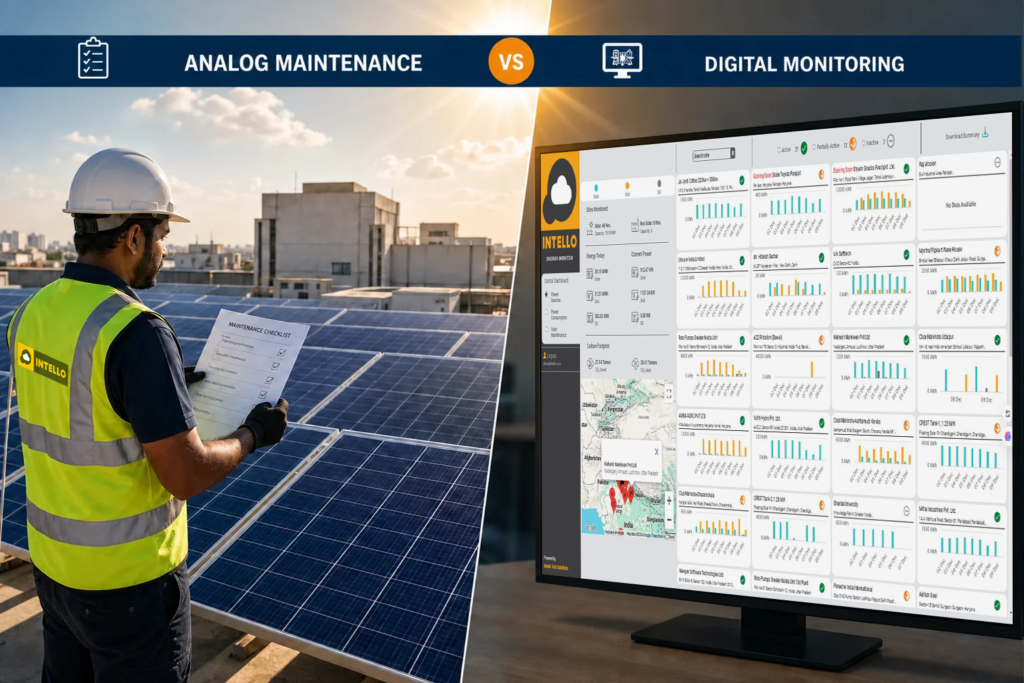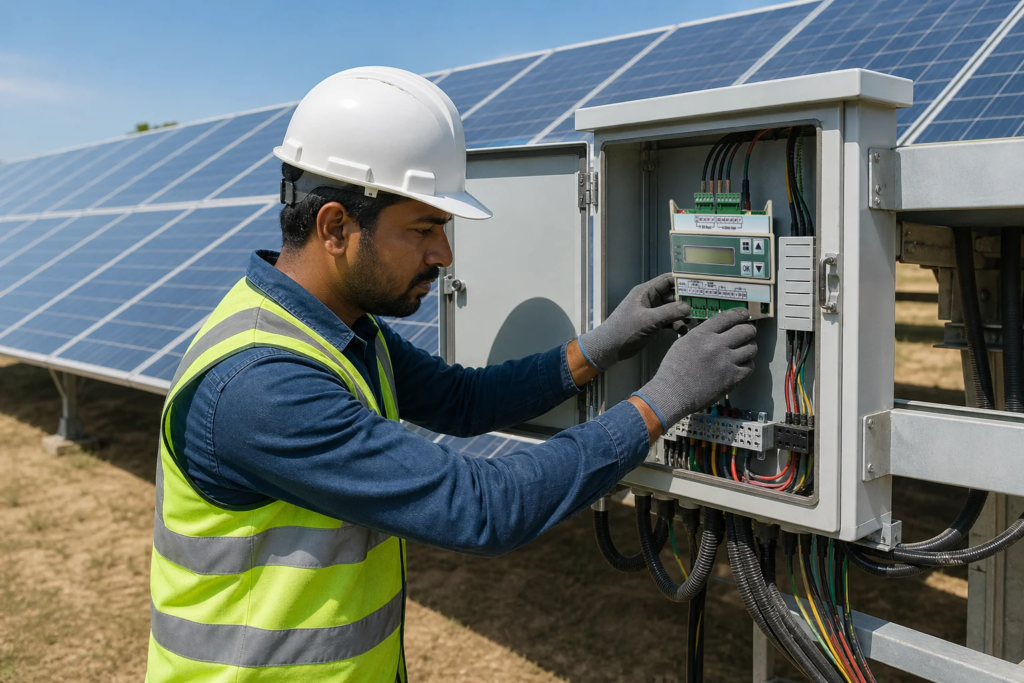
A 2 MW ground-mounted plant in Karnataka ran with a standard datalogger for two years, generating clean monthly reports and green status lights. Then a combiner box developed an intermittent string fault. The datalogger kept logging total plant output, which barely dipped, so the dashboard never flagged anything. By the time a routine inspection caught it, the plant had lost close to six weeks of generation from that one string. A custom-designed RTU running string-level fault logic would likely have caught the imbalance within days. That gap, between hardware that simply records data and hardware that understands it, is the entire story behind the RTU vs datalogger solar monitoring comparison that every solar asset owner and EPC company in India eventually has to work through.
Both devices sit at the same point in a solar monitoring system: between the inverter and the cloud dashboard. Both send data somewhere. But what happens inside the box, and what that means for fault detection, scalability, and long-term ROI, is where the two technologies diverge sharply. This guide breaks down the technical and commercial differences so you can choose the right hardware for your site, whether that’s a 5 kW residential rooftop or a 10 MW utility-scale plant.
What Data Loggers and RTUs Actually Do in a Solar Plant
A datalogger is, at its core, a passive recording device. It polls the inverter (and sometimes a weather sensor or energy meter) at set intervals, stores the readings, and pushes them to a cloud portal over GSM, Wi-Fi, or Ethernet. Most dataloggers sold with residential and small commercial inverters in India fall into this category. They’re inexpensive, easy to install, and adequate for a single-inverter site where the main requirement is “show me today’s generation.”
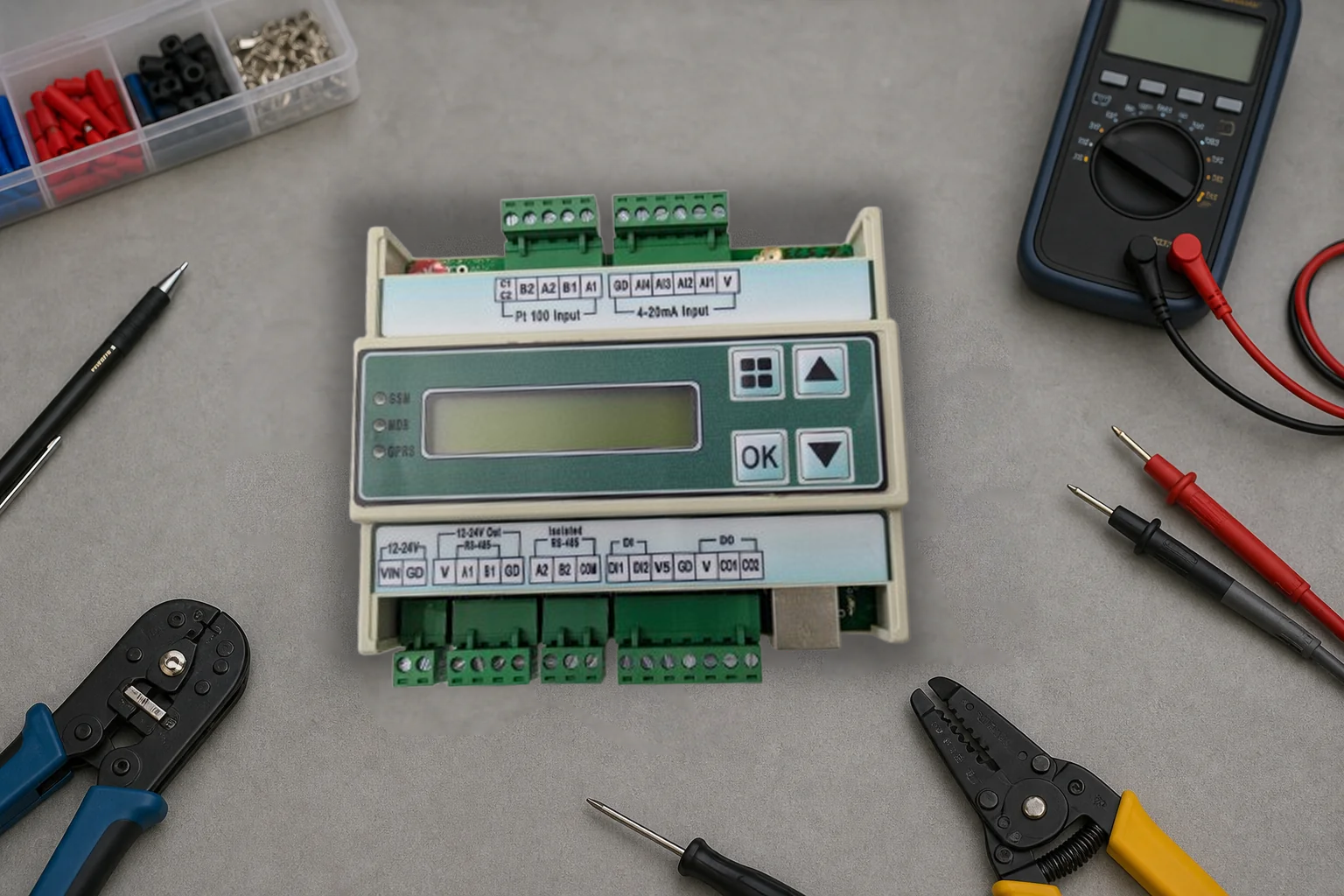
A Remote Terminal Unit (RTU) does more than record. It’s an intelligent hardware node built around a microcontroller or embedded processor, capable of running local logic, aggregating multiple data streams, and making decisions before data ever reaches the cloud. An RTU can poll dozens of inverters, string combiner boxes, weather stations, and energy meters simultaneously, apply plant-specific thresholds, and flag anomalies in near real time rather than waiting for a human to review a report.
In a typical architecture, the flow looks the same on paper: inverter → logger or RTU → cloud dashboard. But the intelligence sitting in that middle layer determines whether your solar dashboard shows you a genuine early warning or just a historical chart you check once a week. If you’re still evaluating what a monitoring system should look like end to end, our guide on how to choose a solar monitoring system covers the broader decision beyond just the hardware layer.
RTU vs Datalogger Solar Monitoring Comparison: Core Technical Differences
The clearest way to understand this comparison is to look at what each device can and cannot do under the hood. Here is where the real gap shows up.
- Processing capability: Dataloggers log and forward. RTUs compute, filter, and act on data locally, using edge logic before anything reaches the cloud.
- Communication protocols: RTUs typically support Modbus RTU/TCP, RS-485, DNP3, and IEC 60870-5-101/104, the same protocols used in SCADA and utility-grade systems. Most consumer dataloggers only speak Modbus or a manufacturer’s proprietary protocol, which limits integration with third-party devices.
- Input/output flexibility: RTUs generally offer expandable analog and digital I/O, so you can wire in a weather station, string combiner box, tracker controller, or even a CCTV trigger. Dataloggers usually ship with a fixed number of channels tied to the inverter brand they came with.
- Offline buffering: Both can buffer data during a connectivity drop, but RTUs generally hold more data locally and can apply logic even when the cloud link is down, which matters in areas with patchy GSM or M2M coverage.
- Latency to alert: A datalogger passes raw numbers to the cloud, where a rules engine decides whether to alert. An RTU can raise a flag at the source, shaving critical minutes or hours off detection time for a developing fault.
None of this means dataloggers are poorly built. They’re designed for a specific job: capturing generation data from a single inverter cheaply and reliably. The problem starts when a datalogger is asked to do an RTU’s job, monitoring a multi-inverter ground-mounted plant with combiner boxes, trackers, and weather stations, without the processing power or protocol support to handle it.
Fault Detection Accuracy: Why Custom-Designed RTUs Outperform Off-the-Shelf Dataloggers
This is the section that matters most for anyone who has ever discovered a fault weeks after it started. Off-the-shelf dataloggers typically use generic threshold alerts: if total output drops below X% of expected, send a notification. That works for catastrophic failures, an inverter going completely offline, for example. It fails badly at catching partial degradation, which is exactly what most solar string faults look like.
Here’s the mechanism: on a plant with, say, 20 strings feeding one inverter, a single failed string might only reduce total inverter output by 4-5%. A generic threshold set at 10% or 15% for the whole inverter will never trigger. The fault sits there quietly, degrading output, until either a manual inspection catches it or the loss becomes large enough to breach the threshold by coincidence.
A custom-designed RTU flips this. Because it’s built and configured for the specific plant, it can be programmed with string-level ratios, comparing each string’s expected output against its neighbors under identical irradiance, rather than a flat plant-wide number. It can also apply DC loss thresholds tuned to the actual array configuration, panel tilt, and shading profile of that site, instead of a one-size-fits-all default. This is edge processing doing real diagnostic work, not just data collection.
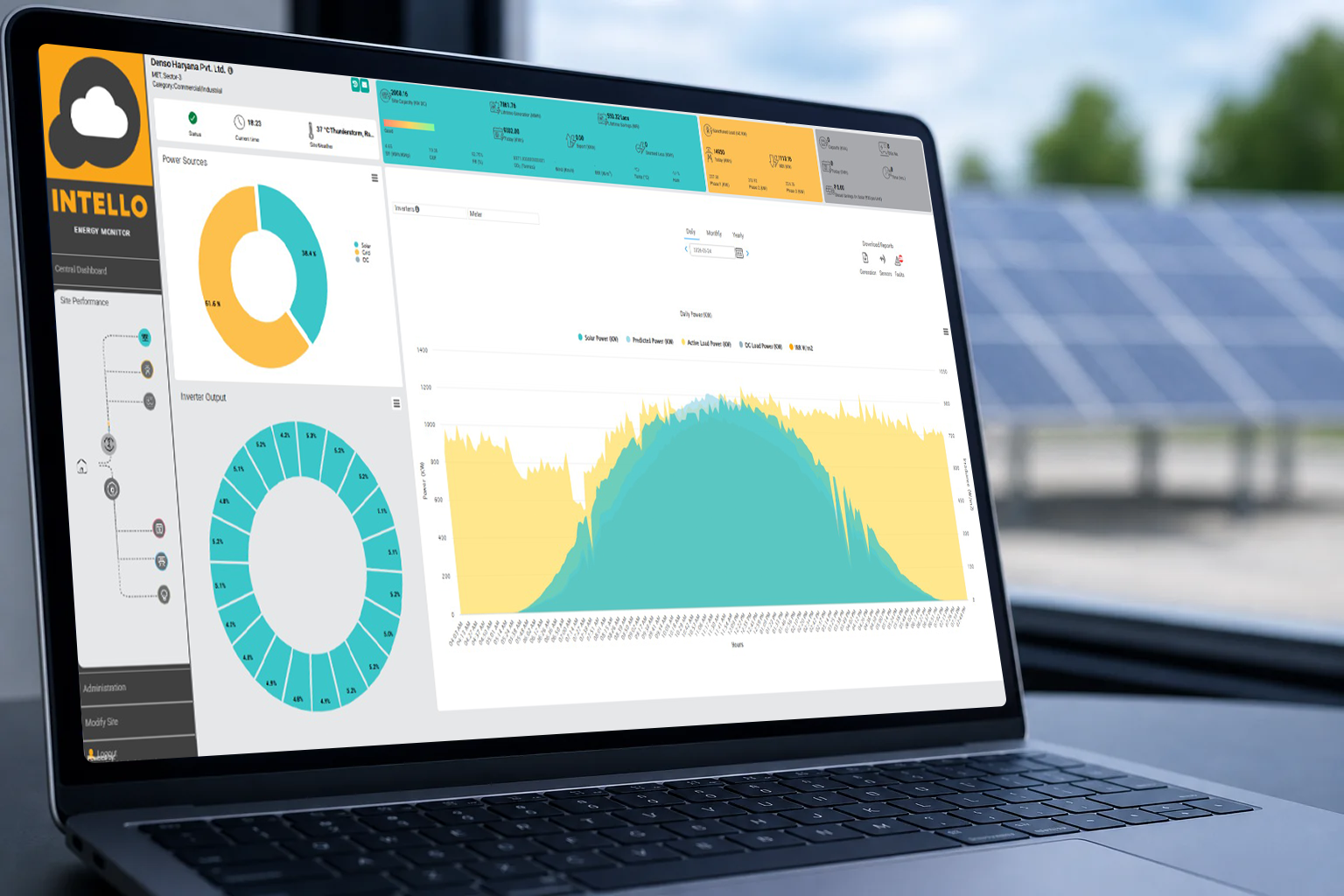
Consider a 1 MW ground-mounted plant where a combiner fuse fails on one of eight combiner boxes. With a generic datalogger and plant-wide alerting, the drop might read as normal daily variance caused by cloud cover. A custom RTU comparing combiner-level currents against each other, in real time, flags the anomaly within hours because it knows what “normal” looks like for that specific box, on that specific day, relative to its peers. That difference between a system that merely records history and one that understands context is precisely why Intello designs its own RTUs rather than deploying generic off-the-shelf loggers across client sites. It’s a core reason asset owners see fewer missed faults and shorter time-to-detection once they move off basic logger hardware.
Scalability: Which Hardware Wins for Large or Multi-Site Portfolios
For a single rooftop residential system with one inverter and no third-party sensors, a datalogger is often perfectly sufficient. There’s little to gain from RTU-level processing when there’s only one data source to begin with. Cost and simplicity win here, and most residential AMC packages in India are built around this assumption.
The picture changes completely for ground-mounted utility plants and portfolios spanning multiple sites. Here, RTUs scale in ways dataloggers structurally cannot. Because RTUs support SCADA-grade protocols and expandable I/O, they can poll dozens of devices, inverters, weather stations, energy meters, and tracker controllers, on one plant, then normalize that data before sending it upstream. This dramatically reduces the volume of raw traffic hitting the cloud platform and lets the plant-level logic do the heavy lifting.
For solar EPC companies managing installed assets across several states, or asset owners running a portfolio of rooftop and ground-mounted sites, this scalability directly affects how well a centralized monitoring setup performs in practice. A datalogger-only architecture across 15 sites means 15 separate data streams with limited local intelligence, more noise reaching the dashboard, and slower fault isolation. An RTU-based architecture consolidates and filters at the edge, so the central team sees fewer, more accurate alerts instead of a flood of raw numbers to sift through manually.
Cost and Commercial Considerations for Asset Owners and EPCs
Hardware cost is usually the first question, and it’s a legitimate one. A basic datalogger typically costs less upfront than a custom-built RTU, sometimes significantly less on a per-unit basis. For a small residential system, that price gap can make the datalogger the obvious choice, since there’s rarely enough complexity to justify the added cost.
The calculation looks different once you factor in total cost of ownership rather than just the bill of materials. An RTU that catches a string fault within days instead of weeks can save far more in recovered generation than the extra hardware cost, especially on commercial and ground-mounted systems where a single missed fault can mean thousands of units of lost energy. Fewer missed faults also means fewer unplanned site visits, and truck rolls are one of the largest hidden costs in solar O&M budgets.
There’s also a commercial angle specific to EPC companies. When an EPC hands over a plant to an asset owner, the monitoring hardware specified at that stage locks in years of visibility, or years of blind spots. Specifying a basic datalogger to save a few thousand rupees on the bill of materials can quietly cost the asset owner far more over a 20-25 year plant lifetime, in missed faults, slower fault resolution, and reduced solar ROI. EPCs that specify custom RTUs at handover, or that partner with an O&M provider offering them as part of an AMC, tend to deliver noticeably better long-term outcomes for their clients.
According to the Ministry of New and Renewable Energy, India’s installed solar capacity has crossed well over 90 GW as of 2026, with a large share now sitting in commercial, industrial, and ground-mounted segments where monitoring hardware choices carry real financial weight. (Source: mnre.gov.in)
How to Choose Between an RTU and a Datalogger: Selection Criteria
Use the following checklist when evaluating hardware for a new installation or when reviewing what’s currently deployed on an existing site.
- Plant size and string count: Single inverter, single string cluster, low complexity. A datalogger is usually fine. Multiple inverters, multiple combiner boxes, or a ground-mounted layout. Lean toward an RTU.
- Third-party sensor needs: If you need to integrate a weather station, energy meter, tracker controller, or CCTV trigger into one monitoring feed, confirm the device supports the required I/O and protocols. Many entry-level dataloggers simply cannot.
- Communication environment: In areas with unreliable GSM or M2M signal, check how much data the device can buffer locally and whether it re-syncs cleanly after a drop. Our piece on zero export solar setups touches on why reliable data transmission matters when grid export rules are being enforced in real time.
- Fault detection granularity: Ask the vendor directly whether alerts are based on plant-wide thresholds or string/combiner-level comparisons. This single question separates genuine edge intelligence from relabeled basic logging.
- Protocol support on paper vs in practice: A device marketed as supporting Modbus TCP or DNP3 should be demonstrable, not just listed on a spec sheet. Ask for a live example of the alert logic running on a comparable plant.
Red flags to watch for:
- Vendors who describe a basic datalogger as “smart” or “AI-powered” without being able to explain what processing happens on the device itself.
- Monitoring quotes that don’t specify which protocols the hardware actually supports.
- No ability to demonstrate string-level or combiner-level fault alerts on an existing installation.
- Hardware specified purely on lowest bill-of-materials cost during EPC handover, with no discussion of long-term fault detection accuracy.
If you’re building out a full evaluation framework beyond just the hardware layer, our guide on choosing a solar monitoring system in 2026 walks through dashboard features, alerting workflows, and vendor evaluation criteria in more depth.
Frequently Asked Questions
Can a datalogger be upgraded to an RTU later?
Generally, no, not in place. Dataloggers are typically built around fixed hardware with limited processing headroom, so adding RTU-level edge logic usually means replacing the device rather than upgrading it. This is why it’s worth specifying the right hardware at installation rather than retrofitting later.
Do RTUs need more maintenance than dataloggers?
Not meaningfully more. Both are solid-state devices with minimal moving parts. The maintenance difference tends to sit in initial configuration, RTUs require setup of plant-specific fault logic, which takes more time upfront but pays off in fewer false alarms and faster fault resolution afterward.
Which is better for residential rooftop systems?
For most single-inverter residential systems, a well-configured datalogger is adequate and cost-effective. RTUs become worthwhile once a site has multiple inverters, string-level complexity, or a need to integrate additional sensors, which is more common in commercial and ground-mounted installations.
Does Intello use custom RTUs or standard dataloggers?
Intello designs its own RTUs specifically because off-the-shelf dataloggers weren’t catching string-level faults with the accuracy commercial and ground-mounted asset owners need. This custom hardware feeds directly into Intello’s centralized monitoring dashboard and mobile app, giving O&M teams string-level visibility rather than plant-wide averages alone.
Choosing Hardware That Actually Protects Your ROI
The RTU vs datalogger solar monitoring comparison isn’t really about which device is objectively better. It’s about matching the hardware’s processing capability to the complexity of your plant and the accuracy of fault detection you actually need. A single rooftop inverter rarely needs SCADA-grade protocols. A multi-inverter commercial or ground-mounted plant almost always does, because the cost of a missed string fault compounds every single day it goes undetected.
If you’re unsure whether your current monitoring setup is catching faults early enough, or whether the hardware installed at handover is still serving your plant’s needs, it’s worth a direct conversation with an O&M team that designs its own RTUs rather than reselling generic loggers. Request a quote from Intello to get a hardware and monitoring assessment specific to your site, or explore Intello’s monitoring portal to see how string-level fault detection looks in practice. You can also learn more about Intello’s approach to integrated solar monitoring and maintenance before making your next hardware decision.