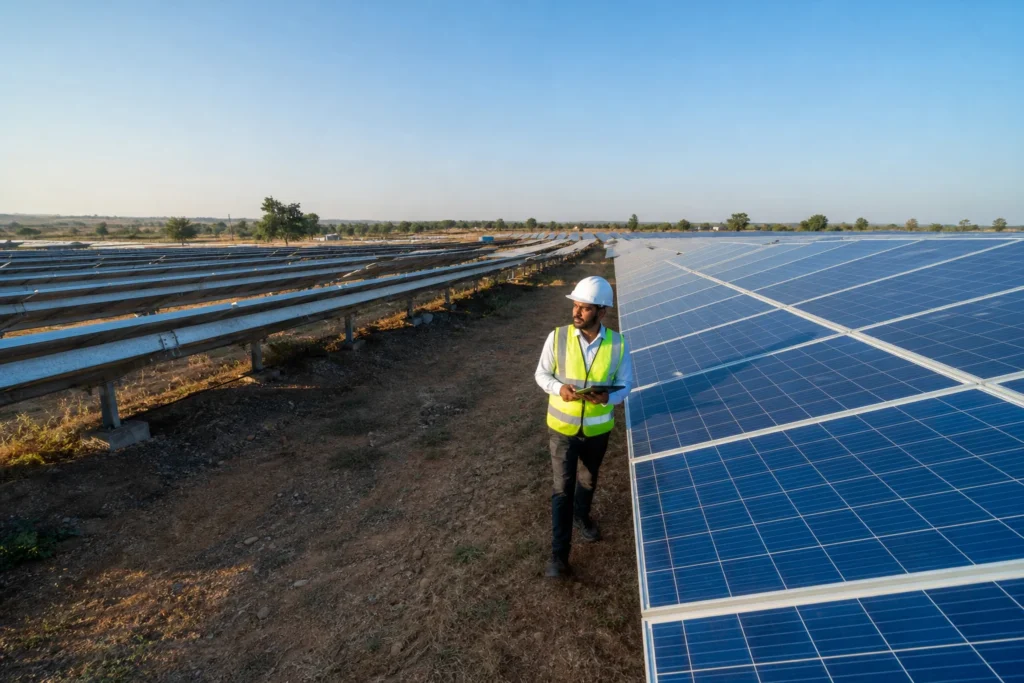
A 3 MW ground-mounted plant in Bikaner had a maintenance checklist pinned to the site office wall. Every box was ticked for six straight months. Then a routine third-party audit found four snapped earthing strips, a colony of rodents nesting inside two combiner boxes, and a string that had been producing 30% below expectation for weeks. Nobody had lied on the checklist. The team had simply walked past problems that a signature couldn’t catch.
This is the gap that trips up most site teams. A ground-mounted solar plant maintenance checklist looks complete on paper long before it’s actually being followed the way it was designed. The panels get wiped, the log gets signed, and the plant keeps losing output anyway. Ground-mounted installations across India, from Rajasthan’s open desert sites to Tamil Nadu’s coastal solar parks, face a different set of physical stresses than rooftop systems: longer DC cable runs, exposed ground-level structures, vegetation growth, and animal intrusion. A checklist built for a rooftop rarely survives contact with these conditions unchanged.
This article isn’t another list of tasks to add to your maintenance folder. It walks through the specific shortcuts and habits that quietly undermine ground-mounted plant maintenance in the field, and what a corrective daily routine should actually look like.
Why Ground-Mounted Plants Fail Their Own Maintenance Checklist
Ground-mounted plants sit exposed to soil, weather, and wildlife in ways rooftop systems simply don’t. Cable trenches run for hundreds of meters between rows and combiner boxes. Steel structures sit at ground level, where moisture and soil contact accelerate corrosion. Vegetation grows unchecked between rows if nobody actively manages it. None of this is a secret to experienced site teams. Yet inspection after inspection turns up the same failures.
The reason usually isn’t a knowledge gap. It’s that daily maintenance work gets compressed into shortcuts under pressure: fewer site visits than planned, faster walkthroughs to cover more ground, and reliance on “nothing looked wrong” instead of actual measurement. A checklist is only as good as the discipline behind it. Below are the six mistakes that show up most often when Intello’s O&M teams audit ground-mounted sites across India, along with what a corrective routine looks like in practice.
Mistake 1: Treating Panel Cleaning as a Fixed-Schedule Task, Not a Condition-Based One
Most site teams clean panels on a calendar: every 15 days, every month, every quarter. That schedule usually gets set once during commissioning and never revisited. The problem is that soiling doesn’t follow a calendar. A ground-mounted plant near an agricultural field in Punjab during harvest season can accumulate more dust in a week than a plant in coastal Kerala accumulates in a month.
Ground-mounted arrays also soil faster than rooftop systems in many regions because they sit closer to open soil, unpaved access roads, and wind-blown dust from surrounding farmland. A fixed schedule built around convenience, not actual soiling levels, means panels sometimes get cleaned too early (wasting water and labor) or too late (losing generation for days before the next scheduled visit).
The fix is to pair cleaning schedules with actual data. Generation-loss triggers from a monitoring dashboard, or simple soiling assessments during weekly rounds, should decide when a cleaning crew gets dispatched. This is exactly why regional cleaning frequency varies so much across India; a plant in the Thar desert has entirely different needs than one in a coastal district. For a deeper regional breakdown, teams managing multiple sites can review Intello’s regional guide to solar cleaning by climate zone before locking in a fixed schedule.
Mistake 2: Skipping Torque Checks and Structural Inspections
Ground-mounted racking structures carry more mechanical load than rooftop mounting systems. Wind loading, soil settlement, and seasonal ground movement all put stress on bolted connections over time. Corrosion at ground level, especially in humid or coastal zones, weakens structural joints faster than teams expect.
The common shortcut: teams only tighten bolts or inspect structures when something visibly fails, like a bent module frame or a leaning row. Torque checks get treated as an annual activity tied to the AMC renewal cycle instead of a routine monthly task. By the time a structural issue is visible to the naked eye, the plant may have already lost alignment on several rows, reducing generation across an entire string.
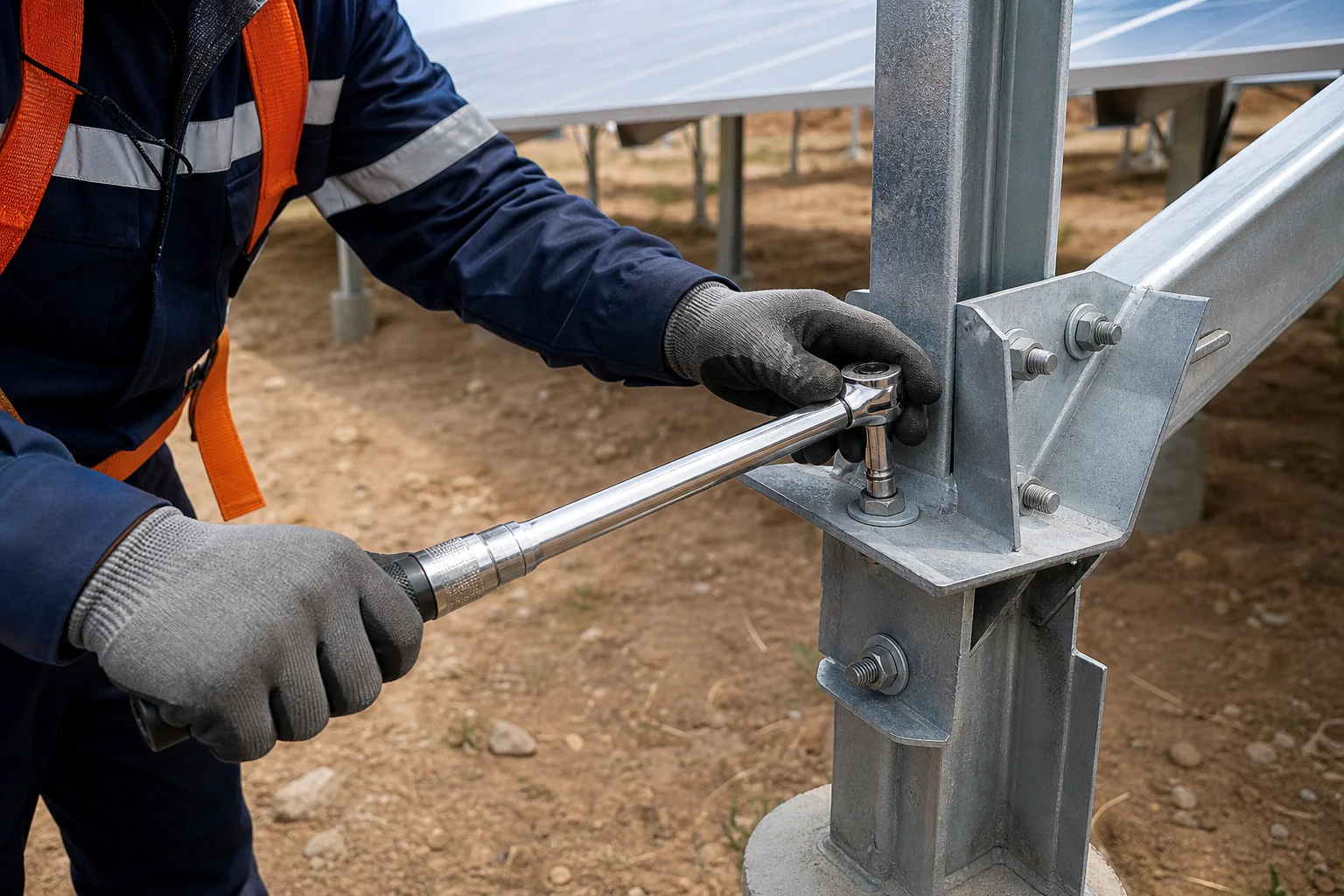
A corrective routine builds structural checks into the monthly maintenance round, not the annual one. This includes verifying torque specifications on a sample of racking bolts, checking for corrosion at ground contact points, and confirming that earthing connections remain intact after monsoon season. Preventive maintenance only works when structural integrity gets the same attention as electrical performance.
Mistake 3: Ignoring Vegetation and Ground Cover Until It Shades Panels
Vegetation control is one of the most underrated risks specific to ground-mounted plants. Grass and shrubs between rows grow quickly during monsoon months across most of India. Left unchecked, they don’t just shade the lower edge of panels; they also block airflow underneath modules, which raises operating temperature and reduces efficiency.
There’s a second, less obvious risk. Overgrown vegetation attracts rodents and small animals, which often chew through DC cable insulation inside combiner boxes and junction boxes. This is one of the most common, and most preventable, causes of string faults on ground-mounted sites. Site teams frequently treat vegetation cutting as a reactive task, triggered only when growth becomes visually obvious, rather than scheduling it around the monsoon calendar when growth accelerates fastest.
A corrective approach ties vegetation control to seasonal triggers rather than visual judgment calls. Pre-monsoon and post-monsoon vegetation clearance, paired with a physical check of cable entry points for rodent damage, closes both risks at once.
Mistake 4: Relying on Visual Inspection Alone for String Faults
Ground-mounted plants typically have longer DC cable runs and more combiner boxes spread across a larger physical footprint than rooftop systems. This makes string faults, DC losses, and connector issues genuinely harder to spot by walking the site. A technician can walk an entire row, see nothing obviously wrong, physically undamaged panels, no visible burn marks, and still miss a string producing well below its expected output.
This is the mistake with the biggest financial consequence. Visual-only inspection gives site teams false confidence that “everything looked fine” when a string fault has actually been draining generation for days or weeks. Without string-level data, that loss often isn’t caught until the monthly generation report shows a shortfall, by which point the revenue is already gone.
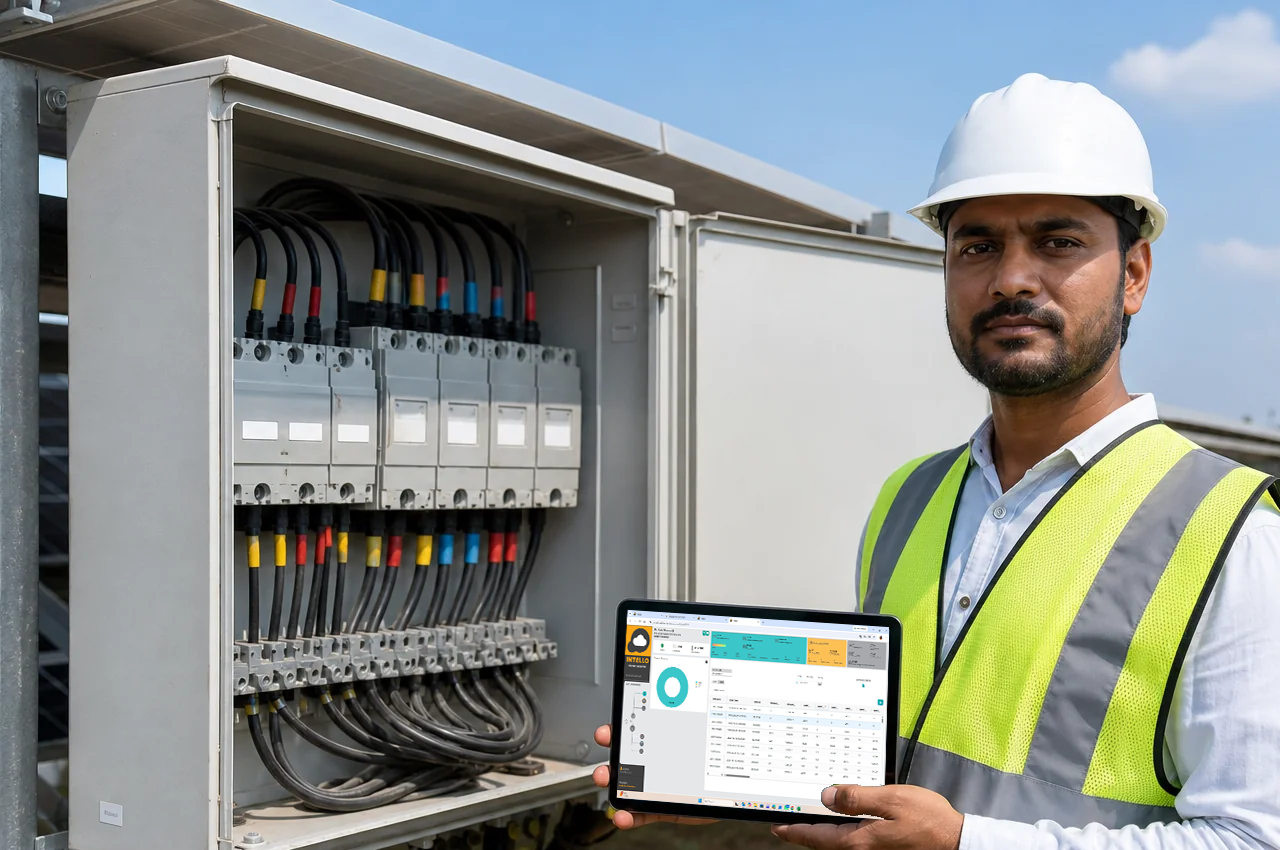
The fix is pairing physical walkthroughs with continuous, string-level monitoring. Intello’s centralized dashboard, fed by custom-designed RTUs installed at combiner box level, flags underperforming strings automatically instead of waiting for a human eye to notice a problem that isn’t visually apparent. Teams evaluating which monitoring hardware fits a ground-mounted site’s cable layout can compare options in Intello’s RTU vs datalogger comparison guide. If you’re still deciding on a monitoring platform for a new or existing ground-mounted asset, this guide to choosing a solar monitoring system in 2026 covers the selection criteria in detail.
Mistake 5: Logging Maintenance Visits Without Verifiable Proof
Paper-based logs and verbal confirmations create a documentation gap that surfaces exactly when it matters most: during a warranty dispute, an insurance claim, or an asset owner’s audit. “The team visited the site and everything was fine” isn’t evidence. It’s a claim that can’t be verified after the fact.
Site teams under time pressure often skip photo documentation or fill in logs from memory at the end of the day rather than at the actual site. This creates records that look complete but can’t withstand scrutiny. When an asset owner or EPC company later questions whether a scheduled cleaning or inspection actually happened, there’s nothing to point to.
The corrective practice is straightforward: every maintenance visit should generate a geotagged, timestamped photo report with a customer or site signature captured at the time of the visit, not reconstructed afterward. Intello’s field teams use a mobile app built specifically for this, capturing location, timestamp, photographic evidence, and signatures as part of the visit itself. Field technicians managing multiple ground-mounted sites can see exactly which app features matter most in Intello’s breakdown of must-have mobile app features for field technicians.
Mistake 6: No Escalation Path When a Fault Is Found
Finding a problem during a site visit is only half the job. A loose MC4 connector, a hotspot on a junction box, or an earthing fault all need someone to act on that finding within a defined timeframe. Many site teams have no formal escalation matrix. A technician notes the issue, moves on to finish the round, and the note sits in a logbook until the next visit, sometimes weeks later.
This delay compounds losses in two ways. First, the underlying fault keeps degrading output every day it goes unaddressed. Second, delayed response can jeopardize warranty claims that require documented, timely reporting of defects. Teams unfamiliar with how strict manufacturer warranty timelines can be should review Intello’s step-by-step guide to the solar panel warranty claim process in India before assuming a delayed report won’t matter.
A working escalation matrix defines response times by severity: a suspected fire risk or earthing fault gets same-day escalation to a senior engineer, while a cosmetic issue can wait for the next scheduled visit. Building this into the daily SOP, not leaving it to individual judgment, is what separates a checklist that protects ROI from one that just documents problems after they’ve already cost money.
Building a Corrective Daily Routine: What Good Looks Like
Fixing these six mistakes means restructuring how daily, weekly, and monthly tasks get assigned, not adding more paperwork. The table below compares three common approaches to ground-mounted plant maintenance and how they typically perform against the same set of outcomes.
| Approach | Fault Detection Speed | Documentation Quality | Typical Annual Downtime Impact | Best Suited For |
|---|---|---|---|---|
| Reactive maintenance (respond only to visible failures) | Slow, often weeks after onset | Minimal, inconsistent | Highest revenue loss from undetected faults | Not recommended for ground-mounted assets |
| Checklist-only (scheduled visual inspections, no monitoring) | Moderate, limited to what’s visible on-site | Depends on discipline, prone to shortcuts | Moderate, misses string-level and hidden faults | Small sites with frequent human presence |
| Checklist + IoT monitoring + escalation SOP | Fast, often same-day alerts | High, photo and data-backed | Lowest, faults caught before major generation loss | Ground-mounted plants of any scale, especially remote or multi-site portfolios |
A practical daily routine combines three layers: a physical walkthrough covering soiling, vegetation, and visible structural condition; continuous string-level monitoring that flags anomalies the human eye can’t catch; and a documented escalation path with defined response times by fault severity. None of these layers substitutes for the others. Vegetation control and torque checks still require boots on the ground. String faults and DC losses still require sensor-level data. Asset owners managing multiple ground-mounted sites across states will recognize this challenge from Intello’s practical setup guide for centralized monitoring across multiple sites, where consistent SOPs across locations matter as much as the technology itself.
Deciding whether your organization should run this routine in-house or through a specialized O&M partner is worth weighing carefully. The trade-offs are covered in Intello’s comparison of in-house versus outsourced solar O&M in India, and the contractual difference between an AMC and a broader O&M agreement is explained in this guide to solar AMC versus O&M contracts.
How Intello Supports Ground-Mounted Solar Plant Maintenance Across India
Intello has spent over five years building preventive maintenance and monitoring services specifically for solar asset owners, EPC companies, and commercial plant operators across India, including ground-mounted installations in remote and multi-site locations. With more than 150 solar experts on payroll and a centralized dashboard fed by custom-designed RTUs, Intello’s approach is built around closing the exact gaps described above: condition-based cleaning triggers, structural inspection schedules, string-level fault detection, and mobile app documentation that captures photographic proof, timestamps, and signatures at the point of service.
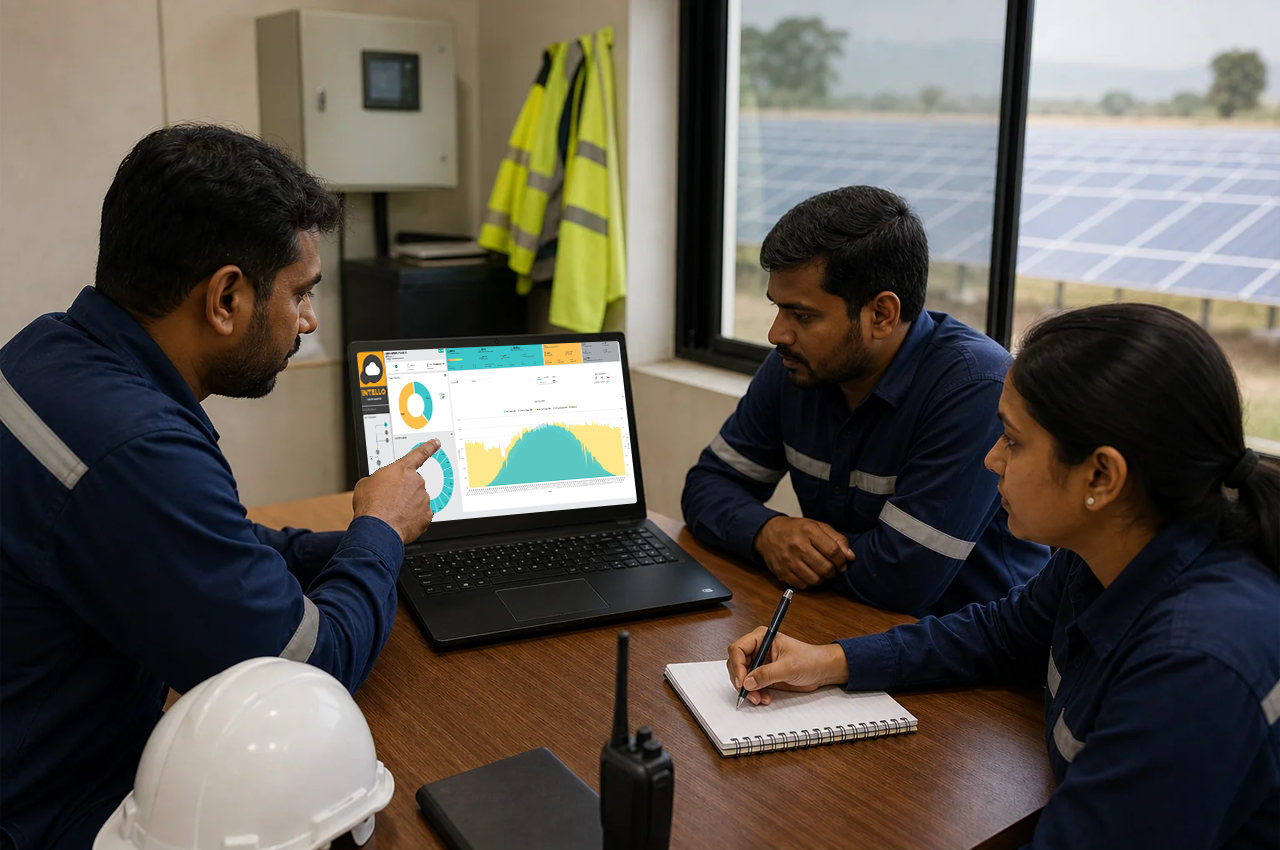
Rather than treating a maintenance checklist as a static document, Intello’s AMC and O&M services build daily accountability into the routine itself, so a plant owner can see exactly what was done, when, and with what result. For ground-mounted assets managing longer cable runs, exposed structures, and remote locations, this combination of on-ground teams and remote monitoring closes the gap between a checklist that looks complete and one that actually protects generation and ROI.
If your ground-mounted plant’s current maintenance routine relies mostly on visual inspection and calendar-based cleaning, it’s worth a closer look at where the gaps are before the next audit finds them. You can request a quote from Intello’s O&M team to review your current site routine, or learn more about Intello’s approach to integrated solar monitoring and maintenance. Existing customers can check daily generation and fault status anytime through the Intello monitoring portal.
Frequently Asked Questions
How is ground-mounted solar maintenance different from rooftop maintenance?
Ground-mounted plants deal with longer DC cable runs, ground-level structural corrosion, vegetation growth between rows, and higher exposure to rodents and wildlife. Rooftop systems don’t face vegetation or soil-contact corrosion in the same way, but ground-mounted sites usually have more physical area to cover during inspections, which is exactly where shortcuts tend to creep in.
How often should a ground-mounted plant be physically inspected?
Most ground-mounted plants benefit from weekly visual walkthroughs covering soiling and vegetation, monthly structural and torque checks, and continuous remote monitoring for string-level performance. The right frequency depends on region, dust levels, and monsoon exposure. This is covered in more depth in Intello’s full solar preventive maintenance checklist for India, or through Intello’s O&M team for a site-specific recommendation.
What causes most string faults in ground-mounted plants?
Loose or corroded connectors, rodent damage to cable insulation near combiner boxes, and undetected DC losses from long cable runs are the most common causes site audits uncover. Many of these are only visible through string-level monitoring data, not a physical walkthrough alone.
Can remote monitoring replace physical site visits entirely?
No. Monitoring detects electrical anomalies like string underperformance or inverter faults, but it can’t spot vegetation overgrowth, structural corrosion, or physical rodent damage before it affects wiring. The most reliable ground-mounted maintenance routines combine both, using monitoring to flag where a physical visit is urgently needed rather than relying on either approach alone.
Does poor maintenance affect solar warranty claims?
Yes. Manufacturers and EPC warranties often require documented, timely reporting of defects. A maintenance routine without verifiable photo and timestamp records can weaken a warranty claim even when the underlying fault is genuinely covered.
A ground-mounted solar plant maintenance checklist only protects your investment when the team following it treats measurement, documentation, and escalation as seriously as the tasks themselves. If your site routine still relies on memory and visual checks alone, contact Intello’s O&M team to build a maintenance program suited to your plant’s location, scale, and risk profile.