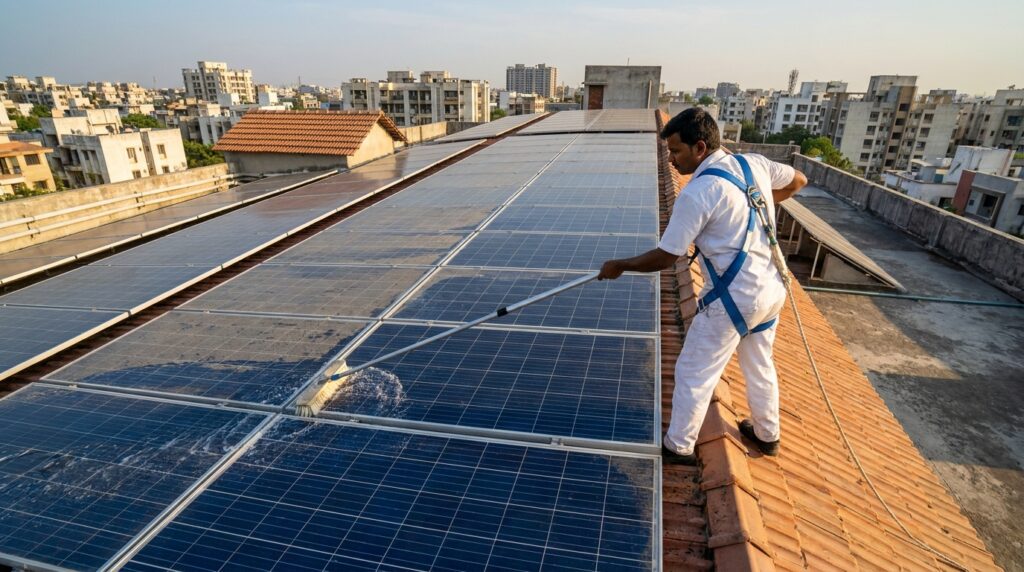
An annual maintenance contract for solar panels is a yearly service agreement where a provider commits to scheduled cleaning, electrical checks, inverter servicing, and repairs within defined response times, in exchange for a fixed fee. It exists because a solar plant left unattended loses output slowly and silently, and by the time an owner notices a lower bill saving, months of avoidable degradation have already happened.
Key Takeaways
- Twelve-element scope has become standard: Cleaning, IR thermal scanning, electrical safety testing, inverter servicing, string balancing, DC cable checks, bolt torque checks, monitoring support, and performance reporting now define a quality Indian rooftop AMC.
- Exclusions matter more than inclusions: A serious AMC excludes major part replacement after OEM warranty, external damage, roof work, DISCOM disputes, and extra visits, all stated in writing, not implied.
- Cleaning frequency is city-dependent: High-dust zones need up to four cleanings a year; coastal and low-dust cities can get by with fewer.
- Response-time clauses separate serious vendors from paperwork vendors: A 24-48 hour fault response commitment, with a named escalation contact, is the single clause most AMCs quietly omit.
- Vague per-visit language is the top red flag: “As required” cleaning counts and undefined “minor repairs” scope are where disputes start after year one.
At a Glance: What a Solar AMC Typically Covers
| Clause | Typical Frequency / Scope | Usually Excluded? |
|---|---|---|
| Panel cleaning | 2-4 times/year, dust-zone dependent | No |
| IR thermal scan | Once or twice a year | No |
| Electrical safety check | Annual | No |
| Inverter servicing | Quarterly or half-yearly | No |
| String balancing | As flagged by monitoring | No |
| Mounting bolt torque check | Annual, pre-monsoon | No |
| Major part replacement | N/A | Yes, after OEM warranty lapses |
| Roof waterproofing or civil work | N/A | Yes, always |
What Is an Annual Maintenance Contract for Solar Panels?
An AMC is a contract between a solar plant owner and a service provider that trades a predictable annual fee for scheduled upkeep. It typically covers cleaning, inspection, electrical testing, and minor repairs, as defined by Heaven Green Energy’s own AMC glossary.
Owners buy an AMC for the same reason they buy any preventive service: reactive repair costs more than scheduled maintenance, and a solar asset degrades in ways that are invisible until a bill arrives. A commercial rooftop owner in Pune or a homeowner in Jaipur is buying certainty, not just cleaning.
The catch is that “AMC” isn’t a standardised legal term in India. Two providers can hand you documents both labeled AMC that cover wildly different scopes. That’s why reading the clause list, not the cover page, is the only way to know what you’re actually paying for.
Clause by Clause: The Elements a Quality AMC Should Contain
Indian rooftop AMCs have converged on a fairly consistent scope in 2026. According to a buyer’s guide covering the current market, a comprehensive contract should include panel cleaning, thermal scanning, electrical safety testing, inverter checks, string balancing, cable inspection, bolt torque verification, monitoring support, and a generation performance report. Here’s what each one actually does for you.
- Panel cleaning: Removes dust, pollen, and bird droppings that block sunlight and cut output.
- IR thermal scan: Uses an infrared camera to spot hotspots on cells before they become permanent module damage.
- Electrical safety check: Tests earthing, insulation resistance, and connection tightness against fire and shock risk.
- Inverter servicing: Checks fans, capacitors, firmware, and fault logs on a set schedule rather than only after a breakdown.
- String balancing: Corrects mismatched strings that quietly drag down total array output.
- DC cable insulation inspection: Catches cable degradation before it causes an arc fault or a ground fault.
- Mounting bolt torque check: Confirms structure bolts haven’t loosened from vibration or thermal cycling, particularly before monsoon.
- Monitoring app support: Ongoing help using the dashboard, not just installation and a login handover.
- Generation performance report: A periodic document comparing actual output to expected output, so underperformance gets caught early.
A checklist like this is also the fastest way to compare two vendor proposals side by side. Our own breakdown of what belongs in a solar AMC contract goes deeper into how to score each line item against a quote.
How Often Should Panels Be Cleaned Under an AMC?
Cleaning frequency under a solar AMC should match local dust levels, not a fixed national number. High-dust cities like Jaipur or industrial belts often need four cleanings a year, while coastal cities with regular rainfall may need only two.
A checklist covering what’s included and excluded in an AMC confirms this range: up to four cleanings annually in high-dust zones is now a common baseline clause. If your contract just says “cleaning as required” with no number attached, that’s a gap worth pushing back on. Our regional cleaning guide by climate zone breaks this down city by city.
What Does the Inverter Servicing Schedule Look Like?
A proper inverter servicing schedule under an AMC runs quarterly to half-yearly, checking fan operation, capacitor health, firmware updates, and stored fault codes rather than waiting for a total shutdown. Inverters fail more often from accumulated small faults than sudden catastrophic breakdown.
Ask your provider to name the exact interval in the contract, not just “regular servicing.” A schedule with dates attached is enforceable; a vague promise isn’t.
What a Solar AMC Excludes, in Writing
A solar AMC should exclude major part replacement after the OEM warranty ends, damage from external causes, roof or civil work, DISCOM-related disputes, and any site visits beyond the agreed count, all listed explicitly rather than assumed. This is the section most owners skip reading, and the one that causes the most disputes at renewal time.

According to a detailed breakdown of AMC inclusions and exclusions, diagnosis usually stays inside the flat fee, but the hardware and the event triggering the fault usually don’t. So if a module cracks from hailstorm impact, diagnosing the fault is covered; replacing the module typically isn’t, unless a separate insurance or extended warranty clause says otherwise.
Roof leaks, waterproofing, and any structural work fall outside AMC scope entirely, because that’s a civil contractor’s job, not a solar technician’s. DISCOM paperwork disputes, net metering delays, and subsidy processing are also usually excluded unless your provider explicitly bundles them in as a paid add-on.
AMC vs O&M Contract vs Pay-Per-Visit: How Do They Compare?
An AMC bundles preventive maintenance into one fixed annual fee, an O&M contract typically adds broader operational responsibility including performance guarantees, and pay-per-visit means you call and pay only when something breaks. Each suits a different owner profile.
| Model | Cost Pattern | Best For | Risk |
|---|---|---|---|
| Solar AMC | Fixed annual fee | Residential and small commercial owners wanting predictability | Exclusions can surprise if not read carefully |
| O&M Contract | Fixed fee plus performance clauses | Commercial and ground-mounted plants needing uptime guarantees | Higher cost, needs clearer SLA negotiation |
| Pay-per-visit | Variable, per call-out | Very small systems, low-risk tolerance for downtime | No preventive work, breakdown costs compound |
If you’re still deciding between the first two, our comparison of AMC vs O&M contract differences in India walks through the negotiation points specific to each.
How Much Does a Solar AMC Cost in India?
Solar AMC pricing in India generally scales with plant size in kW, dust exposure at the site, and how tight the response-time guarantee is. A residential rooftop AMC costs less per kW than a commercial contract with quarterly inverter servicing and monthly performance reports built in.
Rather than quote a fixed number here, since pricing shifts by city and provider, ask any vendor to break the quote down clause by clause against the checklist above. If a lower quote is missing thermal scanning or string balancing entirely, it isn’t actually cheaper, it’s incomplete.
Response-Time Guarantees: What to Actually Look For
A response-time guarantee in a solar AMC should specify a maximum hours-to-acknowledge and hours-to-resolve window for faults, backed by a named escalation contact if the first response misses that window. Without a number and a name attached, “prompt response” means nothing enforceable.
A 24 to 48 hour on-site response for critical faults, like a full inverter shutdown, is a reasonable commercial ask in most Indian metros and tier-2 cities. Ground-mounted plants in remote locations may negotiate slightly longer windows given travel time, but that should still be a specific number, not “as soon as possible.”
Ask whether the contract includes a penalty, like a service credit or fee waiver, if the provider misses its own stated window. Providers confident in their SLA rarely object to writing that penalty down.
Red Flags to Watch in the Fine Print
The biggest red flags in a solar AMC are undefined visit counts, missing SLA penalties, and hidden per-visit charges layered on top of what was sold as a flat annual fee. These three gaps account for most disputes owners raise after the first year.

Watch for phrases like “cleaning as needed” without a minimum number, “minor repairs” without a definition of what counts as minor, and “site visits included” without stating how many. Each of these gives the provider room to under-deliver without technically breaching the contract.
Also check whether the AMC references your actual monitoring setup. A contract that promises a “generation performance report” but has no dashboard access behind it is a paperwork promise. Our guide on red flags in solar AMC fine print lists specific clause wording to push back on before signing.
Is a Solar AMC Worth It for Residential and Commercial Owners?
A solar AMC is worth it for most owners because preventive maintenance costs far less over 25 years than repeated breakdown repairs, especially once a plant is past its manufacturer’s onsite support period. The math favors prevention even before counting the output an unmaintained plant quietly loses.
A dirty panel array or an ignored string fault doesn’t announce itself with an alarm. It just generates a little less, month after month, until the annual bill savings don’t add up the way the sales pitch promised. An AMC exists specifically to catch that decline before it compounds. For a fuller cost comparison, our piece on preventive vs breakdown solar maintenance lays out the real numbers.
The one thing worth being honest about: no AMC removes all risk. A well-written contract narrows it to hardware failures within OEM terms and external events, both of which sit outside any service provider’s control. That residual risk is yours to manage through warranty tracking and, where it makes sense, separate insurance.
FAQs
What does solar panel maintenance actually include beyond cleaning?
Solar panel maintenance beyond cleaning includes electrical safety testing, thermal scanning for hotspots, inverter servicing, string balancing, and mounting hardware checks. Cleaning alone only addresses soiling loss, not the electrical and structural issues that cause bigger output drops over time.
What is solar service supposed to cover in a standard visit?
A standard solar service visit under an AMC covers visual inspection, cleaning where scheduled, electrical parameter checks, and a written report of findings, with any part replacement handled as a separate line item. The exact scope should be listed in your contract, not left to the technician’s discretion on the day.
Why does a solar app matter for AMC monitoring?
A solar app matters because it lets you verify, in real time, whether the maintenance your AMC promises is actually happening, including timestamps, photos, and generation trends. Without app access, you’re relying entirely on the provider’s word that a visit occurred and worked.
What do solar maintenance services typically cost annually?
Solar maintenance service costs vary by plant size, dust exposure, and SLA tightness, so there’s no single India-wide figure. The more reliable approach is comparing quotes against the twelve-element checklist above, since a lower price often means a shorter scope, not better value.
If you’re evaluating AMC quotes right now and want a scope built around IoT monitoring rather than paperwork promises, request a quote from Intello and get a clause-by-clause breakdown for your specific plant size and city. Existing customers can check their latest cleaning, inspection, and performance reports anytime through the Intello customer portal. To see how Intello’s monitoring platform and 150+ field technicians back every AMC clause with photographic proof, learn more about Intello before you sign your next contract.