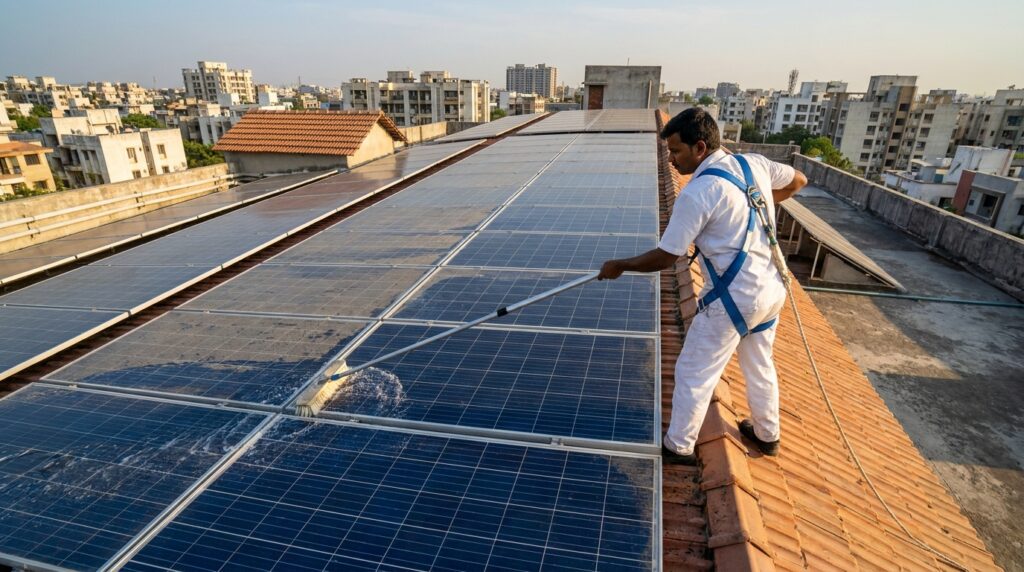
Solar maintenance services in India cover scheduled panel cleaning, electrical safety inspection, inverter servicing, string balancing and a generation performance check, usually bundled into a yearly AMC. They do not cover storm or theft damage, roof repairs, DISCOM disputes or component replacement after warranty unless the contract explicitly says “comprehensive.” Knowing which bucket a clause falls into is the entire game before you sign.
Key Takeaways
- Core scope is fixed: cleaning, inspection, fault diagnosis and a generation check appear in nearly every solar maintenance contract in India, regardless of provider.
- Exclusions need to be written down: major part replacement after warranty, storm and theft damage, roof work, DISCOM fights and unlimited extra visits should be named in writing, not assumed.
- Price tracks coverage, not size alone: residential AMCs typically run ₹2,500 to ₹4,000 per kW per year, while commercial contracts settle lower, near ₹1,000 to ₹2,000 per kW per year, because larger systems spread fixed visit costs over more capacity.
- Comprehensive and non-comprehensive are different products: one includes parts replacement, the other is labour-only with spares billed separately.
- Monitoring and maintenance are not interchangeable: a dashboard tells you something is wrong; an AMC is who shows up to fix it.
At a Glance: Solar Maintenance Services Checklist
| Service Element | Usually Included | Typical Frequency |
|---|---|---|
| Panel cleaning | Yes | Monthly to quarterly, higher in dusty zones |
| Electrical safety check | Yes | Annual |
| Inverter servicing | Yes | Quarterly to half-yearly |
| String balancing / hardware tightening | Yes | Half-yearly |
| Generation / performance report | Yes | Monthly |
| Major part replacement after warranty | Only in comprehensive AMC | As needed |
| Storm, theft, roof damage | No, standard exclusion | N/A |
| DISCOM billing disputes | No | N/A |
What Do Solar Maintenance Services Actually Cover?
Solar maintenance services are the scheduled and on-call work that keeps a rooftop or ground-mounted plant producing at its designed output across its life. The core job is simple: find losses before they show up on your electricity bill, and fix them within an agreed window.
In practice, a solar AMC in India must cover scheduled cleaning, inspection, fault diagnosis and a generation check, as the baseline AMC scope is built around. These four elements show up whether you are a homeowner with a 3 kW rooftop or a factory running a 500 kW ground-mounted array.
Think of it as two layers. The first layer is routine, calendar-driven upkeep: cleaning, torque checks, visual inspection. The second is diagnostic: catching a string fault, a DC loss or an inverter fault code before it costs you a month of generation. Good solar maintenance services do both, not just the first.
The Core Scope: What’s Always Included
Across every credible provider in India, a few line items repeat. Panel cleaning sits at the top because soiling is the single biggest, most preventable loss driver on a dusty rooftop. Dust zones in Rajasthan, Gujarat and parts of Delhi NCR push cleaning frequency up compared with coastal Maharashtra or Kerala.
- Panel cleaning and wiping: removes dust, bird droppings and residue that block sunlight from reaching the cell.
- Annual electrical safety inspection: checks earthing, cable insulation and junction boxes for degradation.
- Inverter servicing: fan checks, firmware updates, heat sink cleaning and fault log review.
- String balancing and hardware tightening: corrects uneven current across strings and re-torques mounting bolts loosened by wind and thermal cycling.
- Monthly generation performance report: compares actual output against expected yield so a drop gets flagged, not discovered three bills later.
Every one of these appears consistently across published Indian AMC checklists, which makes this the floor, not the ceiling, of what you should expect to see written into a contract. If a quote skips string balancing or the generation report, ask why before you sign.
What’s Typically Excluded (and Why That Matters)
Here is the harder truth: an AMC is defined as much by what it refuses to cover as by what it promises. A standard, non-comprehensive AMC in India excludes five things in writing: major part replacement after warranty, storm and theft damage, roof work, DISCOM disputes and unlimited extra visits beyond the scheduled count, as the exclusions checklist lays out.

Each exclusion exists for a reason. Storm and theft damage belongs to insurance, not maintenance, because it is an unpredictable one-off loss, not wear and tear. Roof work sits with your builder or EPC because a maintenance crew isn’t contracted or insured to touch structural waterproofing.
DISCOM disputes, meanwhile, are a billing and regulatory fight, not a technical fault. A maintenance provider can supply generation data to support your case, but fighting your utility is a separate service entirely.
The one that catches people out most is unlimited extra visits. If your AMC promises four visits a year and your system throws a fault in month five, a fifth visit often carries an extra charge unless the contract says otherwise. Read that clause twice before you sign anything.
Comprehensive vs Non-Comprehensive AMC: Which One Do You Need?
A comprehensive AMC bundles labour and parts together, so a failed inverter or module gets replaced at no extra charge during the contract term. A non-comprehensive AMC is labour-only: the technician visits, diagnoses, and services the system, but you pay separately for any spare part, as the comprehensive vs non-comprehensive distinction defines it.
| Factor | Comprehensive AMC | Non-Comprehensive AMC |
|---|---|---|
| Labour (cleaning, inspection, diagnosis) | Included | Included |
| Parts replacement (inverter, module) | Included | Billed separately |
| Annual cost | Higher upfront | Lower upfront |
| Best fit | Systems past warranty, older inverters | New systems still under manufacturer warranty |
| Risk if inverter fails | Covered by contract | You pay out of pocket |
One inverter swap can wipe out three years of savings from a cheaper labour-only plan, which is why the choice matters more once your manufacturer warranty expires. If your system is under five years old and still under warranty, non-comprehensive usually makes financial sense. Past that point, comprehensive coverage starts looking like insurance you actually want.
For a line-by-line breakdown of every clause a fair AMC should contain, see this explainer on AMC terms before you compare quotes.
How Much Do Solar Maintenance Services Cost in India?
Fair pricing for a residential solar AMC in India sits near ₹2,500 to ₹4,000 per kW per year for comprehensive coverage, while larger commercial and industrial contracts run lower, around ₹1,000 to ₹2,000 per kW per year, according to 2026 AMC pricing data.
The gap between residential and commercial rates isn’t about scale discounts alone. A 500 kW commercial plant needs roughly the same number of technician visits as a 50 kW one, so the fixed cost of each visit gets spread across far more capacity, pulling the per-kW rate down.
What actually moves the number within that band is scope. Labour-only AMC and “all parts included” AMC are different products at different prices, and a quote that looks cheap on the surface may simply have stripped out the parts coverage. Always ask what the fee buys: the number of scheduled visits, what’s covered per visit, and whether parts are in or out.
Regional soiling rates also affect real cost. Gujarat, Rajasthan and Delhi NCR need more frequent cleaning cycles than a coastal roof in Kerala, which changes how many visits a fair-priced contract should include. For a state-by-state breakdown of cleaning frequency, this climate zone guide is a useful companion.
Solar Panel Maintenance vs Solar Monitoring: Are They the Same Service?
No, solar maintenance and solar monitoring are two different services that work best together. Maintenance is the physical, scheduled work done on-site; monitoring is the continuous digital tracking of generation data that tells you when maintenance needs to happen sooner than planned.
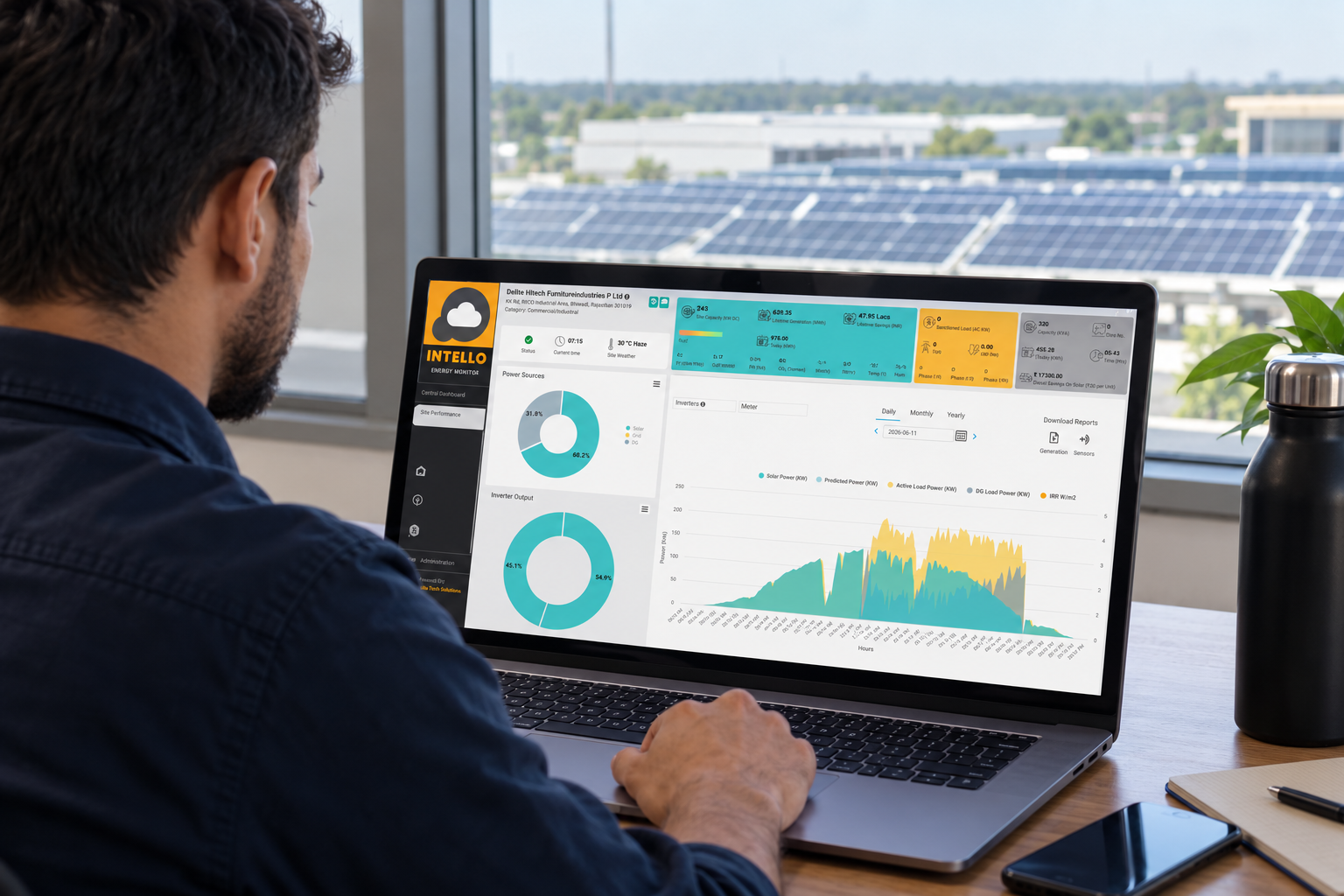
A monitoring dashboard flags a string underperforming or an inverter throwing a fault code within hours. Without a maintenance team behind that alert, the data is just a notification nobody acts on. Without monitoring, a maintenance team only finds problems on its next scheduled visit, which could be weeks away.
This is the gap Intello is built to close: an IoT-enabled monitoring dashboard paired with on-ground maintenance teams and photo-verified visit reports, so a flagged fault turns into a scheduled technician visit rather than a ticket that sits unread. If you’re comparing what a monitoring app should actually surface day to day, this feature walkthrough breaks it down screen by screen.
How Does a Solar Tracking Mechanism Fit Into Maintenance?
A solar tracking mechanism does not fall inside standard maintenance scope because most Indian rooftop and C&I systems use fixed-tilt mounting, not trackers. Where trackers exist, usually on large ground-mounted plants, their motors and actuators need separate mechanical servicing beyond a typical AMC.
If your plant uses tracking hardware, confirm separately whether your AMC covers the motor and controller, or whether that falls to the equipment manufacturer’s own service agreement. Most residential and commercial rooftop owners in India will never need to ask this question, since fixed-tilt remains the default for those system sizes.
Red Flags to Check Before You Sign an AMC
A written AMC should leave nothing to interpretation. Vague language is where disputes start three years in, usually right after the manufacturer warranty expires and the real cost of a failure lands on whoever didn’t read the fine print.
- No fixed visit count: “regular visits” without a number means you have no leverage when a visit gets skipped.
- No written exclusions list: if storm damage, theft and roof work aren’t named as excluded, don’t assume they are, confirm it in writing.
- Unclear parts terms: ask directly whether this is comprehensive or labour-only, and get the answer in the contract, not a verbal promise.
- No generation benchmark: without an expected-yield baseline, nobody can prove underperformance happened or got fixed.
- No response-time commitment: a fault with no deadline for a technician visit can sit for weeks.
For the specific clauses that tend to hide the biggest gaps, this guide to AMC fine print walks through real contract language worth flagging.
Choosing a Solar O&M Provider in India: What to Compare
Price is the easiest number to compare and the least useful one on its own. A provider quoting less per kW but offering half the visits, no parts coverage and no monitoring integration isn’t cheaper, it’s a different, thinner product.
Ask instead about technician headcount and local coverage, since a provider with boots on the ground near your site responds faster than one dispatching from three states away. Ask whether their maintenance visits feed into a monitoring platform, or whether cleaning and diagnostics happen blind, with no data trail.
Finally, ask how disputes get resolved if a fault happens outside their stated response window, and get that answer in writing too. A provider managing solar assets across multiple sites should be able to show you a dashboard, not just promise one. If you’re weighing whether to build an in-house team instead of outsourcing, this comparison of in-house versus outsourced O&M lays out the tradeoffs in more depth.
FAQ
What does solar panel maintenance include?
Solar panel maintenance includes scheduled cleaning, an annual electrical safety inspection, inverter servicing, string balancing, hardware tightening and a monthly generation performance report. These five elements form the baseline scope across nearly every credible AMC in India.
How often should solar panels be cleaned in India?
Cleaning frequency depends on your region’s dust levels, ranging from monthly in high-soiling zones to quarterly in cleaner, coastal areas. High-dust states like Rajasthan and Gujarat generally need more frequent cleaning than coastal Kerala or Maharashtra.
Is monitoring included in a solar AMC?
Not always. Some AMCs include basic monitoring access, but dedicated IoT-based monitoring with real-time alerts is often a separate service layered on top of maintenance, which is why it’s worth confirming explicitly before you sign.
Does a solar AMC cover inverter replacement?
Only a comprehensive AMC covers inverter and major part replacement within the contract term. A non-comprehensive, labour-only AMC requires you to pay separately for any replacement part.
If you’re comparing AMC quotes and want a scope that actually names what’s covered, what’s excluded, and ties every visit to a photo-verified report, request a quote from Intello and get a plan built around your system size and region.
Existing customers can check live generation data and visit history anytime through the Intello portal login. To see how Intello’s integrated monitoring and maintenance platform works end to end, learn more about Intello before your next AMC renewal comes up.