There is no single number that answers “how often should I clean solar panels in India?” Dust levels, rainfall patterns, roof tilt and even nearby bird activity change the answer from one street to the next.
Solar panels in Indian cities can need anywhere from once every 1-4 weeks to once every few months, and the right solar panel cleaning frequency for your site depends on what your own generation data shows, not a generic rule.
Key Takeaways
- No fixed interval works everywhere: Dust, pollution, rainfall, panel tilt, bird droppings and plant size all push the right frequency in different directions, even within the same city.
- Let performance data set the trigger: A measured drop in performance ratio or daily generation is a more reliable signal than a calendar date.
- Dry season concentrates the risk: Dust builds up fastest between October and the start of monsoon, when rain is not around to rinse panels naturally.
- Cleaning is not always a DIY job: Rooftop height, live wiring and water quality all affect whether a safe, trained crew is the better choice over a bucket and sponge.
- Track every clean against output: A before-and-after generation comparison is the only way to know if a cleaning cycle is actually worth the cost.
At a Glance: Solar Panel Cleaning Signals and Intervals
| Site Condition | Typical Trigger | Who Should Clean |
|---|---|---|
| Dense urban dust / industrial belt | PR drop of 8-10% or visible grime within 2-3 weeks | Professional crew (rooftop access, wiring near panels) |
| Coastal or moderately dusty city | PR drop or noticeable haze after 4-6 weeks | DIY dry dusting possible for small ground-mount; professional for rooftop |
| Post dust storm (any region) | Visible layer within 24-48 hours of the storm | Professional spot-clean recommended |
| Monsoon months | Rain largely self-cleans; inspect only | Visual check, cleaning rarely needed |
| Near farms, construction, or bird roosts | Localised staining or droppings, check weekly | Professional (droppings can need chemical-safe cleaning) |
| Large commercial / ground-mounted plant | String-level yield comparison, not a calendar | Professional AMC team with documented reports |
Why There Is No Universal Solar Panel Cleaning Frequency
Search for a single answer and you will find different numbers from different sources, and all of them can be true at once. The honest range is once every 1-4 weeks to once every few months, because dust, pollution, rainfall, location, panel angle, bird activity and plant size are all pulling in different directions on the same roof.
A rooftop system in a quiet residential colony with a steep tilt and regular rain sheds dust faster than a flat, low-tilt commercial array next to a highway. Add a cement plant, a construction site, or a flock of pigeons nearby, and the calendar stops being useful at all.
This is why asset owners who ask “how often should solar panels be cleaned” get a frustratingly vague answer from most guides. The real answer sits in your own generation numbers, not in a blanket rule copied from a different city.
How Dust and Rainfall Patterns Change the Schedule
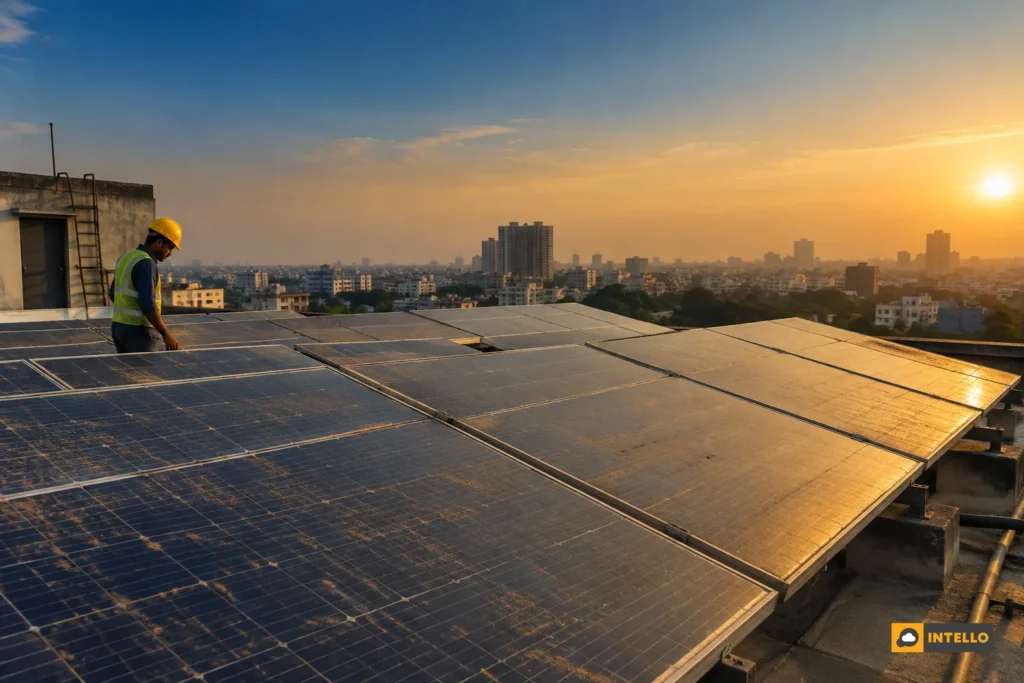
India’s dry season, roughly October through May, is when soiling losses build up fastest. Without rain to rinse the panels, dust, pollen and exhaust particulates settle layer by layer, and the loss compounds week over week in high-traffic urban zones.
Once monsoon arrives, regular rain usually does a decent job of rinsing panels on its own. That doesn’t mean you stop checking; a light film can still cling to low-tilt panels even in wet months, and the first weeks after monsoon often need one thorough clean to clear accumulated grime that rain alone didn’t shift.
Industrial belts and chemical manufacturing zones face a sharper version of this problem. A plant located near heavy industry can see airborne particulate settle on panels within days rather than weeks, the same pattern seen in several seasonal cleaning guides written for India’s chemical manufacturing corridors.
The lesson generalises well beyond any one location: proximity to industrial dust, not just general city grime, is its own variable worth tracking separately. Our regional climate zone guide breaks this down further by zone if you manage sites across more than one region.
What Does Your Monitoring Data Tell You About Soiling Loss?
Your monitoring dashboard tells you soiling loss has crossed a cleaning threshold when daily generation or performance ratio drops gradually over days, with no fault code and no sudden step change. That slow, steady decline is the signature of dust, distinct from the sharp drop of a string fault or inverter trip.

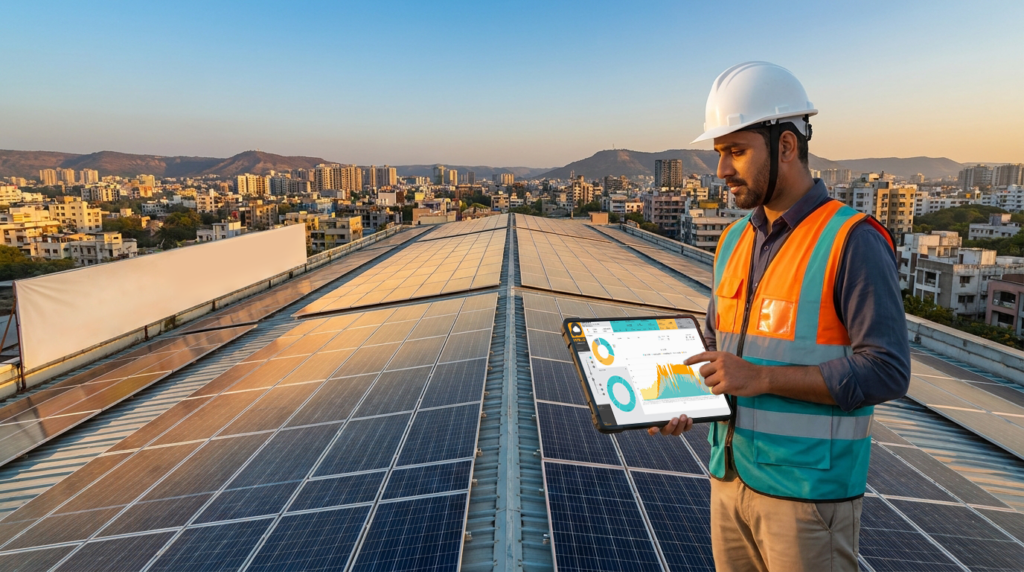
A good solar remote monitoring dashboard plots this trend for you automatically, comparing actual output against expected output for the same weather conditions. When that gap widens past a threshold you set, say 8 to 10%, that’s your cleaning trigger, not the number of days since the last wash.
This matters because a fixed interval wastes money in low-dust months and costs you generation in high-dust ones. Owners managing several sites through a multi-site dashboard can set different thresholds per location, since a Jaipur rooftop and a Kochi rooftop rarely soil at the same rate.
Is It Safe to Clean Solar Panels Yourself?
Dry dusting a small, easily accessible ground-mounted system with a soft brush is reasonably safe to do yourself. Rooftop arrays, anything involving water near live wiring, or panels more than a storey up need a trained technician, because the electrical and fall risks outweigh the savings.
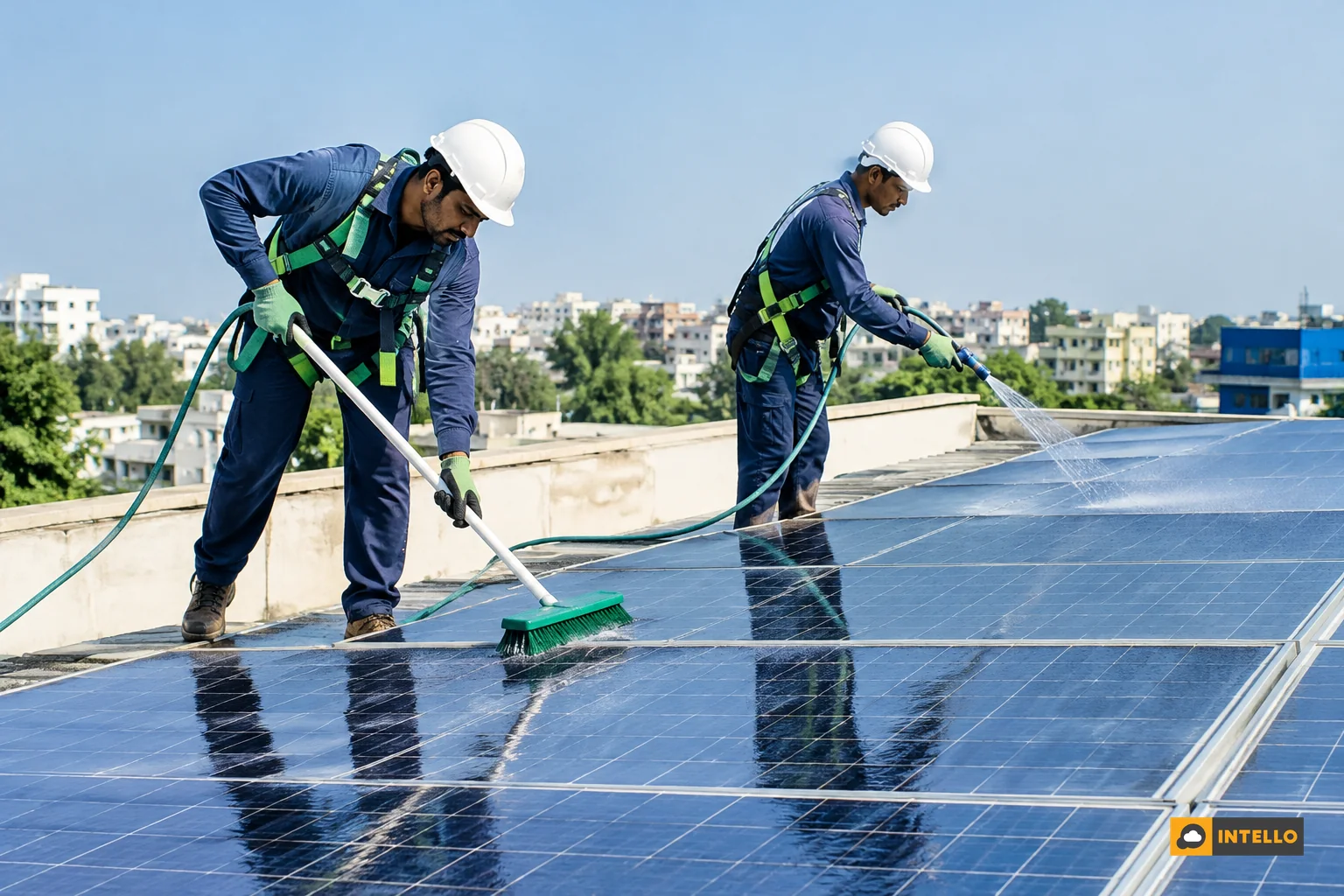
Wet cleaning in particular carries hidden risk. Hard water leaves mineral deposits that can mimic soiling loss over time, high-pressure jets can crack glass or loosen junction boxes, and cleaning hot panels with cold water creates thermal stress that can cause microcracks. A trained crew knows to clean early morning or evening, use the right water quality, and avoid pressure that strips the anti-reflective coating.
If your panels have bird droppings, those often need more than a splash of water, since dried droppings can be acidic and etch the glass if scraped carelessly. That’s a case where calling a professional earns back more than it costs.
How to Build Your Own Cleaning Schedule
Start with a baseline. Pull your plant’s performance ratio for a clean, recently-washed period, and treat that as your reference point for “panels are clean.”
Next, note your local pattern. A northern city with dust storms, an industrial corridor, or a coastal town with salt spray each has a different natural soiling rate, and your own weekly generation trend will show it faster than any guide can.
Set a trial interval based on that pattern, then watch how fast your performance ratio drifts from the baseline. If it falls 8-10% within two weeks, your real-world interval is shorter than you guessed. If it holds for six weeks, you’ve found a longer, cheaper cycle that still protects output.
Compare generation before and after every clean, and keep that log. Over two or three cycles, you’ll have a data-backed schedule specific to your roof, not a number borrowed from a different city’s soiling rate.
It’s worth knowing where cleaning technology is headed too. Researchers have recently demonstrated an electrostatic dust removal film that achieves a 96.36% cleaning rate in lab testing, using an electric charge to repel dust without water. That kind of self-cleaning coating is still emerging technology rather than something available for most installed systems today, but it signals that water-based cleaning schedules may eventually be supplemented, not replaced, by passive dust mitigation.
Professional Cleaning vs DIY: A Comparison
| Method | Best For | Safety Risk | Warranty & Documentation |
|---|---|---|---|
| DIY dry dusting | Small ground-mounted systems, low dust zones | Low, if panels are accessible without climbing | No documented proof for warranty claims |
| DIY wet washing | Not generally recommended for rooftop arrays | High: electrical shock, microcracks, fall risk | None; can void manufacturer warranty if done incorrectly |
| Professional one-off cleaning | Post dust-storm spot cleans, small commercial sites | Low, trained crew with proper equipment | Service report, no ongoing schedule |
| Professional AMC-based cleaning | Rooftop, commercial, and ground-mounted plants of any size | Lowest, scheduled and insured crews | Photo-timestamped reports tied to generation data |
When to Bring in a Professional O&M Partner
Rooftop height and access alone are reasons enough to hand cleaning to a professional crew. Add live wiring, string-level sensitivity, and the fact that a careless wash can trigger a warranty dispute, and the case for a trained team gets stronger the bigger your system gets.
Portfolio owners managing sites across several cities face a second problem: no two sites soil at the same rate, and nobody wants to manually track generation drift at ten locations.
Intello’s O&M teams pair a scheduled cleaning visit with the same AMC that covers inverter servicing and string balancing, and every visit is logged through a mobile app with location, timestamp, and photo proof, so there’s a documented trail if a warranty question ever comes up.
That documentation matters more than it sounds. Global demand for PV cleaning has shifted from optional to something closer to a standard line item, reflected in a global PV O&M market that reached 348 GWdc in 2026, up 61 GW year-on-year, as cleaning demand keeps pace with new installed capacity. Asset owners increasingly treat a cleaning record the same way they treat an inspection log: evidence the system was cared for, not an afterthought.
If you’re currently cleaning on a fixed calendar and not checking whether it’s actually working, that’s the gap worth closing first. A quick look at your preventive maintenance cost versus breakdown cost usually settles the argument for a scheduled, data-driven approach.
Frequently Asked Questions
How often should solar panels be cleaned in India?
Solar panels in India typically need cleaning anywhere from every one to four weeks up to once every few months, depending on local dust, pollution, rainfall and panel tilt. The right frequency for your site is the one your own generation data confirms, not a number copied from another location.
Does rain clean solar panels well enough on its own?
Rain rinses most loose dust off tilted panels effectively, especially during monsoon months. It’s less effective on low-tilt or flat-mounted panels and does nothing for dried bird droppings or industrial residue, so a visual check after heavy rain is still worth doing.
Is professional solar panel servicing worth the cost over DIY?
For rooftop or commercial systems, yes: professional servicing covers safe access, correct water quality, and documented proof of cleaning that protects your warranty standing. For small, easily reached ground-mounted systems in low-dust areas, careful DIY dusting can be reasonable.
Can over-cleaning damage solar panels?
Yes. Frequent high-pressure washing, abrasive brushes, or cleaning hot panels with cold water can cause microcracks and strip protective coatings over time. Matching frequency to actual soiling loss, rather than cleaning on a tight fixed schedule, avoids this.
If you’re unsure whether your current cleaning cycle is protecting or wasting your solar investment, the fastest way to find out is to look at your own performance data over the next cleaning cycle.
Request a quote from Intello’s O&M team to set a site-specific cleaning schedule backed by measured output, not guesswork. Existing customers can check current generation trends anytime through the Portal Login, and anyone wanting to understand how Intello’s monitoring and maintenance platform works end-to-end can learn more about Intello directly.