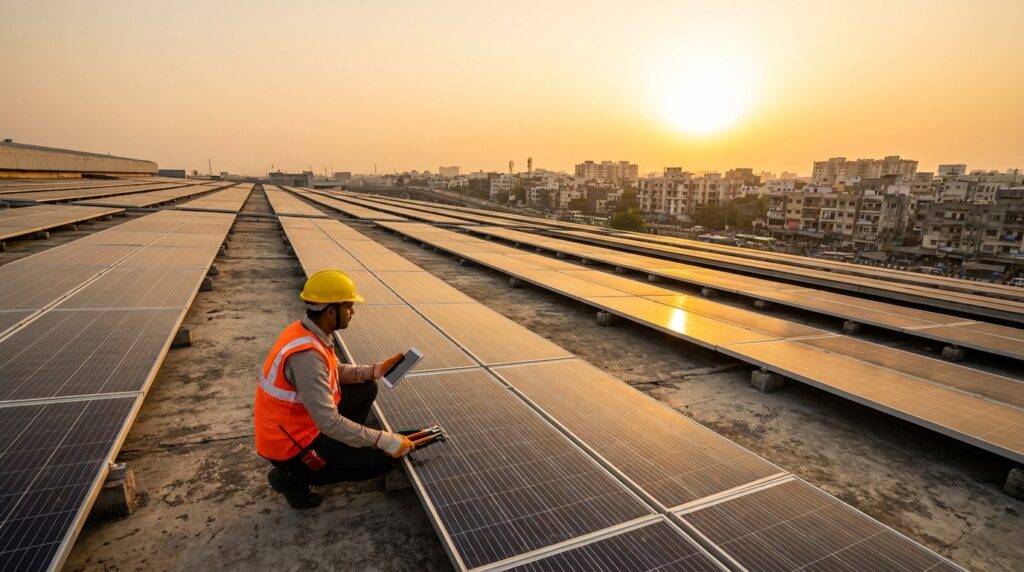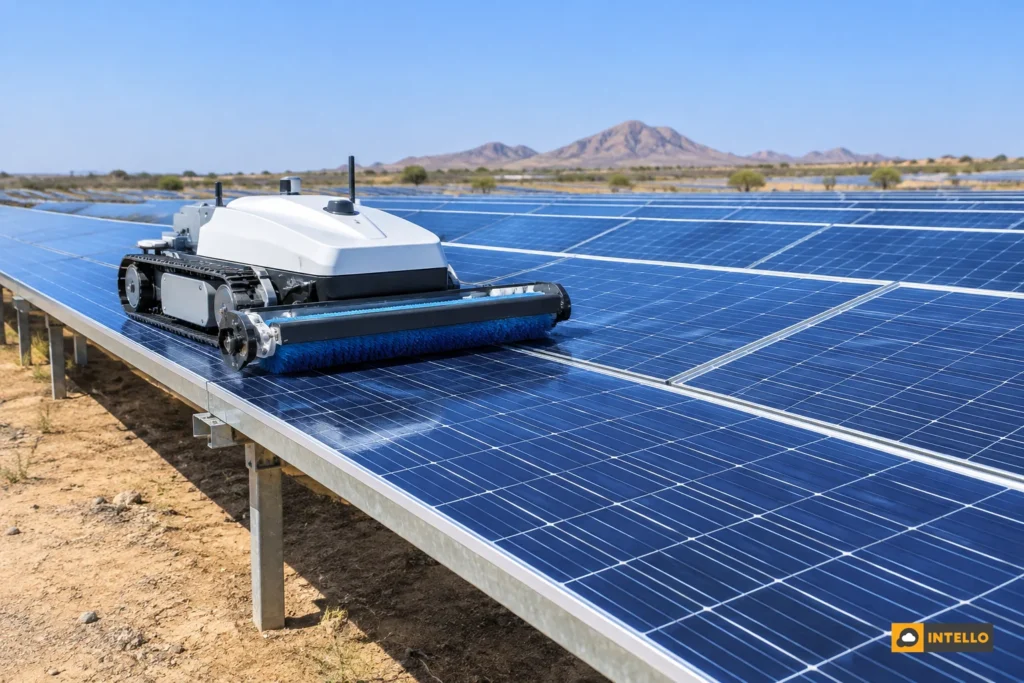
A solar panel cleaning robot is worth it for commercial plants in India only when the site is large, has long uninterrupted panel rows, suffers heavy soiling, and has limited water or labour. For small, cluttered rooftops, scheduled manual or wet cleaning by a trained crew is usually cheaper and safer.
Key Takeaways
- Scale decides: Robots pay back on large ground-mounted plants with regular row layouts; small rooftops rarely justify the capital.
- Soiling must be recoverable: A robot is not justified by labour savings alone; it needs enough avoidable soiling loss and cleaning frequency to turn into extra energy.
- Water is a real driver: Dry robotic cleaning removes water cost and trucking in dry states such as Rajasthan and Gujarat.
- Robots need care too: Batteries, brushes, drive parts and communication need scheduled servicing, so budget for it.
- Compare on one metric: Judge each option on rupees per recovered unit of energy, not on one cleaning invoice.
Cleaning Methods at a Glance
| Method | Best fit | Water use | Cost profile | Main risk |
|---|---|---|---|---|
| Manual dry wiping | Small rooftops, light dust | None | Low upfront, recurring labour | Scratching if done badly |
| Manual wet cleaning | Rooftops with water access, sticky grime | High | Low upfront, labour plus water | Water cost, fall risk, streaks |
| Tractor or truck-mounted wet | Wide-spaced ground plants | High | Equipment plus crew | Needs vehicle access between rows |
| Semi-automatic waterless robot | Mid-size rooftops, regular arrays | None | Higher upfront, lower labour | Operator still moves the unit |
| Fully automated waterless robot | Large ground plants, long rows | None | Highest upfront, lowest running labour | Equipment faults, layout limits |
What Is a Solar Panel Cleaning Robot?
A solar panel cleaning robot is an automated machine that removes dust, pollen and grime from photovoltaic panels without a person wiping each module. It typically runs along a row on its own, using brushes or microfibre, and often needs no water.
Most designs fall into two groups. Row-dedicated robots stay on a table or row and clean on a schedule, usually at night or early morning. Shuttle-type robots clean one row and are carried to the next by a vehicle or by staff.
The economics differ sharply between the two. A fixed-per-row unit means many machines on a big plant. A shuttle unit means fewer machines but more handling. Ask any vendor which model you are being quoted before comparing numbers.
Do Robots Make Sense for Rooftop Plants?
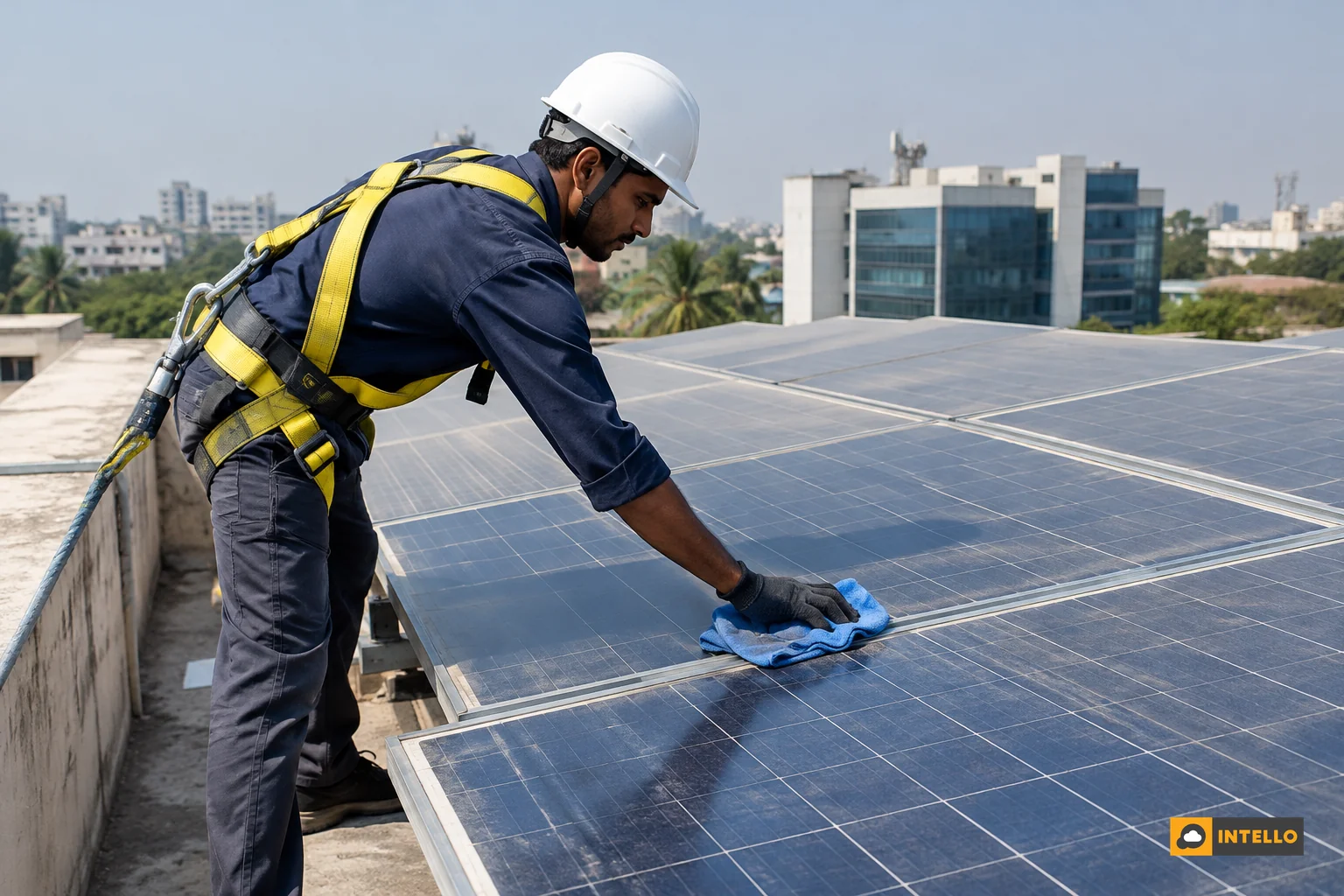
Usually not on small rooftops. Rooftop arrays have short rows, gaps, parapets, water tanks and uneven surfaces that stop a robot from travelling freely. A trained crew with proper fall protection is typically the more practical and cheaper choice.
The picture changes on large flat industrial roofs. Where a factory shed carries long, regular rows of modules, and roof access is dangerous or restricted, a semi-automatic dry robot can cut fall exposure. Manual cleaning carries high labour expense and fall-safety risk, which is why it is only practical for small, easy-access arrays, as a comparative study of roof-mounted self-cleaning mechanisms and industry guidance both indicate.
Rooftop checklist before considering a robot
- Are rows continuous for long stretches, with no obstructions?
- Is the roof load rating confirmed for the robot and any rails?
- Are module frames and tilt uniform across the roof?
- Can the robot be parked safely away from shade and rain?
- Does your roof warranty or insurer have views on equipment fixed to the array?
If you answer no to more than two, plan for crews. Solar panels that stay dirty despite regular cleaning often point to causes other than the method; see why panels get dirty so fast before spending on hardware.
Do Robots Make Sense for Ground-Mounted Plants?
Yes, more often than on rooftops. Ground-mounted plants have long, uniform rows, large module counts and open space, which suits automation. The larger the plant and the heavier the soiling, the stronger the case for robots.
Financing guidance published in 2026 suggests outright purchase generally suits sites of 50 MW and above, where an in-house fleet cuts long-term operating spend, while leasing can suit smaller sites with limited capital. That is a vendor-side view, so test it against your own numbers.
For plants of a few megawatts, the answer is less clear. Layout matters: trackers, uneven terrain, drains and inter-row cabling can block a robot. A site walk with the vendor, checking row length, gaps and tilt, should come before any quote.
How Do Robots Compare on Water Use and Dust Conditions?
Dry robots use no water, while manual wet cleaning uses a lot of it. Dust conditions then decide how often you need to clean. In heavy-dust, water-scarce regions, robots that clean every day or two protect output better than a fortnightly crew visit.
Cleaning solar panels worldwide is estimated to use about 10 billion gallons of water a year, according to MIT Sustainability. The same source notes that waterless attempts have often been labour intensive and can scratch surfaces, which is a reminder that dry methods must be done with soft, well-maintained materials.
Dust, monsoon and droppings
Dust is not the only soiling. Sticky bird droppings and industrial deposits can resist dry brushing, so a robot may still need a wet crew for spot treatment. Read our guide on bird droppings and panel damage to see why.
During monsoon, rain removes loose dust, so robot runs can drop sharply. Cleaning need varies by climate zone; our regional cleaning guide by climate zone and the post on cleaning frequency in dusty Indian cities help you estimate how many robot-days a year you would really use.
For the mechanics of the two approaches, read our comparison of dry versus wet cleaning. Note that this is a general comparison; your own soiling data should settle the choice.
Upfront Cost vs Running Cost: What to Compare
Robots carry higher upfront cost and lower running cost; manual cleaning is the reverse. The right comparison is total cost over the equipment life, divided by the energy you recover, not the price of a single cleaning visit.
One 2025 life-cycle study of a 100 MW plant in Northwest China found robots need a larger initial investment than manual cleaning but compare differently over the full life cycle, and a 2026 ROI analysis states that robots are not justified by labour substitution alone. I would not copy Chinese figures into an Indian business case; use them only as a method.
Cost factors to put in your model
- Upfront: robot units, rails or docking, installation, commissioning, and any roof or structure work.
- Running: electricity or solar charging, spare parts, servicing contract, and staff to supervise.
- Avoided: water, tanker transport, crew wages, mobilisation, and fall-safety cover.
- Gain: extra energy from cleaner panels at your tariff or PPA rate.

A simple worked example method
Suppose your monitoring shows soiling loss averaging a few percent between cleans. Multiply the recoverable share of yearly generation by your tariff. Compare that with annual robot cost (depreciation plus servicing) and annual manual cleaning cost. If the robot’s net annual cost is lower, it pays.
The number that matters is recoverable loss, so you need data. Plants with string-level monitoring can separate soiling from faults; see how IoT sensors detect solar faults to avoid blaming dust for a failing string.
Maintaining the Robots Themselves
Robots are equipment, and they need preventive maintenance. Expect to service brushes or microfibre, drive wheels or tracks, batteries, charging points, sensors and communications. Neglect turns a cleaning tool into a source of scratches and downtime.
- Brushes and cloth: worn or dirty material can abrade glass and anti-reflective coating, so replace on a schedule.
- Batteries and charging: heat in Indian summers shortens life; check capacity regularly.
- Drive and rails: dust and grit wear moving parts; inspect alignment and fasteners.
- Software and logs: confirm every run was completed, row by row.
- Spares and support: verify local service response before you buy.
One unresolved question for many owners: whether a robot’s service contract belongs with the vendor or with your O&M team. Both work, but responsibility must be written down. Our piece on in-house versus outsourced solar O&M covers that split.
A Decision Rule for Commercial Owners
Choose robots when four things line up: a large plant with regular rows, high recoverable soiling, scarce or costly water, and a team able to maintain the machines. If fewer than three hold, stay with scheduled manual cleaning and better data.
My own view: most Indian rooftop owners below a few hundred kilowatts should skip robots and invest in a good cleaning schedule plus monitoring. Large ground plants in dust-heavy states should run a pilot on one block, measure the performance ratio before and after, and scale only on proof. Owners with trackers or uneven terrain should be cautious, since fit is the hardest thing to verify on paper.
FAQ
Does solar panel maintenance include robot cleaning?
Standard solar maintenance covers scheduled cleaning, inspection, inverter servicing and performance checks. Robot cleaning is one delivery method for the cleaning item, not a separate requirement. Confirm in your contract whether robots, manual crews, or both are used.
Can robots damage solar panels?
Poorly maintained robots can, mainly through worn brushes, trapped grit or misalignment. Well-maintained dry robots with soft materials are designed to avoid this, but ask for the cleaning material specification and replacement schedule.
Do robots replace manual cleaning completely?
Rarely. Stubborn deposits such as droppings or cement dust may still need manual spot cleaning, and robots can miss edges or obstructed areas.
How do I know if dirt is my real problem?
Compare performance ratio before and after a clean. If output barely changes, look at shading, string faults or inverter issues instead. Our guide to shading loss diagnosis helps rule that out.
Next Step
Intello can review your soiling data, plant layout and current cleaning cost, then tell you honestly whether a solar panel cleaning robot, a manual crew or a mix suits your site. Request a quote for a cleaning and O&M assessment, or read about how our teams work. Existing customers can open the Intello portal to check their plant’s performance trend first.