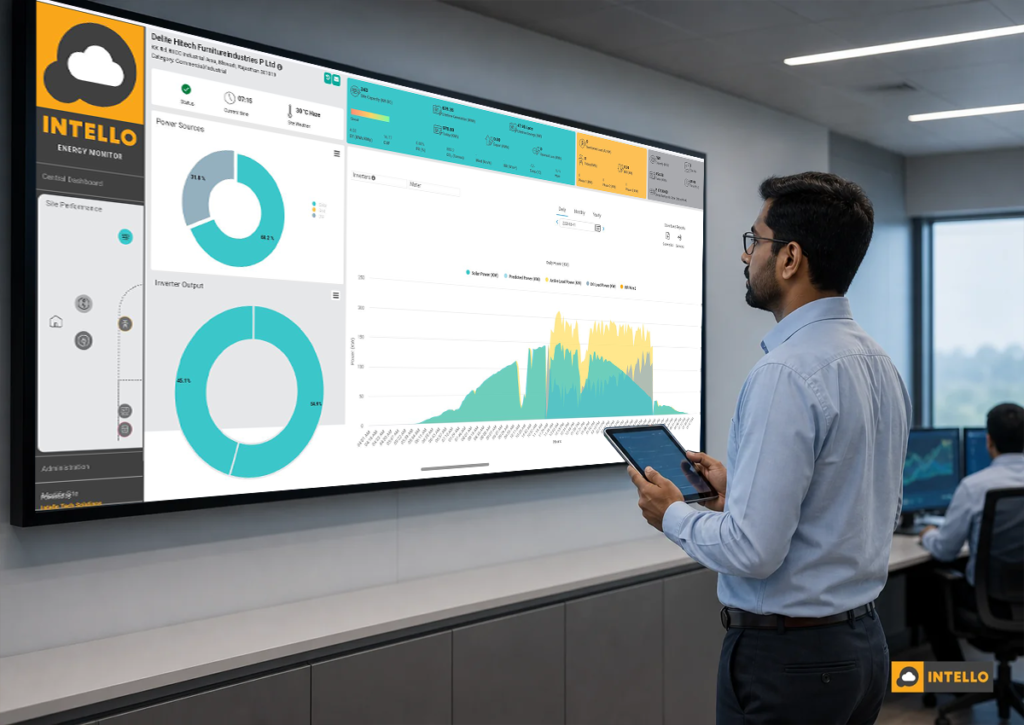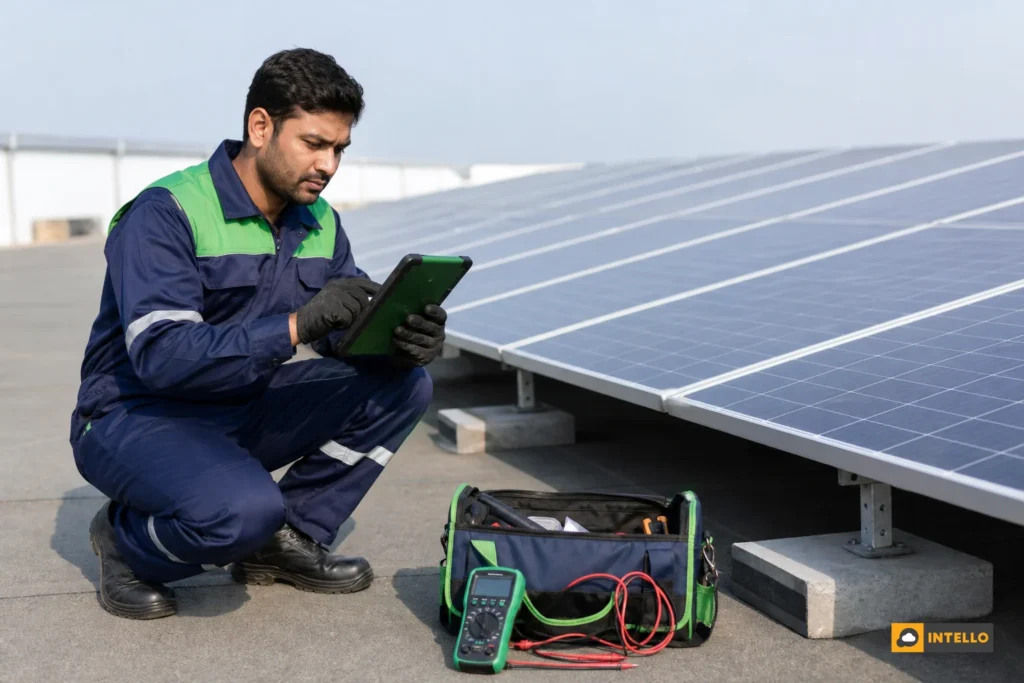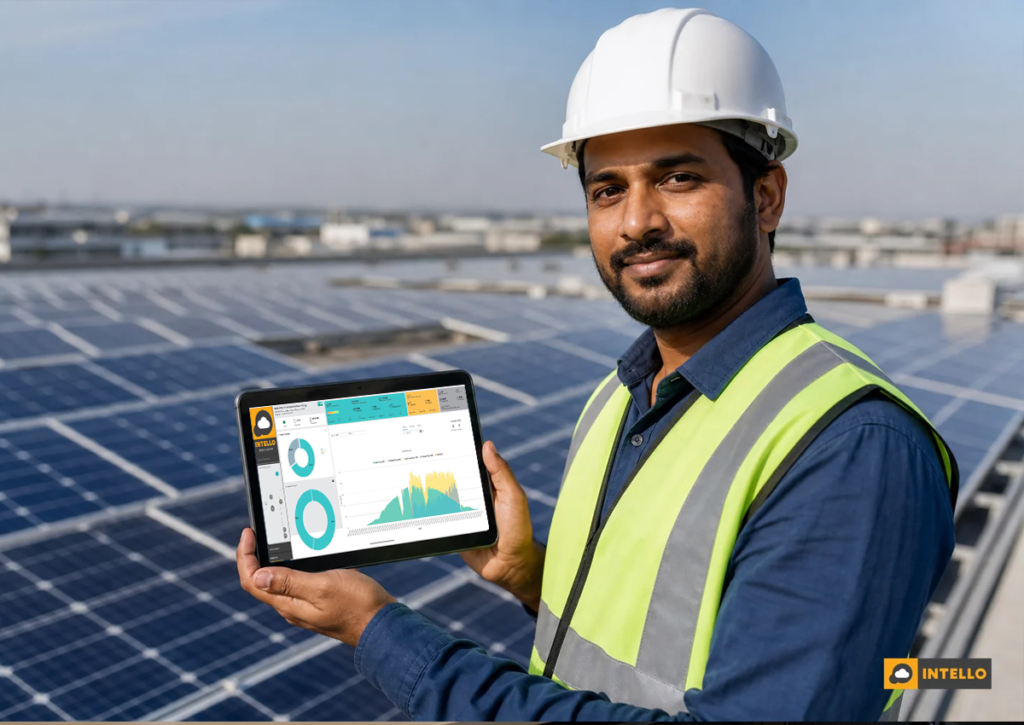
IoT solar fault detection works by placing current and voltage sensors at the string and inverter level, feeding that data to a remote terminal unit (RTU) every few minutes, and flagging any reading that drifts from its expected baseline. Instead of waiting for a monthly site visit or a noticeable spike in your electricity bill, an asset owner in India gets an alert within minutes of a string dropout, an inverter fault, or a DC-side loss, often before it shows up in the plant’s total generation number.
Key Takeaways
- String-level visibility matters most: Total plant output can look normal even when one string has failed completely, because healthy strings mask the loss in aggregate numbers.
- Detection speed changes the cost equation: A fault caught within hours costs a fraction of one left running for three to four weeks before a routine inspection finds it.
- RTUs read inverter fault codes directly: Earth faults, IGBT trips, and grid synchronization errors get logged and pushed as alerts instead of sitting buried in an inverter’s local memory.
- DC losses compound silently: Loose connectors, cable degradation, and localized soiling often shave off 2-8% of yield without tripping any alarm on basic monitoring setups.
- Monitoring alone isn’t maintenance: Sensor alerts only protect ROI when they’re paired with a technician who can act on them, which is why IoT fault detection works best inside a structured O&M or AMC arrangement.
IoT Solar Fault Detection at a Glance
| Fault Type | How IoT Sensors Detect It | Typical Yield Impact if Missed | Typical Detection Time with IoT |
|---|---|---|---|
| String dropout | Per-string current comparison against baseline | 3-12% of plant output, depending on string count | Within 15-60 minutes |
| Inverter fault code (earth fault, IGBT trip) | RTU reads inverter communication protocol directly | Full inverter block offline until reset | Real time to a few minutes |
| DC-side losses (loose MC4, cable wear) | Voltage drop pattern across affected string | 2-8% gradual yield loss | 1-3 days (trend-based) |
| Grid synchronization error | Frequency/voltage mismatch logging | Full or partial inverter shutdown | Real time |
| Localized soiling or shading | String-to-string output deviation on clear days | 1-5% depending on severity | 2-5 days (pattern recognition) |
| Communication or SIM failure | Heartbeat/ping monitoring on the RTU itself | Zero visibility, not direct yield loss | Within the hour |
What IoT Solar Fault Detection Actually Means
Most solar owners in India already have some form of monitoring, usually the free app that came bundled with the inverter. That app can tell you total generation for the day. What it usually can’t tell you is which of your 20 strings dropped out at 11 a.m., or whether an inverter logged an earth fault and quietly restarted itself three times before lunch.
IoT solar fault detection is a step beyond that. It combines sensors at the string and combiner-box level, a remote terminal unit (RTU) that reads data from the inverter and sensors continuously, and a cloud dashboard that compares live readings against what the system should be producing given the weather and time of day. When a reading falls outside its expected band, the system raises a flag automatically, rather than relying on someone to notice a dip in a monthly report.
For asset owners managing rooftop or ground-mounted systems across multiple states, this distinction is not academic. A 500 kW commercial rooftop in Gujarat and a 2 MW ground-mounted plant in Rajasthan behave differently under dust, heat, and voltage fluctuation, and a generic app rarely accounts for that. Purpose-built RTUs and sensor networks are calibrated to the specific configuration of each site, which is why platforms designed for Indian conditions tend to catch faults that off-the-shelf loggers miss. If you’re weighing hardware options, our comparison of RTU vs datalogger solar monitoring breaks down where each falls short.
1. How String-Level Sensors Catch Dropouts Early
A solar array is wired in strings, groups of panels connected in series and feeding into a combiner box before reaching the inverter. If one string fails completely, whether from a blown fuse, a snapped connector, or a failed bypass diode, the inverter keeps running on the remaining strings. Total plant output might dip by only 4-6%, a drop easy to blame on cloud cover or a slightly hazy day.
String-level current and voltage sensors solve this by measuring each string individually instead of only measuring the combined DC input to the inverter. The RTU compares strings against each other in real time. Healthy strings under identical sun exposure should produce similar current. When one string’s reading falls sharply below its neighbors, the system flags a probable string fault immediately, rather than waiting for someone to notice a gradual generation shortfall over weeks.
Consider a 1 MW rooftop installation with 40 strings. Without string-level sensors, a single dropped string quietly costs roughly 2.5% of total yield, month after month, until a technician happens to test that specific combiner box during a routine visit. With sensors in place, the same fault triggers an alert the same day it happens, and a technician can be dispatched before the loss accumulates into a meaningful revenue gap. This is one reason string fault detection has become a standard line item in serious O&M contracts rather than an optional add-on.
2. How RTUs Flag Inverter Errors in Real Time
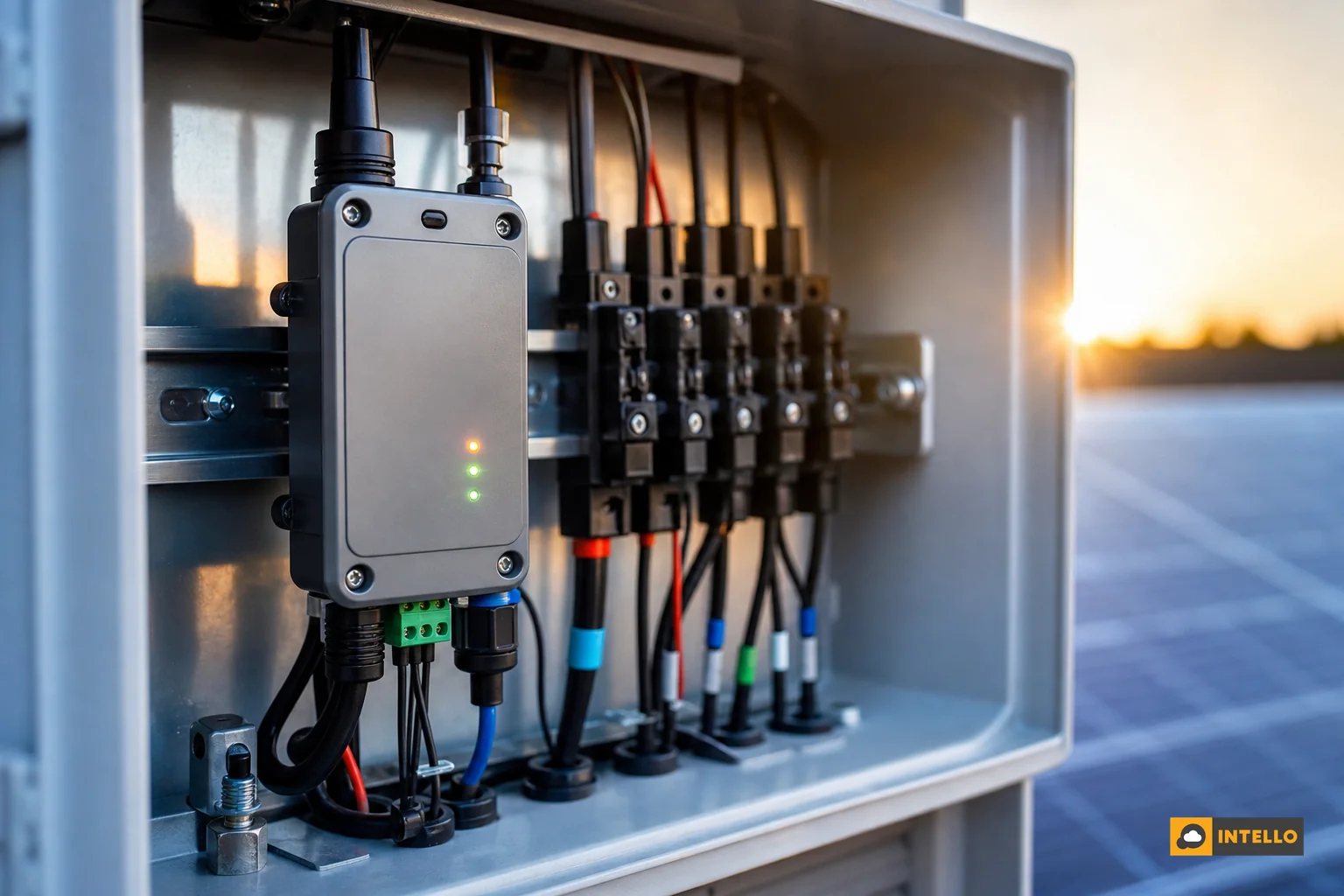
Inverters generate their own fault codes, earth faults, IGBT (insulated-gate bipolar transistor) trips, DC bus over-voltage, and grid synchronization errors among them. Most of that information sits in the inverter’s local display or internal log, invisible unless someone physically checks it or logs into a portal that only shows aggregate numbers.
An RTU changes that by reading the inverter’s communication protocol directly, usually Modbus or a similar industrial standard, and pushing every fault code to the central dashboard as it happens. Instead of a technician discovering during a scheduled visit that the inverter tripped six times last week, the O&M team gets a real-time alert the moment it happens, with the specific fault code attached.
Some of the inverter faults IoT sensors most commonly catch include:
- Earth faults: Often caused by insulation damage or moisture ingress, and dangerous if left unresolved.
- IGBT trips: A sign of internal component stress, frequently a precursor to a larger inverter failure if ignored.
- Grid synchronization errors: Voltage or frequency mismatches with the grid that force the inverter offline until conditions stabilize.
- Over-temperature shutdowns: Common in poorly ventilated inverter rooms during peak summer months.
Catching these early doesn’t just protect yield. It also matters for warranty claims, since manufacturers often want a fault history with timestamps before honoring a claim. Our guide on the solar panel warranty claim process in India covers what documentation you’ll typically need, and IoT-logged fault codes make that process considerably faster.
3. Spotting DC-Side Losses Before They Compound
DC losses are the quiet drain on solar ROI. Unlike a string dropout or an inverter trip, they rarely announce themselves. A loose MC4 connector, a cable run degrading from heat cycling, or localized soiling on one section of the array all reduce output gradually rather than abruptly.
IoT sensors catch these by tracking the ratio between voltage and current across each string over time, not just on a single day. A connector working loose shows up as a small but consistent voltage drop on that string relative to others under the same irradiance. Cable degradation shows a similar pattern, usually worsening slowly over months. Because the system logs data every few minutes, trend analysis can flag a developing DC loss well before it becomes visible in monthly generation reports.
The financial impact of ignoring this is easy to underestimate. A 2-8% DC loss on a 1 MW plant, left undetected for a full quarter, can represent tens of thousands of rupees in lost generation, on top of the higher repair cost once a small issue (a loose connector) becomes a bigger one (a burnt connector requiring string rewiring). For a deeper look at how these losses show up and get fixed, see our breakdown of DC losses and string faults in Indian solar plants.
4. Turning Sensor Data Into Action: Alerts, Dashboards, and Technician Dispatch
Sensor data is only useful if it reaches the right person in time to act. A well-built IoT fault detection setup routes alerts through three layers: an automated flag on the dashboard, a notification to the assigned O&M technician, and a visible status change the asset owner can check without needing to interpret raw numbers.
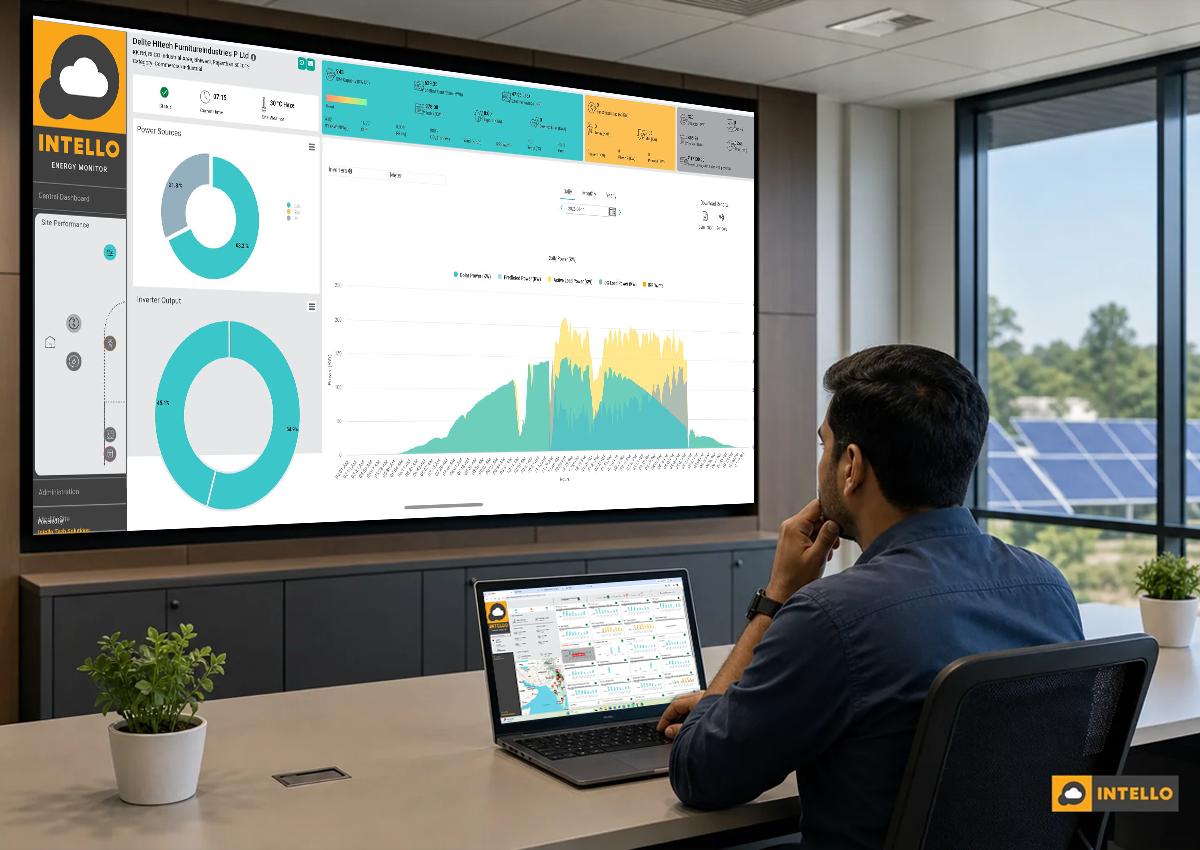
This is where the dashboard becomes the connective layer between hardware and human response. A well-designed dashboard should surface not just that something went wrong, but what and where, ideally down to the specific string or inverter block, so the technician arrives on site already knowing what to check. If you’re evaluating what a good dashboard should include, our piece on what a solar dashboard should show you daily lays out the essential elements.
Once a technician is dispatched, mobile tools close the loop. Field visits logged with location, timestamps, and photographic evidence give asset owners proof that a flagged fault was actually inspected and resolved, not just marked closed in a spreadsheet. This kind of verification matters most for owners managing sites they rarely visit in person, including EPC companies overseeing installations spread across several states. Our article on mobile app features field technicians actually use covers what this verification loop should look like in practice.
IoT Fault Detection vs Traditional Manual Inspection
Manual inspection still has a place, particularly for physical checks like mounting structure integrity or cable insulation wear that sensors can’t directly measure. But as a primary fault detection method, it compares poorly to IoT-based monitoring on the metrics that actually affect ROI.
| Factor | IoT Sensor-Based Detection | Manual/Periodic Inspection |
|---|---|---|
| Typical detection time for a string fault | 15-60 minutes | Days to weeks (until next scheduled visit) |
| Coverage | Every string, every inverter, continuously | Sampled, dependent on technician thoroughness |
| Cost per fault caught | Low marginal cost once hardware is installed | Higher, since each visit has a fixed labor cost |
| Historical trend data | Yes, logged continuously for pattern analysis | No, each visit is a snapshot |
| Best suited for | Electrical faults, generation anomalies, inverter errors | Physical damage, structural wear, connector corrosion checks |
| Multi-site scalability | High, one dashboard for unlimited sites | Low, scales linearly with technician headcount |
The most reliable setups combine both: continuous IoT monitoring to catch and localize faults fast, paired with scheduled physical inspections and preventive maintenance to catch what sensors can’t see. That combination is the core of a properly structured solar AMC vs O&M contract arrangement, rather than relying on either approach alone.
Why Early Fault Detection Protects Solar ROI in India
India’s solar capacity has grown past 90 GW as of 2026, according to the Ministry of New and Renewable Energy, spread across a wide range of climate zones, from the dust and heat of Rajasthan to the humidity of coastal Tamil Nadu. Each of these environments stresses solar hardware differently, and each hides faults differently in aggregate generation data.
A string fault or DC loss that shaves off 5% of yield sounds small until you calculate it against a full operating lifetime. Over a 25-year asset life, a persistent 5% loss that goes unnoticed for even six months represents a meaningful, permanent dent in the plant’s lifetime energy yield and, by extension, its return on investment. This is the core argument for pairing solar monitoring in India with a maintenance provider who actually acts on the alerts rather than just displaying them.
There’s also a downtime cost that’s easy to overlook: every day a fault runs undetected is a day of solar downtime that a basic app simply won’t flag as urgent, because total generation still looks “mostly normal.” For commercial and industrial consumers on time-of-use tariffs, or those managing zero-export compliance, that undetected gap can also complicate zero-export solar setups, where accurate real-time generation data is essential for DISCOM compliance, not just yield tracking.
For asset owners managing multiple sites, whether that’s a chain of commercial rooftops or an EPC company servicing dozens of client installations, the case for IoT fault detection strengthens further. A single technician team cannot physically visit 15 sites daily, but a centralized dashboard can watch all 15 simultaneously and tell the team exactly where to go first. Our guide on centralized solar monitoring across multiple sites walks through how to structure this at scale.
How to Get Started with IoT-Enabled Fault Detection
If your current setup only shows a single daily generation number, here’s a practical path to move toward real fault detection:
- Audit what your current monitoring actually shows. Ask whether it reports string-level data, inverter fault codes, and historical trends, or just a daily total. Most stock inverter apps fail this test.
- Install string-level sensors and an RTU calibrated for your site. A custom RTU accounts for your specific inverter brand, string configuration, and local grid behavior, rather than applying a generic threshold.
- Set up a dashboard with automated alert routing. Alerts should go to a named technician or O&M team, not just sit in an inbox no one checks daily.
- Pair monitoring with a maintenance provider who closes the loop. Detection without dispatch is just data. The value comes from a technician acting on the alert quickly, with photographic proof of resolution.
- Review fault history quarterly. Recurring faults on the same string or inverter often point to an underlying hardware issue worth addressing at the root rather than repeatedly patching.
Intello builds this entire chain in-house: custom-designed RTUs suited to Indian site conditions, a centralized monitoring dashboard, and over 150 solar experts on payroll who respond to flagged faults directly, whether that’s a string dropout, an inverter error, or a DC loss developing on a residential rooftop or a multi-megawatt ground-mounted plant. If you’d like to see how this works for your own installation, you can request a quote and get a sense of what a properly instrumented monitoring and maintenance setup would look like for your site.
Frequently Asked Questions
What is IoT solar fault detection?
It’s a monitoring approach that uses sensors at the string and inverter level, connected through an RTU, to continuously compare actual output against expected output. When a reading deviates, the system generates an automated alert instead of waiting for someone to notice a problem manually.
Can IoT fault detection be added to an existing solar plant?
Yes. Most retrofits involve installing string-level sensors at the combiner box and adding an RTU that communicates with the existing inverter, without needing to replace panels or inverters themselves. This works for both rooftop and ground-mounted systems already in operation.
Does IoT monitoring replace the need for physical site visits?
No. Sensors catch electrical anomalies like string dropouts, DC losses, and inverter faults, but physical issues like connector corrosion, mounting structure wear, or panel soiling still need a technician on site. The two work best together, which is why most serious solar O&M arrangements combine both.
How quickly can a fault be detected with IoT sensors?
String dropouts and inverter fault codes typically show up within 15-60 minutes. Slower-developing issues like DC losses from a loosening connector or gradual soiling usually need one to three days of trend data before the pattern is clear enough to flag confidently.
Is IoT fault detection worth it for a small residential system?
For small systems, the case shifts slightly toward simpler monitoring paired with a responsive AMC provider, since the absolute rupee value of a missed fault is smaller. Still, catching a string fault within a day rather than three months meaningfully protects a homeowner’s payback period, as covered in our piece on residential solar AMC benefits.
If undetected string faults, inverter errors, or DC losses have been quietly eating into your solar output, the fix isn’t more guesswork, it’s better visibility paired with a team that actually responds. Intello’s monitoring dashboard and on-ground technicians work together to catch these issues early and close them fast. Check your existing site’s data through the Portal Login if you’re already a client, or contact us to discuss setting up IoT-enabled fault detection for your installation. You can also learn more about Intello’s approach to solar monitoring and maintenance before making a decision.