A commercial solar owner in Pune once waited four months for a net metering approval, only to find their DISCOM had capped rooftop export at 50% of sanctioned load anyway. The choice between zero export vs net metering India setups isn’t philosophical, it comes down to what your local DISCOM allows, how much power you actually consume on-site, and how much delay you can absorb before commissioning. Net metering credits surplus power back to the grid; zero export blocks that surplus entirely so nothing flows backward.
Key Takeaways
- DISCOM policy decides first, not preference: Several states cap rooftop export at 50-100% of sanctioned load, and some group housing or industrial connections disallow export entirely, making zero export mandatory regardless of what the owner wants.
- Residential systems usually favor net metering: Smaller loads mean more surplus generation, and export credits materially improve payback when family consumption is low during peak sun hours.
- Commercial and high self-consumption sites often do better with zero export: Daytime industrial or office loads absorb most generation on-site, so export credit value is low while approval delays and compliance risk are high.
- A zero export device adds hardware and O&M cost: The current transformer and controller need periodic calibration checks, unlike net metering which mainly needs annual bidirectional meter reconciliation.
- The wrong choice quietly erodes ROI: Miscalibrated zero export curtails good generation unnecessarily, while unauthorized export under net metering can trigger DISCOM penalties or disconnection notices.
At a Glance: Zero Export vs Net Metering India
| Factor | Net Metering | Zero Export |
|---|---|---|
| What it does | Exports surplus power to grid, credited on bill | Blocks any backfeed to grid in real time |
| Hardware needed | Bidirectional meter from DISCOM | CT-based controller plus curtailment logic on inverter |
| Typical approval time | 4-12 weeks, varies by state | Faster in most cases; some DISCOMs mandate it upfront |
| Best fit | Residential, low daytime consumption sites | Commercial sites, capped connections, high self-consumption |
| ROI impact | Higher if surplus generation is regular | Depends on self-consumption ratio; lower if curtailment is frequent |
| Ongoing O&M need | Annual meter reconciliation, billing checks | Periodic CT calibration, controller firmware and communication checks |
| DISCOM compliance risk | Penalty for exceeding sanctioned export limit | Low, since backfeed is physically prevented |
What Net Metering Means for a Solar Asset Owner in India
Net metering replaces your regular electricity meter with a bidirectional one that tracks power flowing both ways. When your solar system generates more than you consume, the surplus flows to the grid and gets credited against your bill in the next cycle. When your panels underproduce, say on a cloudy day, you draw from the grid as usual.
Most state DISCOMs allow net metering for rooftop systems, but the terms vary. Some restrict sanctioned solar capacity to a percentage of your connected load, commonly 80-100% for residential and lower for commercial connections. Others cap how much surplus can be exported at all, which effectively forces a hybrid arrangement even under a net metering label. If you’re weighing this option, it’s worth reading how a zero export solar setup in India works as a comparison point, since many owners end up needing both configurations understood before signing an EPC contract.
The billing math only favors you if your consumption pattern leaves real surplus to export. A household away at work all day with an empty house generating peak solar output has a lot to send back. A 24×7 manufacturing unit consuming most of what it generates has very little left to export, which is where the conversation shifts toward zero export.
What a Zero Export Setup Actually Does
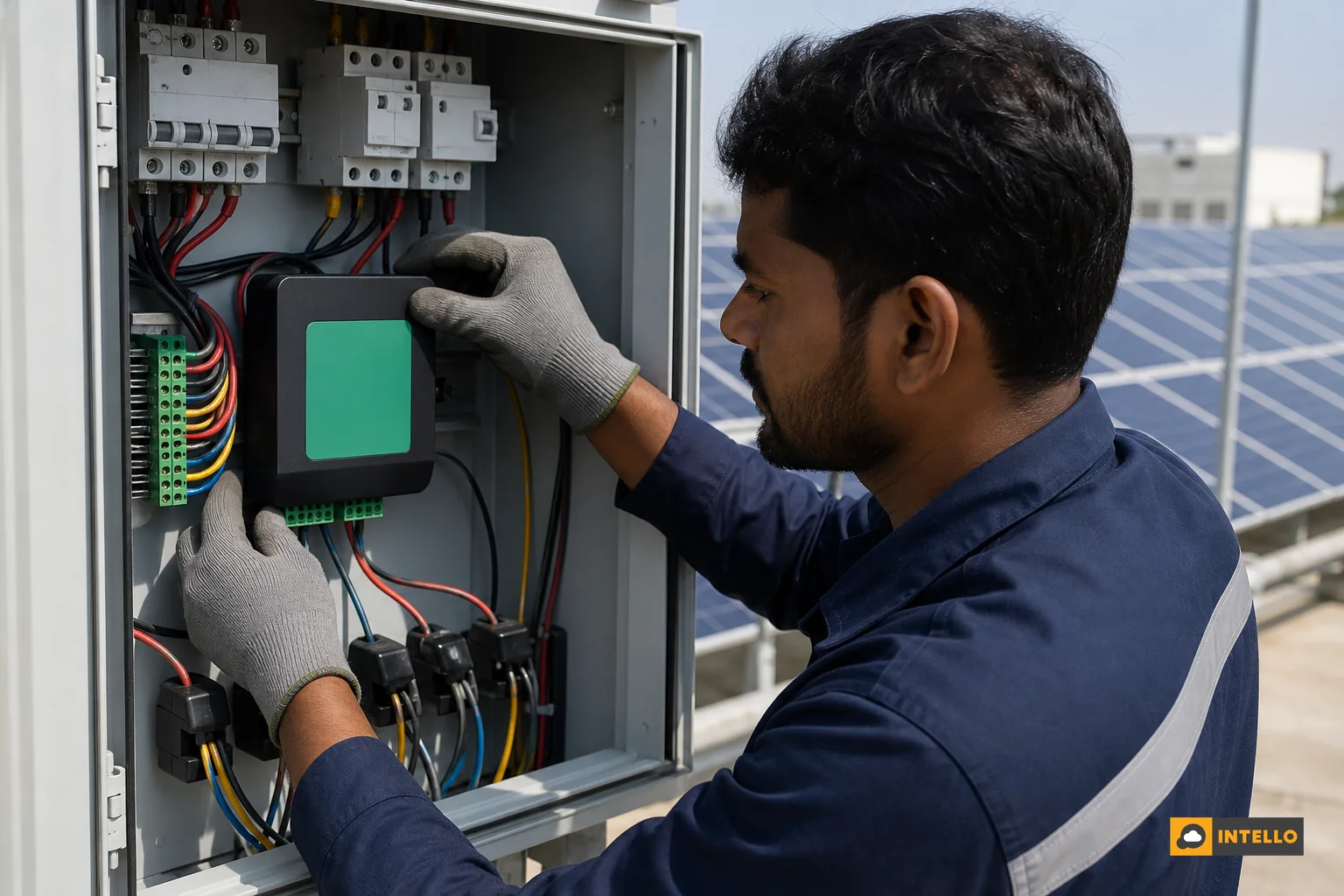
A zero export device sits at your grid connection point and measures power flow using a current transformer, checking direction in near real time. The moment it detects any risk of power flowing backward into the DISCOM grid, it signals your inverter to curtail output immediately. This isn’t a monthly reconciliation like net metering, it’s a live control loop running every few seconds.
Zero export exists for one practical reason: it lets you install solar capacity larger than your sanctioned export limit without violating DISCOM rules. A factory with fluctuating shift loads, a mall with seasonal footfall, or a residential society with an export ban can all install solar sized to their roof space rather than their permitted export ceiling, as long as a working zero export device prevents backfeed.
The tradeoff is that any curtailed generation is generation you paid for but never used. If the device is miscalibrated or the load profile assumption behind system sizing was wrong, you can lose a meaningful chunk of output to unnecessary curtailment. That’s a maintenance and monitoring problem as much as a design one, which is why ongoing checks matter as much as the initial installation.
Zero Export vs Net Metering India: Side-by-Side Comparison
Beyond the summary table above, a few operational differences shape the real day-to-day experience of owning each setup.
- Paperwork burden: Net metering requires DISCOM application, bidirectional meter installation, and periodic billing disputes if credits are miscalculated. Zero export mostly needs a one-time DISCOM approval confirming the device is functioning, with fewer recurring billing touchpoints.
- System sizing flexibility: Net metering usually restricts your system size to a percentage of sanctioned load. Zero export removes that ceiling in many DISCOM jurisdictions, letting you size for available roof area instead.
- Failure mode risk: A failed bidirectional meter under net metering typically just delays your credit reconciliation. A failed or miscalibrated zero export device can either curtail too aggressively, wasting generation, or fail to curtail at all, risking a DISCOM compliance breach.
- Long-term cost: Net metering has near-zero incremental hardware cost after the meter swap. Zero export adds a controller and CT hardware cost upfront, plus periodic calibration as part of ongoing O&M.
When DISCOMs Mandate Zero Export
Several scenarios in India push zero export from an option to a requirement. Group housing societies in states with strict net metering caps often can’t get export sanctioned at all, since the DISCOM treats the entire building as one connection with limited headroom. Industrial connections above certain sanctioned load thresholds frequently face outright export bans tied to grid stability concerns in that feeder zone.
Commercial buildings with highly variable daytime load, think a school that’s empty on weekends, or a warehouse running one shift, also tend toward zero export because the DISCOM doesn’t want unpredictable backfeed on a low-demand day. If your EPC company has already flagged a DISCOM export restriction on your sanctioned load letter, the zero export path isn’t really a choice, it’s a compliance requirement you need installed and verified correctly before commissioning gets signed off.
Owners who’ve been through this process without the right O&M partner often discover the compliance requirement late, after the system is already built for net metering assumptions. That’s a costly retrofit. Getting DISCOM export terms confirmed in writing before finalizing system design avoids that entirely.
Cost-Benefit Tradeoffs for Commercial vs Residential Owners
Commercial solar asset owners generally see fewer benefits from net metering unless their load profile genuinely leaves surplus during sunlight hours. A factory running two shifts might consume close to 100% of solar generation on-site, so export credit value is marginal, while the compliance risk of exceeding an export cap carries real financial penalty. For these owners, zero export protects against fines and disconnection risk without meaningfully sacrificing ROI, since there wasn’t much export value to begin with.
Residential owners typically see the opposite math. A home consuming power mostly in the evening, after the sun has set, generates a large midday surplus that has nowhere to go except the grid. Net metering captures real financial value from that surplus. Blocking it with a zero export device, unless mandated by the DISCOM, usually reduces the effective ROI of the system. Homeowners weighing AMC options alongside net metering setup should look at what other residential solar AMC benefits owners reported after their first year, since a well-maintained net metering system compounds savings year over year.
The middle ground, common among small commercial owners like retail stores or clinics, often comes down to whichever the DISCOM actually approves fastest. In markets with a backlog of net metering applications, some owners choose zero export simply to avoid a multi-month wait, even where net metering would have been financially better.
How to Decide: A Practical Checklist
Before signing an EPC contract or finalizing system design, run through these checks:
- Confirm your DISCOM’s export policy in writing. Ask specifically whether your connection category and sanctioned load allow net metering, and if there’s a percentage cap on export.
- Map your actual daytime load profile. If your site consumes most of its power between 10 AM and 4 PM, net metering surplus will be small regardless of what’s technically allowed.
- Check group connection restrictions. Housing societies and shared commercial complexes often have building-wide export limits that override individual unit preferences.
- Weigh the O&M cost difference. A zero export device needs periodic CT calibration and controller checks as part of routine solar AMC or O&M contract coverage, while net metering mainly needs annual meter and billing reconciliation.
- Factor in approval timelines. If commissioning deadlines are tight, check which pathway your specific DISCOM approves faster in your circle.
- Plan for future capacity expansion. If you expect to add panels later, zero export often gives more sizing headroom since it isn’t tied to a sanctioned export percentage.
Protecting ROI Regardless of Configuration

Whichever setup you land on, the ROI risk doesn’t disappear after commissioning, it shifts form. Net metering owners need visibility into whether export credits are being calculated correctly against actual generation. Zero export owners need visibility into how much generation is being curtailed and whether that curtailment is actually necessary, or just a poorly calibrated device wasting output.
Intello handles both sides of this through its solar O&M and monitoring services, offering zero export device installation, calibration, and ongoing maintenance alongside a monitoring dashboard that tracks generation, curtailment events, and performance ratio in one place. Field teams verify CT accuracy and controller response times as part of preventive maintenance visits, catching drift before it becomes a compliance issue or a silent ROI drain. For deeper technical detail on fault detection, see how IoT sensors detect solar faults before they cost you, which applies directly to both zero export controllers and net metering communication modules.
Owners managing multiple sites with a mix of net metering and zero export configurations across different DISCOM jurisdictions face an added layer of complexity. A centralized view that flags curtailment losses at one site and export credit discrepancies at another saves the back-and-forth of manually checking each site’s meter data. That’s exactly the kind of setup covered in a practical guide to centralized solar monitoring across multiple sites in India.
Frequently Asked Questions
Can I switch from net metering to zero export later?
Yes, though it usually requires DISCOM re-approval and installing zero export hardware retroactively. It’s more expensive as a retrofit than including it in the original design, so confirm your DISCOM’s export policy before commissioning if there’s any doubt.
Is a zero export device mandatory everywhere in India?
No. Requirements vary by state and DISCOM. Some jurisdictions mandate zero export for connections above a certain sanctioned load or for group housing societies, while others allow full net metering with generous export caps. Always confirm the current policy for your specific circle before finalizing system design.
Does zero export reduce my solar savings?
It can, if your system generates significant surplus during the day that would otherwise have been exported and credited. For sites with high daytime self-consumption, the impact is minimal since there wasn’t much surplus to lose in the first place. Regular monitoring of curtailment events helps quantify exactly how much output is being lost so you can decide if a redesign or recalibration is worthwhile.
How do I know if my zero export device is working correctly?
Check curtailment logs against your actual load data. If the device is curtailing generation even when your site is clearly consuming most of its output, the CT calibration or controller threshold may need adjustment. A monitoring dashboard that logs these events in real time makes this diagnosis straightforward instead of guesswork.
Getting this decision wrong, or getting it right but leaving the hardware unmonitored, both end the same way: quietly lower returns on a system you paid full price for. If you’re evaluating zero export vs net metering for a new installation, or need an existing zero export device inspected and calibrated by a team that handles this daily, request a quote from Intello to get a DISCOM-compliant setup that protects your ROI from day one. Existing customers can check real-time curtailment and generation data anytime through the Intello monitoring portal, and new owners can contact us to walk through which configuration actually fits your site’s DISCOM terms and load profile.