
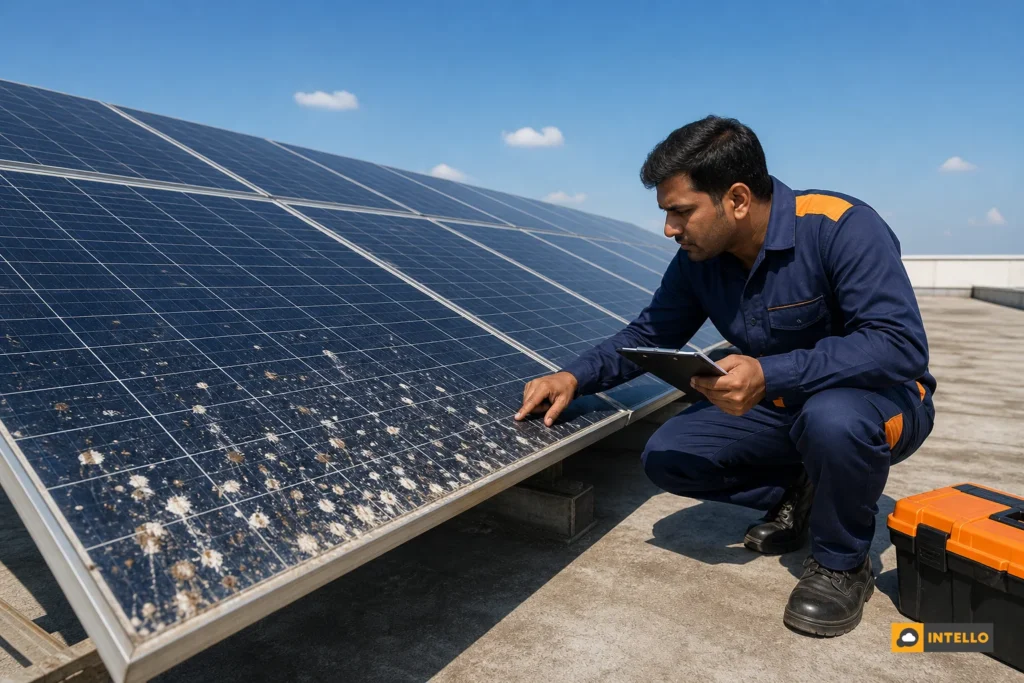
A single bird dropping on a solar panel can drag down the output of an entire string, not just the cell it sits on. Bird droppings on solar panels damage output through opaque shading, localized hotspots, and slow chemical etching of the glass, and unlike dust, rain rarely washes them off before harm is done. For rooftop sites near trees, open fields, or water bodies across India, this is a maintenance problem that needs a specific plan, not a general cleaning schedule.
Key Takeaways
- Droppings are opaque, dust is translucent: a dropping blocks a cell almost completely, while dust merely dims it, which is why droppings cause disproportionate string-level losses.
- Rain does not remove them reliably: droppings bond to warm glass within hours, according to Total Solar Cleaning, so waiting for the next monsoon shower is not a strategy.
- Hotspots can become permanent: a shaded cell forced to absorb current instead of generating it heats up, and prolonged exposure can damage the cell and its bypass diode beyond a simple wash.
- Location predicts risk: droppings concentrate along ridge lines, cable trays, and lower module edges near trees or open fields, per PV-Protector’s field data.
- Inspection frequency should match site risk: sites near trees or water bodies need weekly visual checks; open rooftops away from perches can go monthly.
At a Glance: Bird Droppings vs Dust Soiling
| Factor | Bird Droppings | Dust Soiling |
|---|---|---|
| Coverage pattern | Concentrated, patchy, opaque | Thin, uniform film across module |
| Removed by rain | Rarely, bonds within hours | Partially washed off |
| Risk of hotspots | High, can fully shade a cell | Low, reduces light evenly |
| Chemical effect on glass | Etches anti-reflective coating over time | Minimal chemical impact |
| Detection method | Visual check plus string-level monitoring | Gradual PR decline across whole array |
| Recommended cleaning | Spot wet-clean, soft brush, no scraping | Regular dry or wet wash on schedule |
| Typical hotspot zones | Ridge lines, cable entries, lower edges | Not zone-specific |
How Bird Droppings Actually Damage a Solar Panel
Bird droppings on solar panels damage output through three mechanisms working together: they block and scatter sunlight, they create electrical hotspots inside the shaded cell string, and they slowly etch the glass surface. Each mechanism compounds the other over months of exposure.
A dropping is opaque. Where a film of dust dims a cell by a small percentage, a dropping can block a cell almost entirely, as confirmed by experimental testing referenced in a peer-reviewed study on real environmental factors affecting PV output. That study notes panels rated near 22% peak efficiency lose disproportionate output when localized opaque obstructions sit on individual cells rather than spreading evenly.
The bigger issue is what happens electrically. Solar cells in a string are wired in series. When one cell is shaded, it can’t pass current the way its neighbors do. Instead of generating power, it starts absorbing it, and that reverse-bias condition generates heat. Vista Drone Cleaning’s research confirms this hotspot effect suppresses current across the entire string the shaded cell belongs to, not just the one cell.
Left long enough, that heat degrades the encapsulant, stresses the solder bonds, and can permanently damage the cell. The dropping’s chemical composition also plays a role. Its acidity slowly etches the glass and the anti-reflective coating, leaving a mark that a wash won’t fully remove once it has set for weeks.
Why Rain Doesn’t Solve This
Rain does not reliably clear bird droppings because they bond to warm panel glass within hours, turning viscous and adhesive well before the next shower arrives. A dropping that lands at 9 am on a rooftop panel in Chennai or Ahmedabad has usually hardened by the time it might rain days later.
Dust behaves differently. It settles as a loose film that a moderate downpour can rinse away, at least partially. Droppings, by contrast, are sticky and organic. Once the sun bakes them onto the glass, only mechanical cleaning removes them fully. This distinction matters for anyone assuming monsoon rain is doing their cleaning for them.
If you can see droppings from ground level, they have likely already been affecting output for days or weeks. That visual test alone is a useful, low-effort early warning sign for site staff walking past a rooftop array.
Where Droppings Concentrate on Rooftop and Ground-Mounted Sites
Droppings don’t spread randomly across a solar array. They cluster where birds actually perch and nest, which means specific zones on your site carry far more risk than the rest of the array.
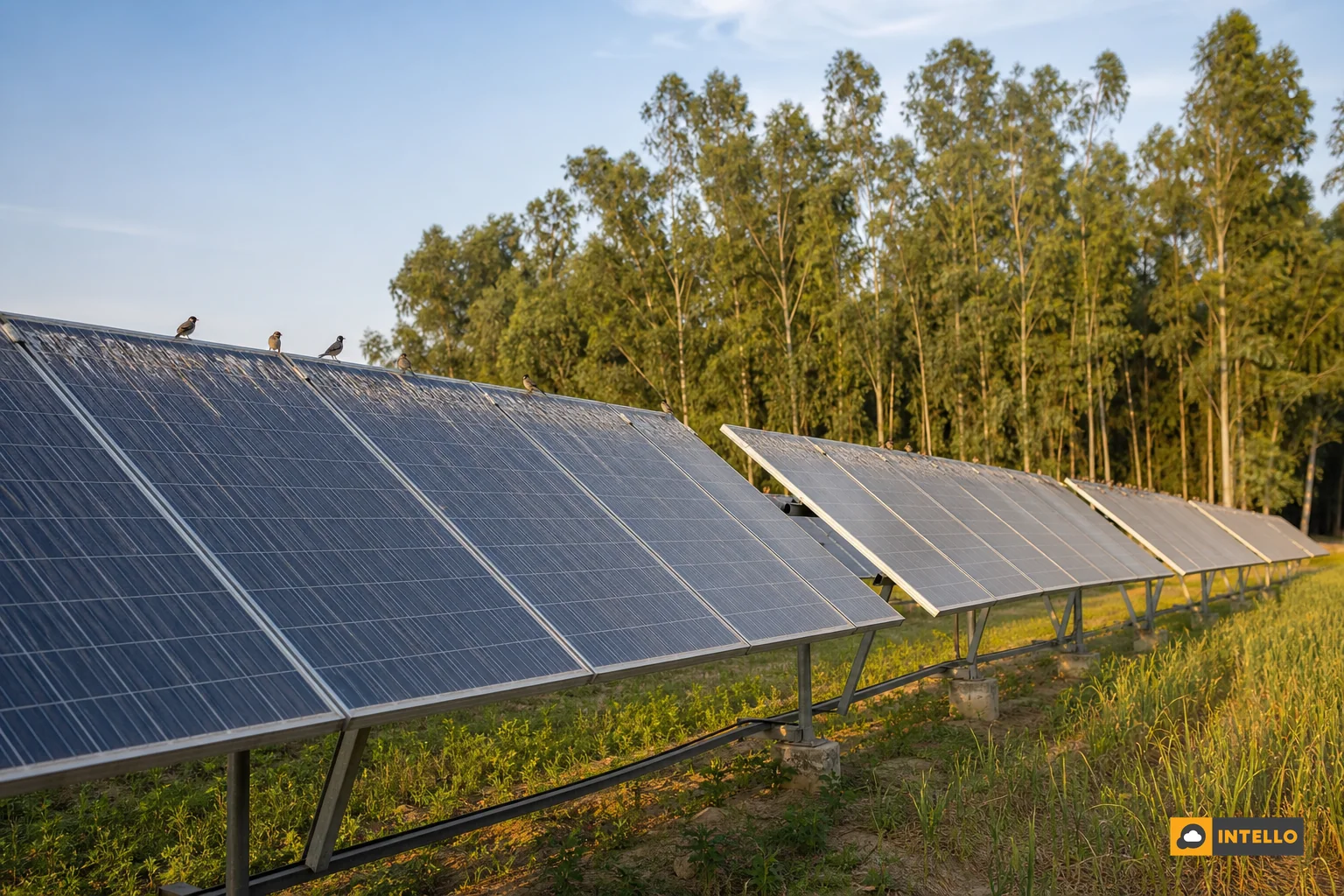
Ridge lines at the top of tilted modules are a common perch. Cable entry points and junction boxes, which sit slightly proud of the module surface, attract birds looking for a ledge. The lower edge of each module row, where droppings from perched birds above tend to run down and dry, is another high-risk zone identified in field surveys by PV-Protector.
In India, this risk multiplies near open fields, water bodies, and mature tree cover. Ground-mounted plants bordering agricultural land or forest edges deal with crows, mynas, and migratory flocks. Rooftop installations near urban tree lines or terrace water tanks see pigeons nesting in structural gaps under the mounting frame. Coastal sites add wading birds and gulls into the mix.
If your plant sits in one of these zones, treat it as a higher-risk site in your regional cleaning schedule rather than applying a blanket frequency across your whole portfolio.
How Do You Know Bird Droppings Are Cutting Your Solar Output?
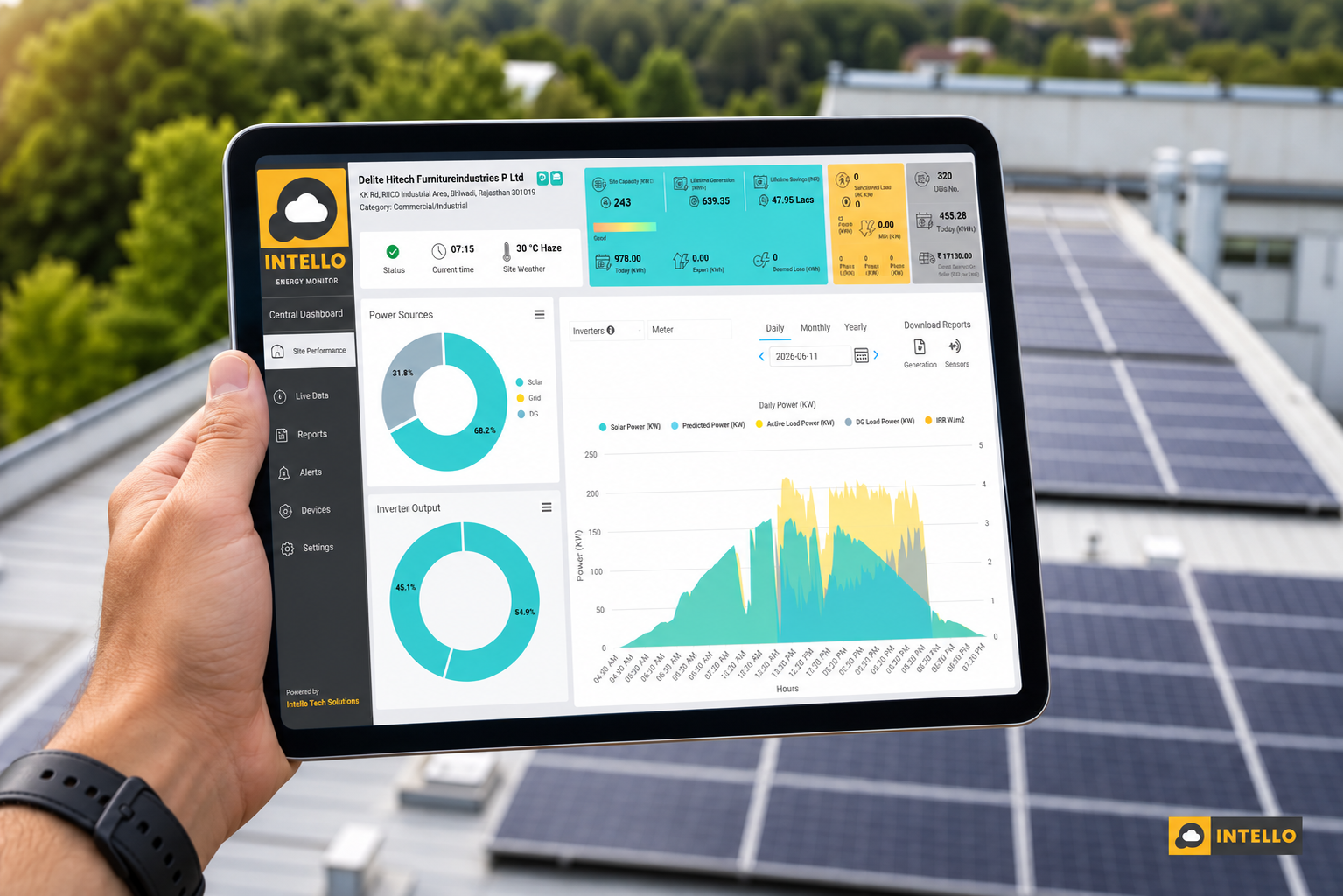
You know bird droppings are cutting output when one or two strings underperform against the rest of the array while total irradiance and weather conditions look normal. This shows up as a localized dip on a string-level monitoring dashboard, not a uniform drop across every inverter.
Whole-plant soiling from dust tends to lower performance ratio gradually and evenly. A dropping-related hotspot instead shows up as one string or one inverter channel falling out of step with its neighbors, sometimes overnight. A good solar dashboard flags this kind of anomaly automatically, well before a site visit would catch it visually.
This is where remote monitoring earns its cost. Waiting for a monthly generation report to notice a shortfall means weeks of a cell sitting in reverse bias, generating heat instead of power. Real-time, string-level alerts close that gap and give a technician a reason to inspect a specific row rather than the whole array.
1. Set an Inspection Frequency Based on Site Risk
Match your inspection schedule to what surrounds the site, not to a fixed calendar date. A rooftop with mature trees or a water tank nearby needs a weekly visual sweep, focused on ridge lines and module edges. A clean, open rooftop away from perches can go monthly.
- High-risk sites (near trees, open fields, water bodies): weekly visual inspection plus a check of string-level dashboard alerts.
- Moderate-risk urban rooftops: fortnightly visual checks, tied to your regular cleaning cadence.
- Low-risk enclosed rooftops: monthly visual checks are usually sufficient.
These frequencies should sit alongside, not replace, your baseline cleaning schedule. Cities across India already see different solar panel cleaning frequency requirements for dust alone; bird droppings just add a targeted, higher-frequency layer for specific zones of the array.
2. Choose the Right Cleaning Approach
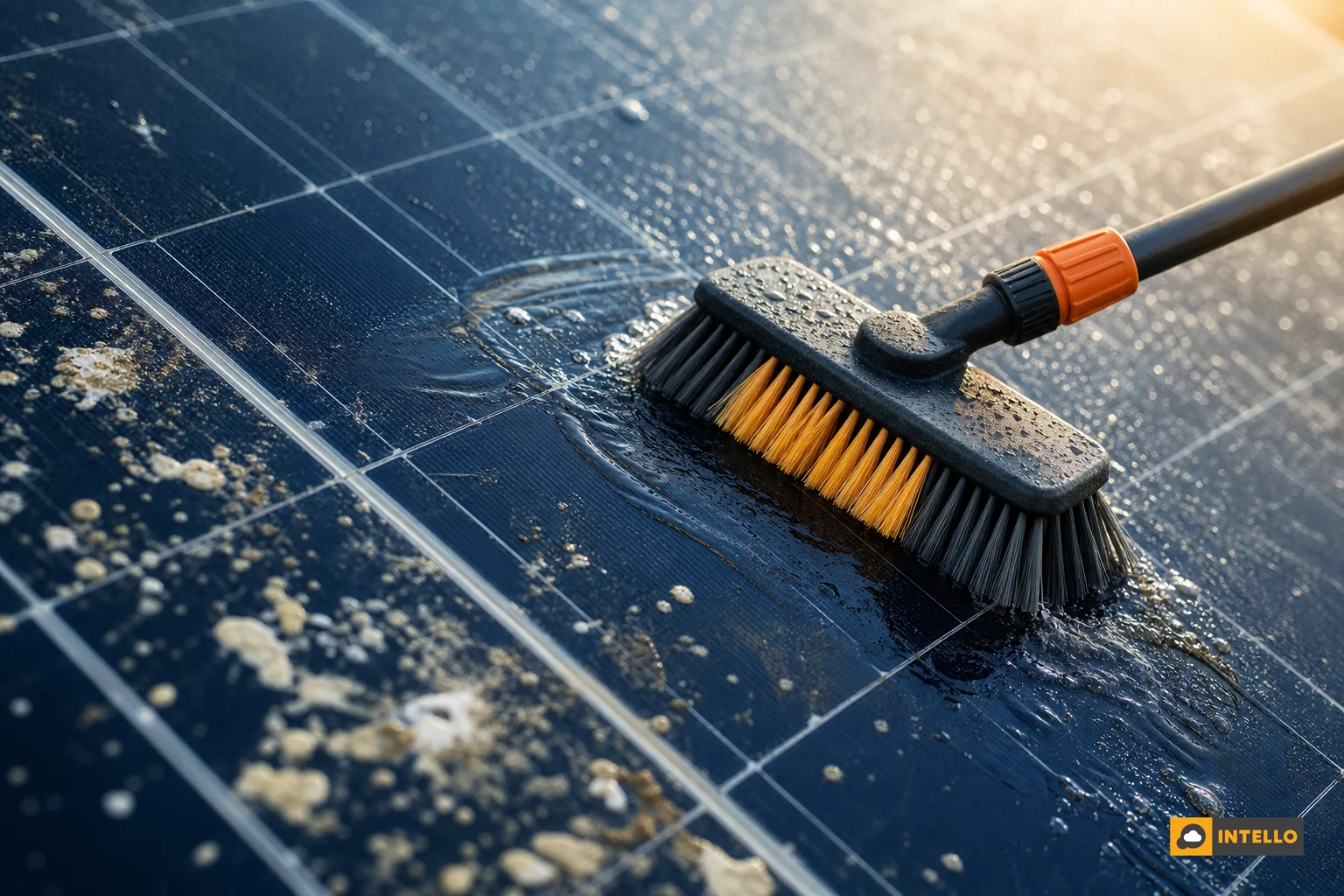
Wet cleaning with a soft brush works better on bird droppings than dry wiping does, because dry cloths smear the residue and can scratch the anti-reflective coating instead of lifting it off. Water softens the bonded material first, which is what actually makes it removable.
Avoid scraping with hard tools. A dropping that has hardened for a week or more can tempt a technician to scrape it off with a blade or fingernail, but that risks etching the glass permanently and voiding manufacturer warranty terms on the module surface.
Instead, soak the spot with water for a few minutes, then work it loose with a soft-bristle brush before rinsing. For sites with recurring hotspots in the same zone, spot cleaning between full wash cycles keeps a single dropping from sitting on a cell for weeks. Full array cleaning still follows your usual dust-driven schedule; spot cleaning is the targeted add-on for droppings specifically.
3. Prevent Repeat Perching and Nesting
The cheapest long-term fix is reducing how much birds want to perch on the array in the first place. Bird spikes along ridge lines and mounting frame edges discourage landing without damaging the module. Reflective deterrents and predator silhouette decoys work on some sites, though effectiveness varies by bird species and location.
Cable trays and junction boxes are common nesting spots because they offer shelter. Covering exposed cable runs and sealing gaps under ground-mounted frames removes a nesting incentive that many EPC teams overlook during initial installation. If your plant sits near a forest edge or agricultural field, expect this to be an ongoing management task, not a one-time fix.
4. Catch Hotspot Damage Before It Becomes Permanent
Thermal imaging during a routine site visit is the most reliable way to confirm whether a dropping has already caused a hotspot, since a damaged cell reads visibly hotter than its neighbors on an infrared scan even after the dropping itself is cleaned off.
Pairing thermal checks with preventive maintenance visits means a technician who is already on-site for string balancing or inverter servicing can scan suspect zones at the same time. This is far cheaper than a dedicated hotspot investigation triggered after generation losses show up on a monthly report.
If a hotspot is confirmed, string balancing after cleaning helps redistribute load evenly and can catch whether the affected cell has recovered or needs a warranty claim. Left unchecked, a confirmed hotspot rarely resolves on its own.
What Happens If Bird Dropping Hotspots Go Unaddressed?
Left unaddressed, a bird-dropping hotspot can cause permanent cell damage, stress the bypass diode meant to protect the string, and shorten the effective lifespan of the panel well below its rated warranty period. The financial impact compounds the longer the cell runs hot.
A bypass diode is designed to reroute current around a shaded or damaged cell, protecting the rest of the string. But repeated hotspot cycles put thermal stress on that diode too, and a failed diode turns a single-cell problem into a full-string failure. At that point, you’re looking at a repair or module replacement instead of a simple clean.
The ROI math is straightforward. A cleaning visit costs far less than a string repair, and a string repair costs far less than a warranty dispute over a permanently damaged module. Filing a claim after the fact also means navigating the warranty claim process, which manufacturers scrutinize closely when physical damage like etched glass is involved.
Building Bird Dropping Checks Into Your O&M Program
A cleaning contract that only covers dust removal on a fixed schedule misses the risk profile bird droppings create at high-risk sites. Bird dropping checks belong in the scope of your O&M or AMC contract as a named line item, not an assumption.
Intello builds this into its preventive maintenance visits by having field technicians photograph and geo-tag suspect zones through its mobile app, so every spot-clean and thermal check gets logged with a timestamp and photo evidence, not just a verbal report. Combined with string-level alerts from Intello’s remote monitoring dashboard, a dropping-related dip gets flagged and dispatched to a technician before it turns into a multi-week hotspot.
For EPC companies handing off completed rooftop or ground-mounted projects, specifying dropping inspection zones during commissioning saves the receiving O&M team from guessing where the risk sits later. This is especially relevant for sites bordering trees, fields, or water, where the risk is predictable from day one.
Frequently Asked Questions
Does solar panel maintenance cover bird droppings?
Most standard cleaning contracts cover general soiling but not targeted, high-frequency spot cleaning for bird droppings. Check your AMC scope specifically, since dropping-related hotspots need faster response than a monthly wash cycle provides.
Can bird droppings void solar panel warranty?
Bird droppings themselves usually don’t void a warranty, but physical damage from improper removal, like scraping that scratches the glass, can. Manufacturers may also dispute claims where etched coatings suggest droppings sat unaddressed for an extended period.
How often should panels be checked in areas with trees?
Sites within range of trees, open fields, or water bodies should get a weekly visual inspection of ridge lines and module edges, in addition to whatever standard cleaning cycle your city’s soiling levels require.
Bird droppings look like a minor nuisance until a hotspot forms and a string’s output quietly drops for weeks before anyone notices. If your current maintenance plan doesn’t have a specific answer for where droppings concentrate on your site and how fast they get cleaned, that’s a gap worth closing before the next season of tree flowering or nesting activity. Request a quote from Intello’s O&M team to add targeted dropping inspection and spot cleaning into your preventive maintenance schedule, or log into your monitoring portal to check whether any of your strings are already showing the kind of localized dip this article describes. To see how Intello’s integrated monitoring and maintenance platform works end to end, you can also learn more about our approach.
