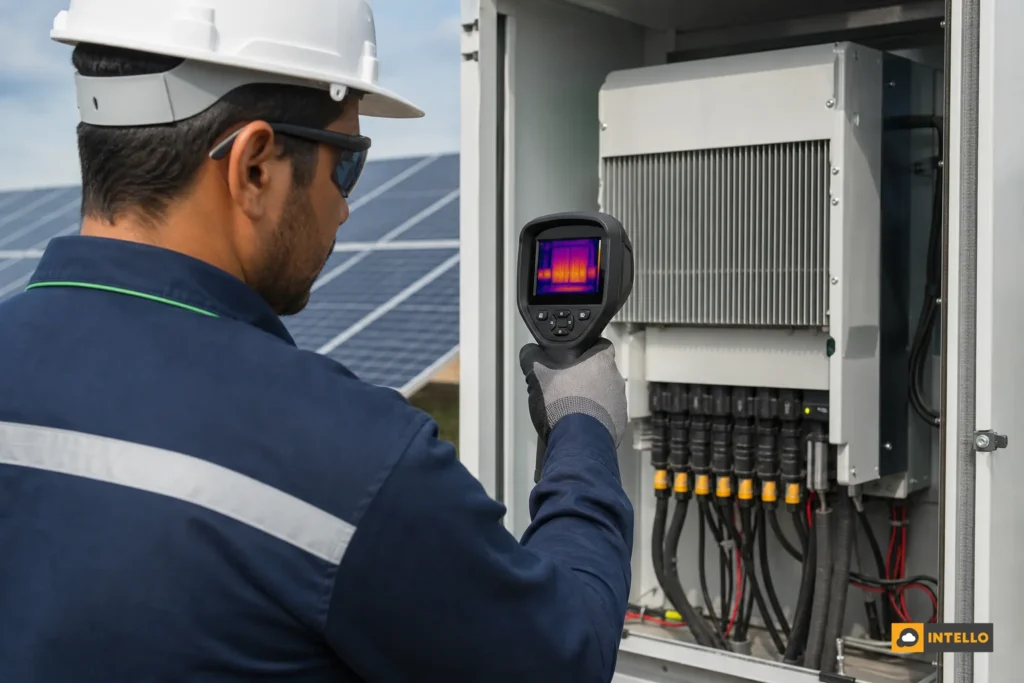
Managing solar assets across multiple locations comes down to one decision: put every site on a single dashboard, or keep logging into five separate OEM portals and hope nothing slips through. Owners who centralize typically cut fault detection from days to hours. Fragmented portfolios bleed revenue quietly through undetected downtime rather than failing loudly.
Key Takeaways
- Fragmentation has a measurable cost: portfolios split across multiple OEM monitoring portals lose an average of 2% to 5% of annual yield to underperformance nobody catches in time, according to Ellume’s analysis of multi-OEM solar portfolios.
- Response time is the real lever: a fault that sits unnoticed for a week costs far more in lost generation than the same fault caught and dispatched within hours. Push a vendor for a written response-time SLA, not a verbal promise.
- One dashboard beats five logins: vendor-neutral monitoring pulls data from every inverter brand and EPC contractor into a single view, regardless of who installed each site.
- Preventive maintenance needs scheduling, not memory: spreadsheet-based tracking across sites is where cleaning cycles and inverter servicing quietly get skipped.
- Photo-verified site visits close the trust gap: a mobile app with timestamps and signatures gives asset owners proof that maintenance actually happened, not just an invoice saying it did.
At a Glance: Before vs After Centralization
| Metric | Fragmented (Multiple OEM Portals) | Centralized Platform |
|---|---|---|
| Fault detection | Days, often found during manual review | Real-time to a few hours |
| Dashboards to check daily | One per OEM or EPC | One, across all sites |
| Maintenance record | Spreadsheets, email confirmations | Photo, timestamp, and signature per visit |
| Cleaning schedule consistency | Varies by site and contractor | Standardized preventive schedule |
| Reporting for ownership/board | Manually compiled, delayed | Consolidated, on-demand |
| Estimated yield at risk from fragmentation | 2% to 5% annually | Recoverable with faster response |
Why Multi-Site Solar Portfolios Lose Visibility
A commercial owner with rooftop plants in three or four cities rarely built that portfolio with one monitoring plan in mind. Sites get added over years, each installed by a different EPC. Each ships with its own inverter brand and its own login. The result looks like five separate businesses instead of one asset base.
Global research backs up why this matters financially. Complex, multi-OEM portfolios fragment operational data in ways that threaten asset returns. The industry itself has admitted it lacks standardised processes across data collection, spanning a broad range of inconsistencies in how monitoring data gets reported across vendors. In India, this shows up as an operations manager toggling between five apps every morning, none of which talk to each other.
The fix isn’t more staff checking more screens. It’s one screen that already did the checking. That’s the core argument for centralized solar monitoring across multiple sites in India: consolidate the inputs so a human only has to react to exceptions, not hunt for them.
A Real Multi-Site Starting Point: Swami Solar
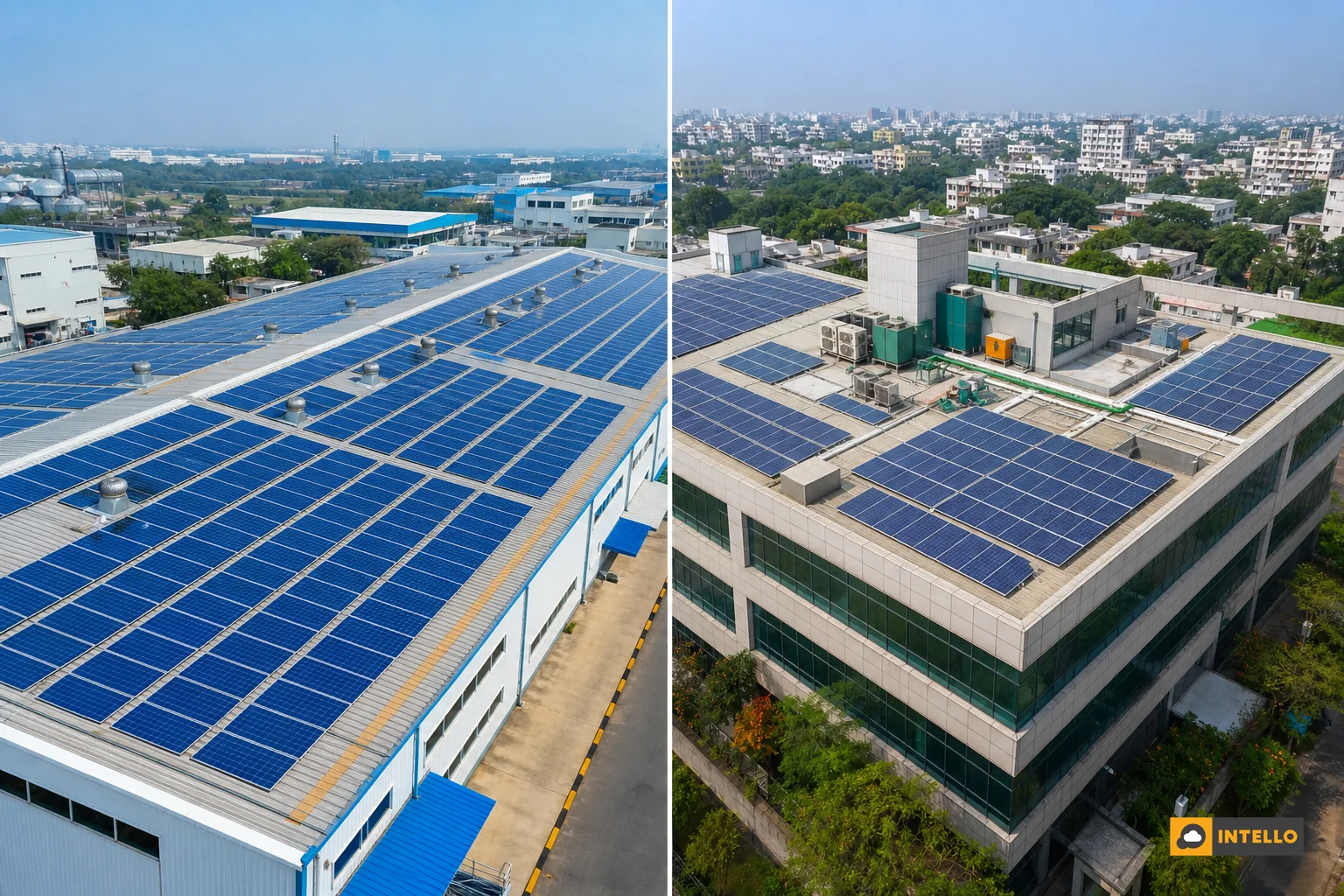
Swami Solar’s rooftop installations span 9 buildings across a 1.8 km campus. Each building operated independently before centralization. That made it difficult for the operations team to get a complete picture of overall plant performance, exactly the pattern that traps most multi-site commercial owners: a portfolio grows building by building, and visibility does not grow with it. The full Swami Solar unified monitoring case study walks through how a single dashboard replaced the per-building setup.
This is the pattern behind most requests Intello gets from EPCs and asset owners handling in-house versus outsourced solar O&M decisions in India. The portfolio grows faster than the visibility does.
What Changed: Consolidating Onto One Platform
The fix in a case like this starts with hardware that doesn’t care which inverter brand it’s talking to. Custom-designed RTUs pull data from every site, regardless of OEM, and push it into one dashboard. The owner stops needing a login per building. They start needing one.
On top of that sits a mobile app for the maintenance side. Every cleaning visit, every inverter service, every hardware tightening gets logged with a location, a timestamp, a technician signature, and a photo. That record replaces the informal “yes, we cleaned it” phone call with something an owner can actually audit.

Preventive maintenance also stops being a per-site guess. String balancing, hardware checks, and inverter servicing get scheduled centrally across every building on the same cadence, the same way a fleet manager schedules vehicle servicing instead of waiting for a breakdown. That distinction between reactive and scheduled work is covered in more depth in Preventive vs Breakdown Solar Maintenance: The Real Cost.
Before and After: Fault Response Time and Uptime
The clearest way to show impact is a side-by-side of the two operating models. The table above summarizes it. The detail is in how much faster a fault gets acted on once it’s visible in one place instead of buried in a portal nobody checks daily.
| Stage | Fragmented monitoring | Centralized monitoring |
|---|---|---|
| Fault occurs | Logged only in that site’s OEM portal | Logged instantly on the shared dashboard |
| Fault noticed | Next manual portal check, often days later | Alert pushed within minutes to hours |
| Technician dispatched | Depends on whoever manages that site’s contract | Nearest available technician assigned automatically |
| Resolution confirmed | Verbal or email update, rarely documented | Photo, signature, and timestamp on close-out |
A string fault that used to sit unnoticed for days now gets flagged the same day once every site reports into one dashboard. That single change is what protects the 2% to 5% of annual yield that fragmented, multi-portal monitoring puts at risk across a portfolio.
When you compare vendor promises, ask each one to put their fault-alert and dispatch window in writing, in hours, and hold them to the “minutes to hours” standard the table above describes rather than accepting “we’ll get to it.”
How Does Centralized Monitoring Work Across Multiple Solar Sites?
Centralized monitoring works by placing a vendor-neutral RTU at each site that pulls data from any inverter brand. That data streams into one dashboard covering every location. Alerts get routed automatically to the nearest available technician instead of waiting for someone to check a portal manually.
The dashboard itself needs to show more than a generation number. Which KPIs actually matter across a multi-site view, from performance ratio to string-level current, are covered in Which KPIs Matter Most on a Multi-Site Solar Dashboard? A dashboard that only shows total kWh generated hides exactly the string fault that costs the most money.
Location matters too. India’s climate varies sharply by region, from coastal humidity to Rajasthan’s dust load. A centralized platform needs cleaning and maintenance schedules that reflect that instead of applying one national default. That regional detail is covered separately in Solar Cleaning India: Regional Guide by Climate Zone.
What Switching From Fragmented Portals to One Platform Actually Involves
Owners considering the move usually want to know two things before anything else: how long does it take, and what does it disrupt. In practice, the switch happens in stages rather than as a single cutover, so no site goes dark while the transition happens.
- Audit every existing portal. List each site, its inverter brand, its OEM login, and who currently has access. This is the same inventory used in the checklist below, so it does double duty.
- Install or connect vendor-neutral hardware. A custom-designed RTU at each site pulls data regardless of inverter brand, so no site needs new inverters just to be monitored.
- Run the centralized dashboard alongside existing portals. Both systems report in parallel for a short verification period, so nothing gets missed if a reading looks off during the switch.
- Retire the OEM portals one by one. Once the centralized dashboard is confirmed to match each site’s readings, the old per-site logins can be dropped.
- Migrate maintenance records into the mobile app. Past AMC history and any spreadsheet-based logs get folded into the photo/signature workflow going forward.
The exact timeline and cost depend on how many sites, how many different inverter brands, and how much of the AMC scope is being renegotiated at the same time. Rather than estimate a figure that won’t hold across portfolios, ask any prospective provider to quote both against your own site list, using the checklist below as the basis for that quote.
A Copyable Checklist for Evaluating a Multi-Site Monitoring and AMC Provider
Use this checklist as a working template before signing or renewing an AMC across multiple sites. Copy it into your own procurement document and mark each item Yes/No/Needs Clarification per vendor.
| Checklist item | What to write down |
|---|---|
| Multi-OEM data ingestion | List every inverter brand across your sites; confirm the platform ingests all of them |
| Fault response SLA | Get the committed response window in writing, in hours, not “quick support” |
| Photo/signature visit logs | Confirm every cleaning or repair visit produces a timestamped, signed record |
| AMC scope line-items | List what’s included (cleaning, string balancing, inverter servicing) vs billed separately |
| Regional cleaning cadence | Confirm cadence is set per climate zone, not one national default |
| Consolidated reporting | Ask for a sample portfolio-wide report before signing, across all sites, not one |
| Migration plan | Ask for the staged plan above in writing: audit, install, parallel-run, retire, migrate |
What Should You Look for When Managing Solar Assets Across Multiple Locations?
Look for vendor-neutral compatibility first: a platform that can ingest data from any inverter brand and any EPC’s installation, not just the ones from a single manufacturer. Beyond that, check for standardized KPI reporting, photo-verified maintenance logs, and clear AMC terms with defined response-time commitments in writing.
- Multi-OEM data ingestion: confirm the platform pulls from every inverter brand across your sites, not just a subset.
- Defined fault response SLA: get response-time commitments in writing. Ask what window they commit to, in hours, and compare it against the minutes-to-hours benchmark a centralized dashboard should hit.
- Photo and signature-based visit logs: insist on documented proof for every cleaning or repair, not a verbal confirmation.
- Clear AMC scope: know exactly what’s covered versus billed separately before signing. The line-by-line breakdown in Solar AMC vs O&M Contract in India: Key Differences is a useful checklist here.
- Regional cleaning cadence: a plant in Chennai’s humidity and a plant in Jodhpur’s dust need different schedules, not the same default.
Common Questions From Multi-Site Asset Owners
What does solar panel maintenance actually cost across a multi-site portfolio?
Costs vary by number of sites, panel count, and how much preventive work is bundled into the contract. A single national figure doesn’t hold across regions. Ask any provider for a written scope and per-site pricing rather than a flat estimate that ignores site-specific access and climate factors. If a provider won’t put a number against each line item in the checklist above, treat that as a warning sign, not a formality.
How does a solar app help when I’m managing sites I can’t visit often?
A solar app replaces physical checks with remote visibility: real-time generation, fault alerts, and photo-verified maintenance records for every site, viewable from one login. For an owner managing sites two states apart, that’s the difference between finding out about a problem in an audit and finding out about it the same afternoon.
What should solar service actually include for a multi-location commercial owner?
It should include scheduled preventive visits, inverter servicing, string balancing, cleaning, and warranty claim support, all logged centrally rather than tracked per site. If a provider can’t produce a consolidated report across your whole portfolio on request, the service isn’t actually centralized.
What’s a reasonable fault response time to expect from a monitoring vendor?
Based on how the centralized model performs in the tables above, a well-run platform pushes fault alerts within minutes to a few hours of an event, not the multi-day gap typical of manual portal checks. When comparing vendors, ask each one to state their committed response window in hours and put it in the contract. Then measure their actual performance against that number.
Getting Started With a Centralized O&M Partner
A portfolio scattered across cities doesn’t need more staff checking more portals. It needs one dashboard, one maintenance record, and one point of accountability for every site. Intello’s centralized monitoring and AMC services are built around exactly this problem for commercial owners and EPCs managing solar assets across multiple locations in India.
If your team is still logging into separate OEM portals every morning, request a quote and see what a single, vendor-neutral dashboard would look like across your sites. Ask specifically for the checklist above, filled in with their SLA hours, migration timeline, and AMC scope.
Existing customers can check current site status anytime through the portal login, and if you want the fuller picture of how Intello’s team and platform work together, learn more about Intello before your next site review.