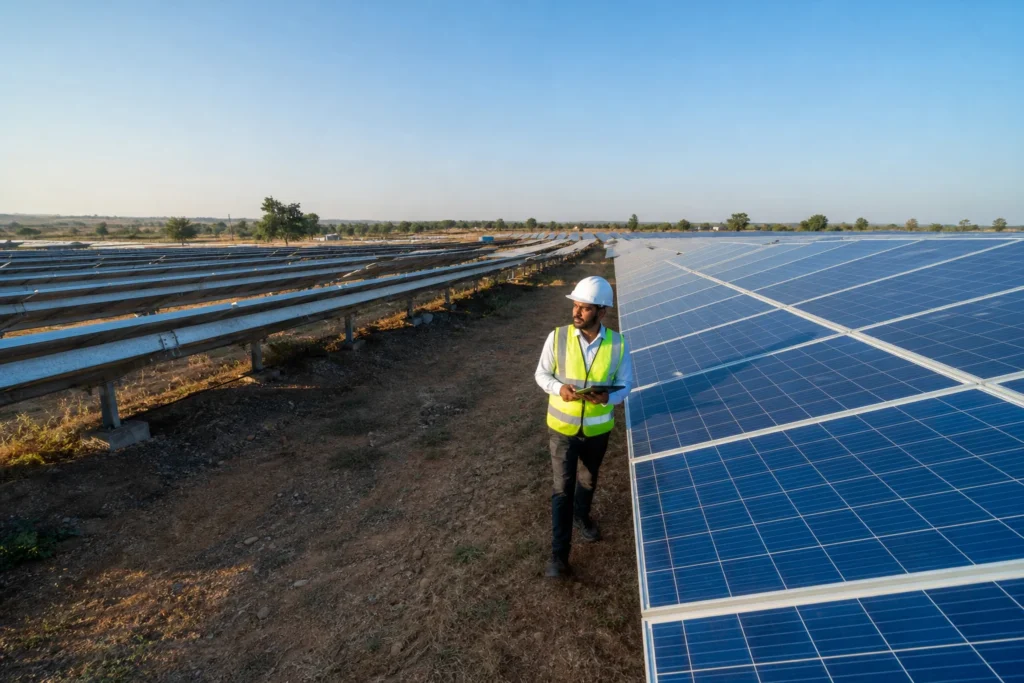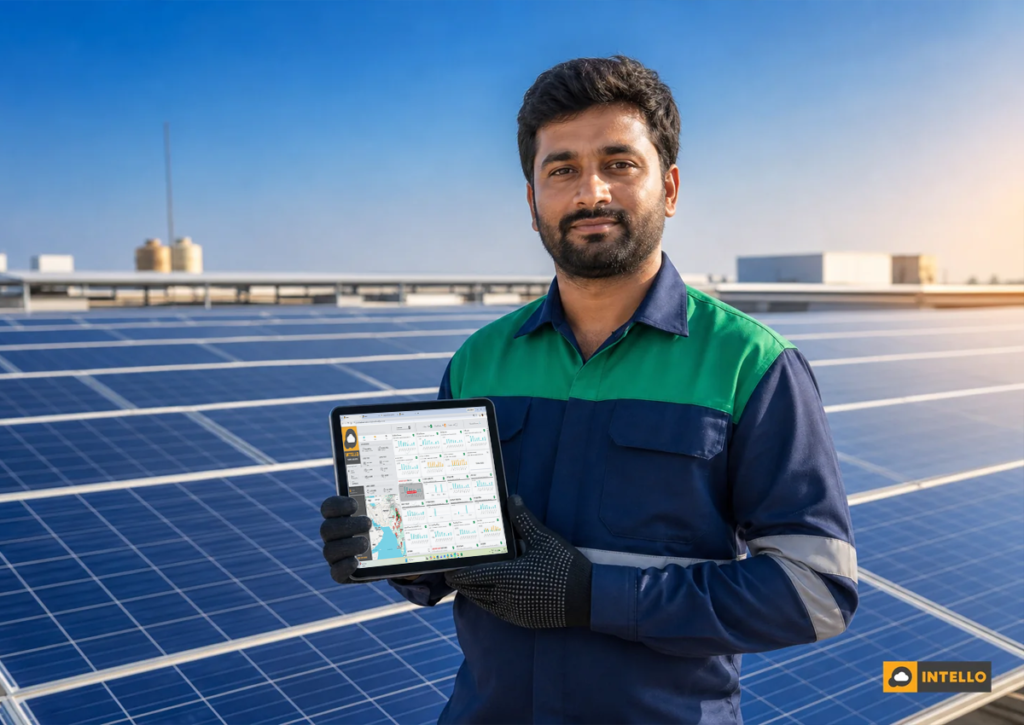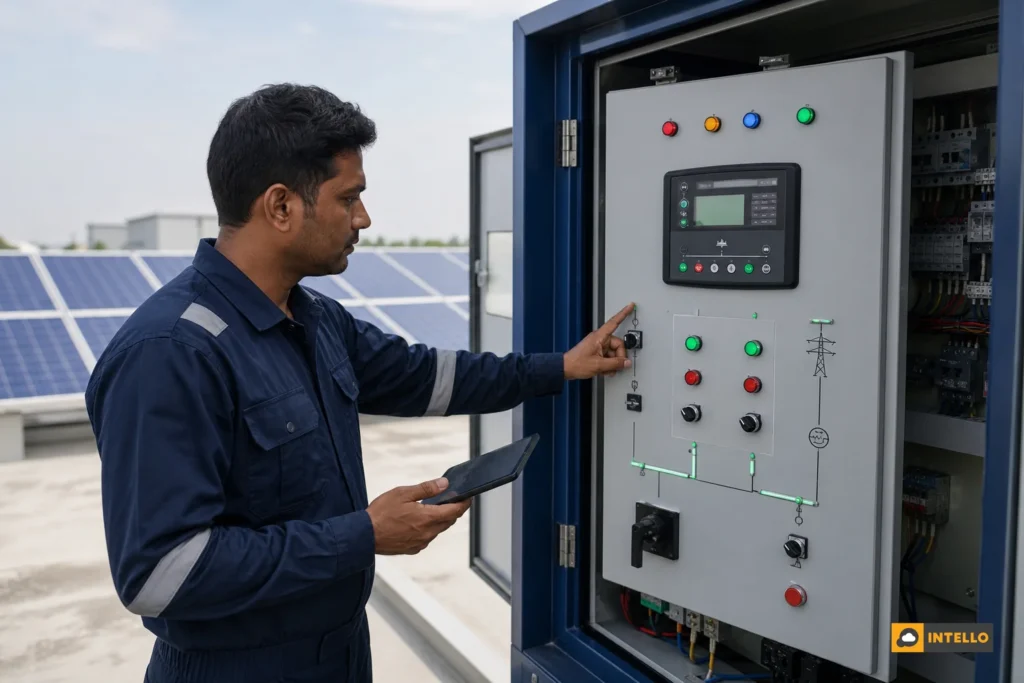
A client calls the EPC three months after handover, furious that “solar isn’t working” every time the power cuts and the diesel generator kicks in.
The real cause is almost never the panels. It’s a dg synchronization with solar fault, where the DG and the solar inverter fail to match voltage, frequency and phase before sharing the load. The inverter trips offline exactly when the client needs it most.
Key Takeaways
- The trigger is usually anti-islanding protection: grid-tied solar inverters are built to disconnect the instant they sense an unstable or generator-fed bus. That condition looks identical to a “solar failure” to the client.
- Escalations spike in the first 90 days post-handover: that’s when EPC site teams have moved to the next project and nobody is watching the sync controller settings.
- Controller drift, not design flaws, causes most repeat faults: firmware updates, load changes and DG replacement after handover shift the parameters the sync controller was tuned for.
- A monitoring dashboard turns a phone-call escalation into a ticket: real-time alerts on sync trips let an O&M team intervene before the client even notices.
- AMC contracts should explicitly name DG-PV synchronization as a covered fault type, with a defined response time. Otherwise, it falls into a grey zone between the EPC, the DG vendor and the inverter OEM.
At a Glance: DG-Solar Sync Complaints and Fixes
| Issue | Common Cause | Who Usually Gets Blamed | Actual Fix |
|---|---|---|---|
| Solar drops out when DG starts | Anti-islanding protection trips inverter | EPC / panel quality | Verify sync controller logic and re-tune trip thresholds |
| Repeated breaker trips on DG bus | Backfeed or reverse power flow | DG vendor | Check load-sharing setpoints on the synchronization panel |
| Sync works, then fails weeks later | Firmware update or controller drift | Whoever installed the system | Scheduled controller audit under AMC |
| No one notices the fault for days | No remote monitoring post-handover | EPC (by default) | Centralized dashboard with sync-fault alerts |
| Client escalates directly to EPC leadership | No dedicated O&M contact after handover | EPC support process | AMC with named response SLA |
| DG fuel savings lower than promised | Poor load coordination between PV and DG | System design | Real-time load coordination and controller re-commissioning |
Why DG Synchronization with Solar Keeps Coming Back to Haunt EPCs
Most EPCs treat commissioning as the finish line. For a hybrid site running dg synchronization with solar, commissioning is closer to day one of a system that needs continuous tuning.
The synchronization controller has to keep matching voltage, frequency and phase between two very different power sources. That balance shifts as loads, firmware, and even ambient temperature change.
The root technical issue is well documented: grid-connected solar PV plants are built with anti-islanding protection. That protection makes the inverter disconnect the moment it senses conditions typical of an unstable or generator-fed bus, which is exactly what happens when a DG starts up on-site (IJESE, 2026).
Without a properly tuned synchronization controller managing that handoff, the inverter does what it’s designed to do: it drops out.
To the client standing at the panel that day, none of that context exists. What they see is simple: the power cut happened, the generator started, and the solar app shows zero output.
The natural conclusion is that the EPC sold them a system that doesn’t work with a backup generator. The physics of anti-islanding protection, however, has nothing to do with panel quality or installation workmanship.
What Actually Breaks After Commissioning?
Sync failures after handover usually trace back to drift, not a design defect. A controller tuned correctly at commissioning gets pushed out of tolerance by three things: firmware updates on the inverter or the sync controller, a change in connected load, or a generator swap that changes the DG’s response curve.
Industrial hybrid systems that pair solar PV with diesel generators have moved from a niche setup to standard infrastructure across factories, campuses, and commercial buildings.
That growth is exactly why controller mismatches are showing up more often as fleets scale (Datoms, 2025). More hybrid installs, spread across more sites, means more controllers quietly drifting out of their original settings with nobody checking.
Three failure patterns repeat across most EPC portfolios we see:
- Frequency/phase mismatch on startup: the DG takes a few seconds to stabilize. If the controller’s tolerance window is too tight, it reads that as an unsafe condition and blocks the sync.
- Backfeed tripping the DG breaker: when solar output briefly exceeds the connected load right as the generator ramps in, reverse power flow trips protection on the DG side.
- Load-sharing setpoints left at default: many controllers ship with generic thresholds that were never adjusted for the site’s actual load profile. They work in testing and fail under real conditions.
Read the mechanics of this failure chain in more depth in how DG synchronization with solar works and why it fails.
How Does This Become a Client Escalation, Not Just a Technical Fault?
A sync fault becomes an escalation when nobody catches it before the client does. Without remote monitoring, the first person to notice the drop is the facility manager staring at a dark app screen.
Their first call goes straight to the EPC, not a maintenance desk.
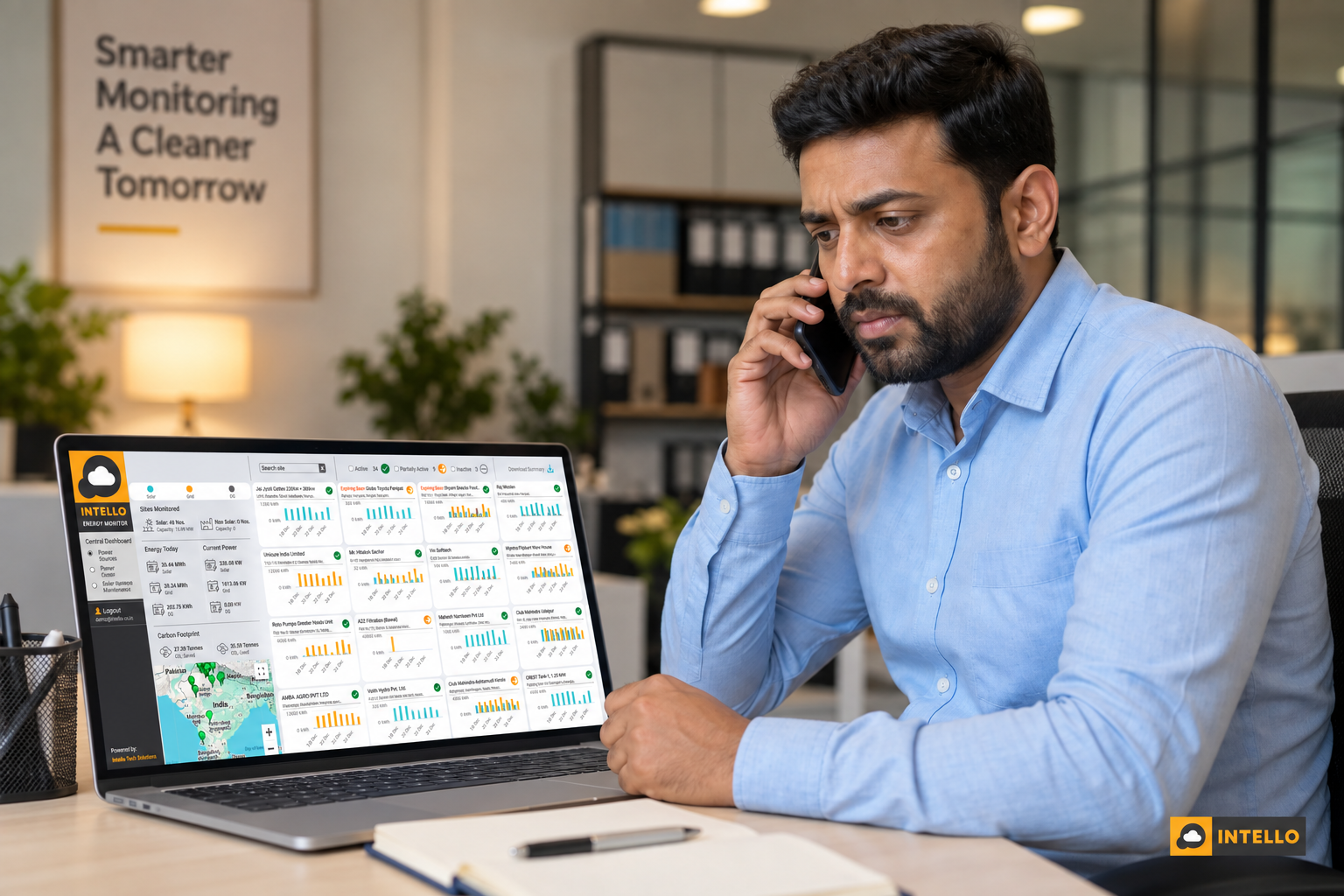
By the time that call happens, the EPC’s commissioning team has usually moved on to the next project. There’s no dedicated contact who owns the fault, no ticket number, and no clear service-level timeline.
The client escalates to whoever they can reach. That’s frequently someone in EPC leadership who has no visibility into the site’s current sync controller status.
This gap is well understood in the industry. Hybrid power systems combining solar, grid, and DG have become the default at many commercial and industrial sites.
That multi-source approach adds real operational complexity, and reliability now depends on more than just correct installation (Synchro Electricals, 2026). The complexity doesn’t go away after handover. It just changes hands, usually to whoever the client happens to reach on the phone.
Rising fuel costs and continuous-uptime pressure have pushed more industrial sites toward PV-DG hybrid setups as one of the more effective ways to control energy spend (Force-V, 2025).
That means more sites are exposed to this exact failure mode, and more EPCs are fielding these calls than they were a few years ago.
What Does a DG-PV Synchronization Controller Actually Cost in India?
Controller pricing depends on site capacity, whether it’s a retrofit onto an existing DG panel or a fresh install, and the controller brand chosen.
Rather than quote a single number that varies wildly by project, budget planning should separate the controller hardware cost from the ongoing tuning and monitoring cost that keeps it working after handover.
That second cost, the ongoing tuning, is usually where EPCs under-budget. A controller that’s correctly commissioned but never rechecked is a liability waiting to surface as a client complaint.
For a full breakdown of what to look for in a controller, see our DG-PV synchronization controller buyer’s guide for India.
A Practical Troubleshooting Checklist for DG-Solar Sync Faults
When a client reports the solar system “not working” after a power cut, work through this sequence before escalating further:
- Confirm the timeline: did the inverter drop out exactly when the DG started, or was it already offline before the outage? This separates a sync issue from an unrelated inverter fault.
- Check the sync controller status log: most controllers log the last failed sync attempt with a reason code, whether it’s voltage window, frequency window, or phase angle.
- Verify DG output stability: an aging or poorly maintained generator can take longer than expected to stabilize frequency, pushing it outside the controller’s sync window.
- Review recent firmware or setting changes: ask whether the inverter, sync controller, or DG’s AVR/governor had any updates in the weeks before the fault started.
- Check for load changes on site: a new HVAC unit, motor, or production line can shift the load profile the controller was originally tuned for.
- Inspect for backfeed trips on the DG breaker: reverse power protection tripping repeatedly points to a load-sharing setpoint issue, not a wiring fault.
- Re-tune and re-test under load: adjust the controller’s tolerance windows to match current site conditions, then run a live DG-start test with monitoring active.
- Log the fix and update the AMC record: document the resolved reason code so the next technician isn’t troubleshooting blind.
This checklist mirrors the deeper fix-it framework in DG synchronization with solar: why it fails and how to fix it, which walks through each reason code in more detail.
How Does a Dedicated O&M Partner Prevent This From Reaching the Client?
A dedicated O&M partner prevents sync escalations by catching the trip in the monitoring dashboard before the client notices a gap in generation.
The fault gets logged, assigned, and often resolved within the AMC’s response window, not surfaced as a phone call to EPC leadership.
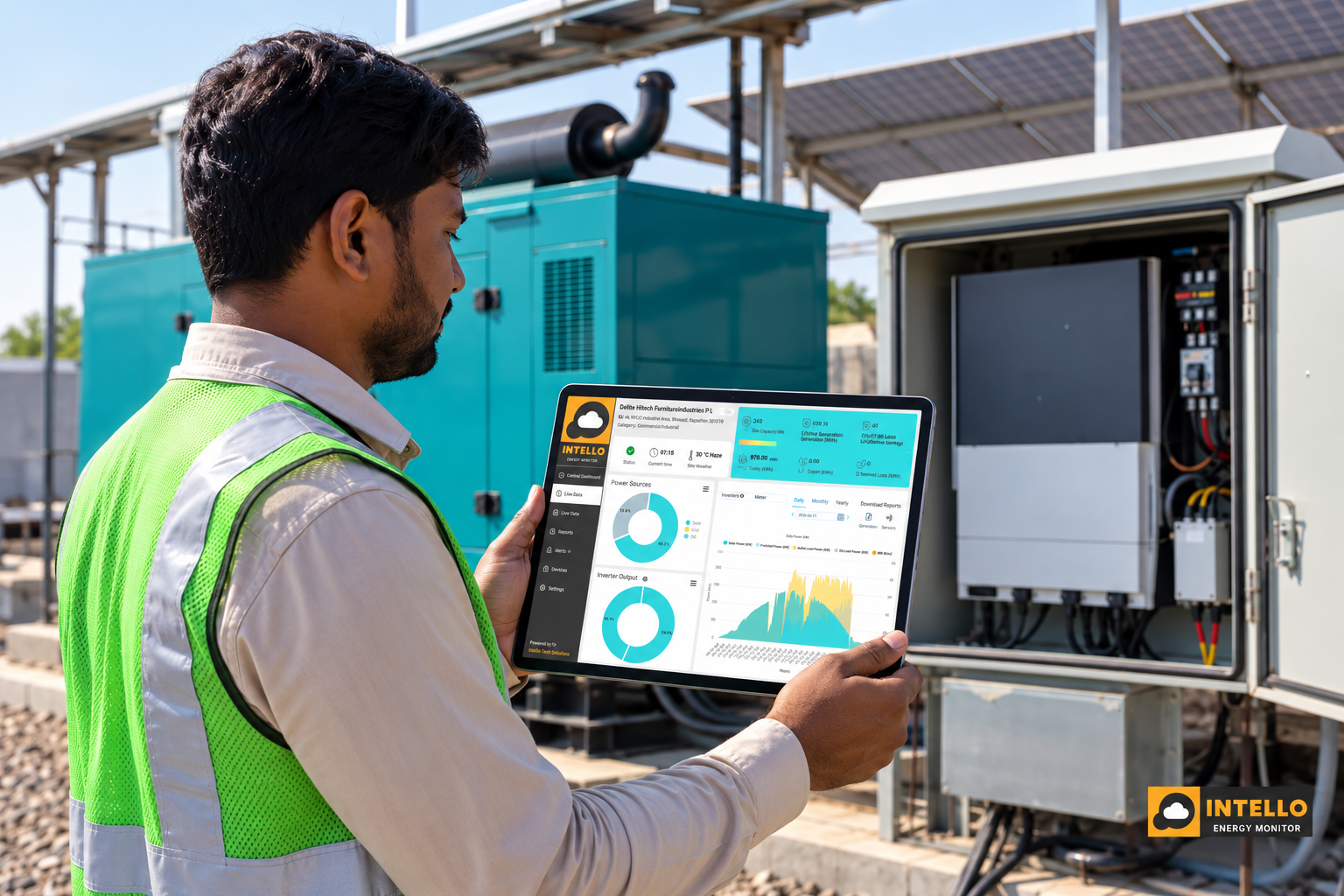
This works because the monitoring layer is watching continuously, not just during scheduled site visits. Intello’s centralized dashboard, built on custom RTUs, flags a sync trip the moment it happens.
It also flags string faults, DC losses, and inverter communication drops. A technician gets dispatched with the reason code already known, instead of arriving on-site to start diagnosis from zero.
Photo-verified visit reports, timestamped and geo-tagged through the Intello mobile app, close the loop that most EPCs lose after handover: proof that the fault was actually fixed, not just marked resolved on paper.
That documentation matters when a DISCOM, an insurer, or the client’s own finance team asks for a maintenance trail.
The gap most EPCs underestimate isn’t technical skill. It’s that nobody owns the sync controller after the commissioning certificate is signed.
See how a live dashboard actually surfaces these faults in what a solar remote monitoring dashboard should show you.
See how IoT sensors catch problems like this before they turn into a client call in how IoT sensors detect solar faults before they cost you.
How Should EPCs Structure the Handover to Avoid This?
Handover should include a named point of contact for sync faults, a documented controller tuning record, and an AMC clause that explicitly covers DG-PV synchronization as a fault category.
That clause should cover more than panel cleaning and general inverter checks. Without it, the sync controller falls into a grey zone between the DG vendor, the inverter OEM, and the EPC.
Comparing AMC scope against a straight O&M contract helps clarify where synchronization coverage should sit. Our breakdown of Solar AMC vs O&M contract in India covers exactly this kind of scope gap.
For EPCs weighing whether to build an in-house team for this or hand it to a specialist, in-house vs outsourced solar O&M in India 2026 lays out the trade-off in cost and response time.
Frequently Asked Questions
What is solar service supposed to cover after a hybrid handover?
Solar service after a hybrid handover should cover inverter health checks, string monitoring, cleaning, and DG-PV synchronization controller audits, not just panel cleaning.
If the AMC scope excludes synchronization, the client has no formal channel to report sync faults.
Does the solar app show DG synchronization faults?
A properly integrated solar app shows sync trips as a distinct alert type, separate from string faults or inverter shutdowns, because the reason code and fix are different.
If the app only shows generation totals, it can’t distinguish a sync fault from normal nighttime zero output.
How does solar tracking mechanism relate to DG synchronization?
Solar tracking, which tilts panels to follow the sun, is unrelated to DG synchronization.
The confusion usually comes from both being automated control systems on the same site. Tracking affects yield, while synchronization affects whether the inverter can safely share load with a generator at all.
DG synchronization failures rarely stay a small technical footnote. Left unmanaged, they become the reason a client stops trusting the EPC that built their system, even when the panels themselves are performing exactly as designed.
The unresolved part, honestly, is that no single sync controller setting fits every DG-PV combination forever. Load profiles change, and even well-tuned systems need periodic revisiting.
If your hybrid sites are generating these calls, request a quote from Intello’s O&M team to get sync monitoring and AMC coverage in place before the next power cut turns into an escalation.
Existing clients can check live fault status anytime through the Intello portal login. To see the full scope of what Intello’s monitoring and maintenance platform covers, visit our about page.