An EPC company outsourcing O&M after project handover typically keeps warranty liaison and design authority in-house, while handing the daily cleaning, monitoring, string balancing and inverter servicing to a dedicated O&M partner bound by a written SLA. Done well, this protects the client relationship long after the crew has moved to the next site. Done badly, it turns a completed project into a dispute waiting to happen.
Key Takeaways
- Hand off documents, not just the plant: as-built drawings, commissioning test reports, warranty certificates and monitoring credentials must move with the site, not stay in a project manager’s inbox.
- Retain warranty liaison authority: the EPC, not the O&M vendor, should stay the point of contact for module and inverter manufacturers during the defect liability period.
- SLAs need numbers, not adjectives: response time in hours, uptime guarantee as a percentage, and cleaning frequency by season all belong in the contract, not the sales deck.
- Ground-mounted and commercial rooftop sites need different handover packs: a 2 MW ground-mounted plant has spares inventories and civil works a rooftop system never will.
- Monitoring continuity is the first thing that breaks: if dashboard logins and baseline KPI data don’t transfer cleanly, the O&M team starts from zero.
At a Glance: Handover-to-O&M Decision Table
| Decision Point | Retain (EPC) | Hand Off (O&M Partner) |
|---|---|---|
| Warranty claims | Manufacturer liaison, defect liability tracking | Field diagnosis, photo evidence, first-level filing |
| Documentation | Original design IP, contract terms | As-built drawings, O&M manual, test reports |
| Monitoring | Client-facing performance reporting cadence | Day-to-day dashboard checks and alerting |
| Cleaning & preventive maintenance | Contract oversight | Scheduled visits, string balancing, inverter servicing |
| Site-specific knowledge | Design rationale, shading study | Baseline performance ratio, spares list |
| SLA enforcement | Penalty clauses, escalation path | Uptime and response-time reporting |
Why EPCs Outsource O&M After Handover
Building a solar plant and running one for fifteen years are different jobs. An EPC company is built to survey, design, procure and install fast; an O&M team is built to notice a slow inverter fan a week before it fails. Asking the same crew to do both stretches people thin, and the client usually notices first.
There’s also a reputation angle. A client rarely separates “the plant that got built” from “the plant that keeps underperforming.” If output drops in year two, the EPC’s name is still the one on the contract, even if a different team is meant to be watching the meters. Structuring a clean handover to a specialist O&M partner is how EPCs protect that reputation instead of leaving it to chance.
This is also where a lot of the questions in Google’s search data come from. Homeowners and facility managers typing “solar maintenance company” into search are usually the downstream result of an EPC that never set this up properly. Getting the handover right at the start avoids that call six months later.
1. Decide What to Hand Off vs What to Retain
A complete solar plan set covers engineering drawings, component specifications, procurement records, installation procedures, testing protocols and O&M documents. That entire package moves to whoever runs O&M day to day, whether that’s an in-house team or an outside vendor.
What should not move is warranty authority. The EPC signed the original contracts with module and inverter manufacturers, and those relationships stay strongest when one party manages them consistently. If your team is unsure where a rejected claim stands, our solar panel warranty claim process guide walks through the documentation an O&M partner needs to build before escalating to the manufacturer.
Design intellectual property, the layout rationale, shading study assumptions, DC/AC ratio decisions, also stays with the EPC. The O&M partner needs the outputs of that thinking, not the internal debate that produced it.
Build the Handover Pack Before You Search for a Partner
A structured handover checklist built for treatment plants makes a point that applies just as directly to solar: the day of handover is the day the real work begins for the next fifteen to twenty years, and the difference between a plant that runs smoothly and one that doesn’t often comes down to whether documents were handed over complete or assembled in the final week under pressure.
The same logic runs through solar-specific guidance. A solar handover pack should include as-built drawings, equipment warranties, commissioning test reports aligned to IEC 62446, monitoring login access, an O&M manual, and permit or inspection sign-offs. Miss any one of these and the O&M team spends its first weeks reverse-engineering a plant instead of maintaining it, a gap that shows up clearly in how incomplete handover packages affect O&M efficiency for years afterward.
- As-built single-line and layout drawings
- Commissioning and testing reports (insulation resistance, earthing, IV curve tests)
- Manufacturer warranty certificates with serial numbers matched to install location
- Spares inventory list and where spares are stored
- Monitoring platform credentials and baseline generation data
- Training sign-off records for site staff, where applicable
2. Choose Between In-House O&M and a Third-Party Provider
Some EPCs, especially larger ones with a captive client base, build an internal O&M arm. Most find it cheaper and faster to bring in a specialist instead, particularly once a portfolio spans multiple states and inverter brands. Our detailed comparison of in-house vs outsourced solar O&M in India breaks down the staffing, tooling and cost trade-offs in full.

| Factor | In-House O&M | Outsourced O&M Partner |
|---|---|---|
| Setup time | Months to hire, train, equip a team | Weeks, using an existing field network |
| Multi-site coverage | Difficult beyond one or two regions | Built for portfolios across states |
| Monitoring tooling | Needs separate procurement and integration | Usually comes bundled with the contract |
| Cost predictability | Fixed payroll regardless of workload | Tied to AMC terms, scales with plant count |
| Client-facing reporting | Depends on internal process discipline | Often standardized with photo-verified visits |
Neither option is universally right. An EPC with five large ground-mounted clients in one state might justify an in-house crew. One selling rooftop systems across ten cities almost never can.
3. Structure the SLA With Your O&M Partner
The contract is where good intentions either become enforceable or evaporate. An SLA worth signing states response time in hours for a fault alert, a minimum uptime percentage, cleaning frequency by season, and a fixed reporting cadence, not vague language like “regular visits” or “prompt response.”
Tie the SLA’s start date to the plant’s defect liability period, not to when the O&M contract happens to be signed. If there’s a gap between handover and when the AMC actually begins, that gap is exactly when an early fault goes unnoticed and unclaimed. Readers deciding between contract types should compare our breakdown of Solar AMC vs O&M contract differences in India before finalizing terms.
The transition from EPC to O&M is a critical handover point: the EPC delivers documentation, training, and a commissioned facility, and the O&M provider must understand what was built, how it works, and what the baseline performance should be.
That understanding doesn’t happen automatically. It has to be written into the SLA as a requirement, with a defined onboarding period where the O&M partner reviews handover documents against the physical site before the clock starts on their performance obligations.
4. Set Up Monitoring and Reporting Continuity
The fastest way to lose visibility on a newly handed-over plant is letting monitoring access lapse between the EPC’s commissioning dashboard and the O&M partner’s platform. Baseline performance ratio, expected generation curves and string-level data need to carry forward, or the new team starts guessing at what “normal” looks like for that specific site.
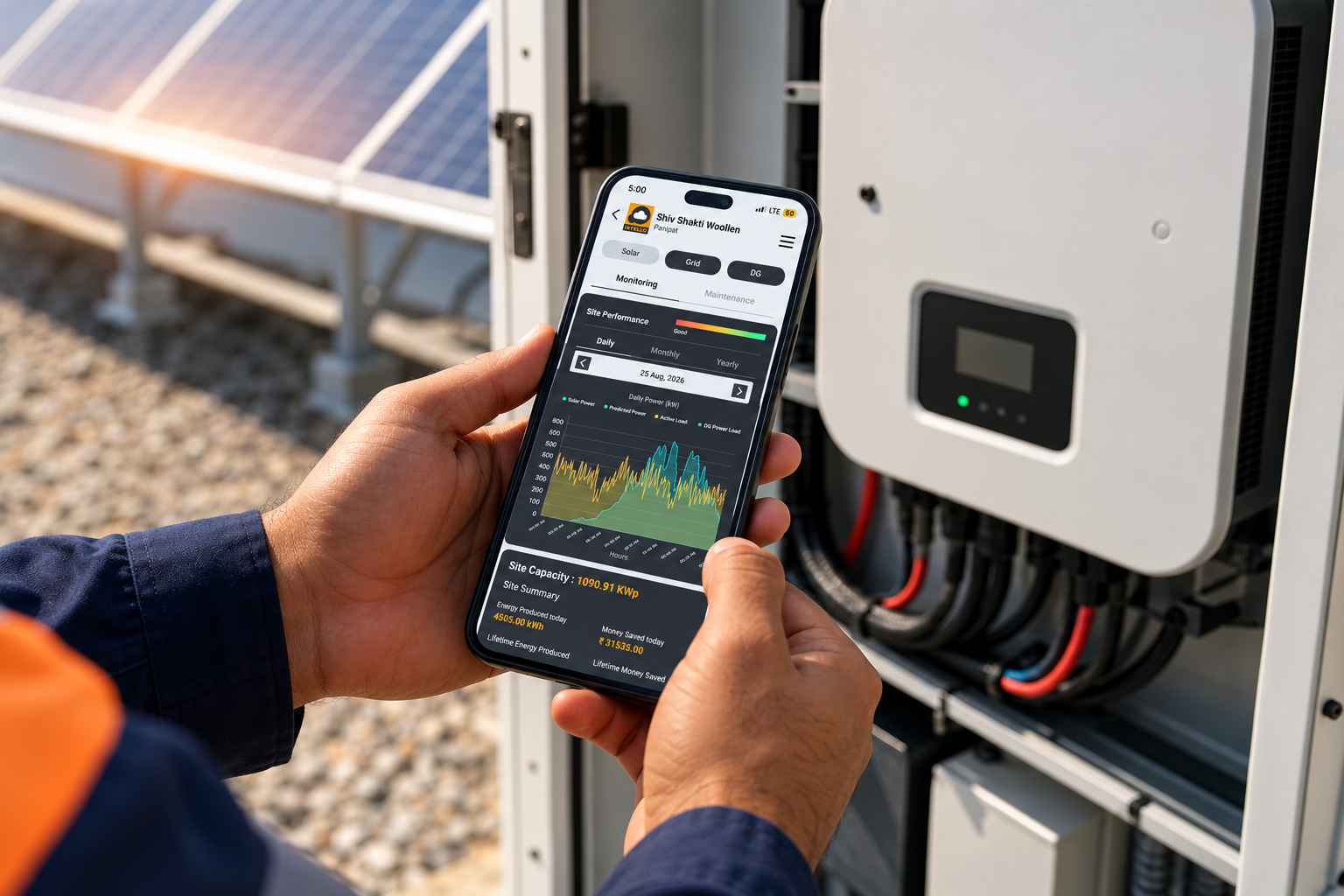
A centralized dashboard that consolidates every site under one login solves this for EPCs managing portfolios across regions. Our guide to centralized solar monitoring across multiple sites in India covers the practical setup steps, and our piece on which KPIs matter most on a multi-site dashboard is worth reviewing before you write KPI clauses into any SLA.
Intello’s own monitoring platform is built around this exact handoff moment: custom RTUs, a centralized dashboard, and a mobile app that logs location, timestamp, customer signature and photographic proof for every maintenance visit, so an EPC’s client keeps full visibility even after the O&M work moves to a third party.
5. Common Handover Gaps EPCs in India Run Into
Ground-mounted plants and commercial rooftop systems fail in different ways at handover. A ground-mounted site usually has a larger spares inventory and civil infrastructure (fencing, drainage, tracker mechanisms) that a rooftop system never has, and that inventory list is one of the most commonly missing documents.
Monsoon readiness is another recurring gap. An EPC that hands over a plant in December without flagging drainage checks or cable gland inspections leaves the O&M team to discover those issues the hard way come June. Our monsoon solar maintenance checklist for India is a useful reference to attach to the handover pack itself.
String-level baseline data is the third gap. Without it, an O&M team can’t tell whether a 4% output dip six months in is normal seasonal variation or an early sign of a fault. If the plant runs a diesel generator alongside solar, add DG-PV synchronization settings to the handover list too. Our article on why DG synchronization with solar keeps tripping up EPC clients covers exactly this failure mode.
What Happens if an EPC Skips a Structured O&M Handover?
Skipping a structured handover usually produces the same three outcomes: warranty claims get rejected for missing test records, the client blames the EPC for underperformance the O&M team can’t diagnose, and disputes drag out because nobody agreed in writing who owned which failure.
Each of those costs more to fix after the fact than the handover checklist would have cost to build up front. A rejected warranty claim, in particular, often traces back to missing commissioning documentation that a properly assembled handover pack would have preserved.
How Should an EPC Company Evaluate an O&M Partner Before Signing?
Evaluate an O&M partner on five things: field technician headcount and coverage area, whether their monitoring platform integrates with your inverter brands, their documented response-time history, whether reporting includes photo verification, and how clearly their SLA maps to your defect liability period.
Ask for a sample monthly report before signing, not after. It tells you more about how the partner actually operates than any pitch deck will.
FAQs
What should a solar maintenance company cover after handover?
A solar maintenance company handling post-handover work should cover panel cleaning, preventive inverter servicing, string-level fault monitoring, warranty claim support, and scheduled reporting, all governed by an SLA tied to the plant’s defect liability period rather than a loosely defined “annual visit.”
What does Intello do differently for EPC partners specifically?
Intello builds its monitoring platform around custom RTUs and a centralized dashboard designed for multi-site portfolios, backed by field technicians on payroll rather than subcontracted labor, and a mobile app that timestamps and photo-verifies every visit, which gives EPCs a documented trail for warranty and client-reporting purposes long after their crew has moved on.
Does DG-PV synchronization need special handling at handover?
Yes. Hybrid sites running solar alongside a diesel generator need synchronization settings, controller configuration and fault history documented separately, since a poorly handed-over sync setup is one of the more common causes of a client believing “solar isn’t working” when the fault actually sits in how the two systems switch over.
Handover is where an EPC’s reputation either compounds or quietly erodes. If your team is still assembling AMC terms project by project, or a client is asking who’s responsible for a plant six months after commissioning, it’s worth reviewing how a structured, SLA-backed O&M partner fits your process.
Request a quote from Intello to see how a documented, photo-verified handover-to-O&M transition would work for your next batch of projects. Existing clients can check technician visit logs and site performance any time through the Intello portal, and EPCs wanting a fuller picture of the platform and field team behind it can learn more about Intello before making the switch.