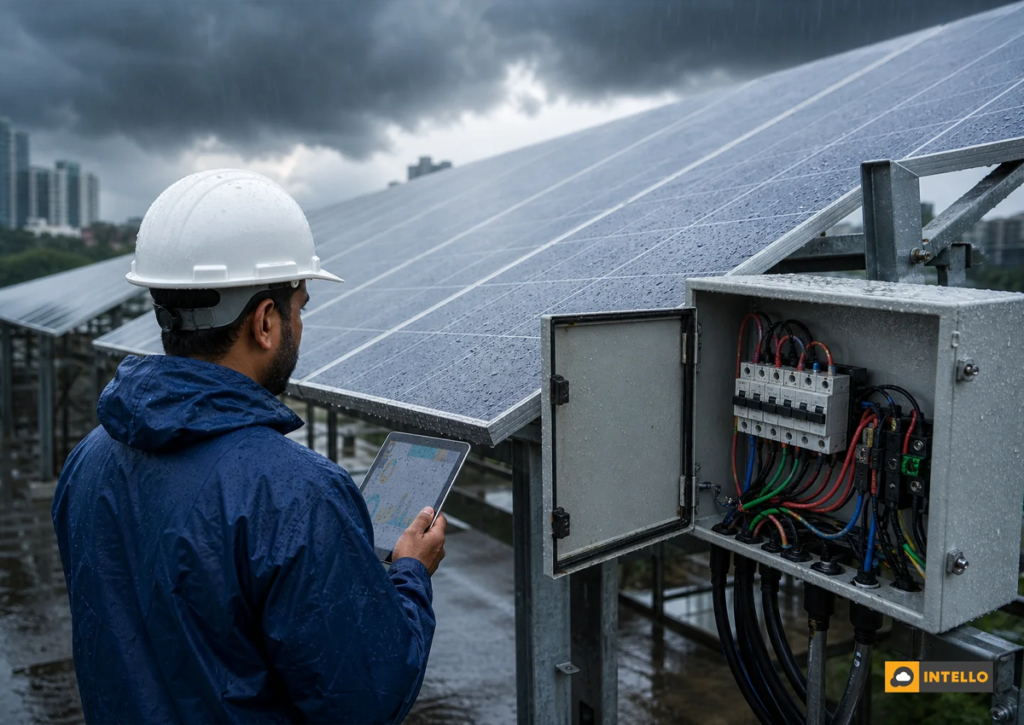
A single flooded earthing pit in Pune can knock 40 kW of rooftop capacity offline for days if nobody catches it before the first heavy downpour. That is the real cost of skipping a monsoon solar maintenance checklist: not a dramatic fire or explosion, but quiet, preventable downtime that eats into your generation numbers month after month. Getting ahead of the rains with a structured pre- and post-monsoon routine is the difference between a plant that sails through July and August and one that spends September in repair mode.
Key Takeaways
- Earthing resistance changes with soil moisture: test it before monsoon and again after, since values that pass in April can drift out of spec by August.
- Drainage failures cause more downtime than lightning: clogged rooftop channels and ground-mount trenches are the single most common cause of water pooling near junction boxes.
- Corroded MC4 connectors cause silent string faults: moisture ingress at connector points can drop a string’s output by 15-20% without tripping any alarm.
- Post-monsoon cleaning matters as much as pre-monsoon prep: algae and silt build-up after weeks of rain can cost more generation than dust ever does.
- AMC-backed teams complete monsoon prep on a schedule: one-off cleaning visits rarely include the earthing, cable, and drainage checks that actually prevent monsoon faults.
At a Glance: Monsoon Solar Maintenance Checklist
| Checklist Item | When | What It Prevents | Recommended Frequency |
|---|---|---|---|
| Earthing pit resistance test | Pre- and post-monsoon | Earth faults, RCD trips, safety hazards | Twice a year minimum |
| Drainage channel clearing | Pre-monsoon | Water pooling near junction boxes and cabling | Once before onset, checked monthly during season |
| Cable gland and junction box sealing | Pre-monsoon | Moisture ingress, string faults | Annually before onset |
| Lightning arrestor and SPD test | Pre-monsoon | Surge damage to inverters and combiner boxes | Annually |
| Remote monitoring alert review | Throughout monsoon | Undetected string drops during cloud cover | Daily via dashboard |
| Panel cleaning (algae/silt removal) | Post-monsoon | Soiling loss, moss growth | Immediately after season ends |
| Connector and terminal re-torquing | Post-monsoon | Arcing, corrosion-driven losses | Annually |
| Structural and vegetation check (ground-mount) | Post-monsoon | Foundation shifting, shading from overgrowth | Annually |
1. Why Monsoon Is the Riskiest Season for Solar Assets in India
Indian solar sites face a different failure profile between June and September than the rest of the year. Heat drives degradation slowly; monsoon drives faults fast. Water finds its way into junction boxes, earthing pits lose their designed resistance as soil composition shifts, and cable insulation that survived a summer of 45°C heat can crack open under repeated wetting and drying cycles.
The monsoon does not hit uniformly. Sites along the Western Ghats and coastal Karnataka can see over 3,000 mm of rainfall in a season, while plants in Rajasthan or western Madhya Pradesh get short, intense bursts with far less total volume but higher runoff speed. The Northeast, particularly Assam and Meghalaya, deals with sustained humidity that keeps components damp for weeks. Each of these patterns demands a slightly different emphasis in the checklist, but the underlying risks, earth faults, drainage failure, and connector corrosion, are common across all of them.
According to the India Meteorological Department, the southwest monsoon typically arrives on the Kerala coast by late May or early June and withdraws from northwest India by mid-October. That gives asset owners roughly a two-week window after the seasonal forecast to complete pre-monsoon prep before real exposure begins.
2. Pre-Monsoon Checklist: What to Inspect Before the First Rain
Pre-monsoon work should be finished before the first sustained rainfall, not squeezed in during a lull between showers. Here is what a thorough inspection covers.
- Drainage clearing: Clear rooftop drainage channels, gutters, and ground-mount trenches of leaves, dust cake, and debris. Standing water near inverter plinths or combiner boxes is one of the most common causes of monsoon downtime.
- Earthing pit testing: Measure earth resistance at every pit using a proper earth tester, not a visual check. Indian electrical codes generally expect earthing resistance under 5 ohms for most installations; values creeping above that need immediate attention, including pit refilling with fresh charcoal-salt mixture where applicable.
- Cable gland and junction box sealing: Inspect every gland for cracked rubber seals and re-seal or replace as needed. A junction box that looks fine in April can have a hairline gap that lets in water once pressure builds during heavy rain.
- Mounting structure corrosion check: Look for rust at bolts, clamps, and welded joints, especially on rooftop installations near coastal air. Touch up galvanized coating where scratches expose bare metal.
- Inverter enclosure integrity: Confirm the IP rating seal on outdoor inverters is intact and vents are not blocked. Water entering an inverter enclosure is one of the costliest monsoon failures to repair.
- Lightning arrestor and surge protection device (SPD) testing: Monsoon brings the highest lightning strike frequency of the year in most Indian regions. Test SPDs on both AC and DC sides and confirm arrestor grounding is intact.
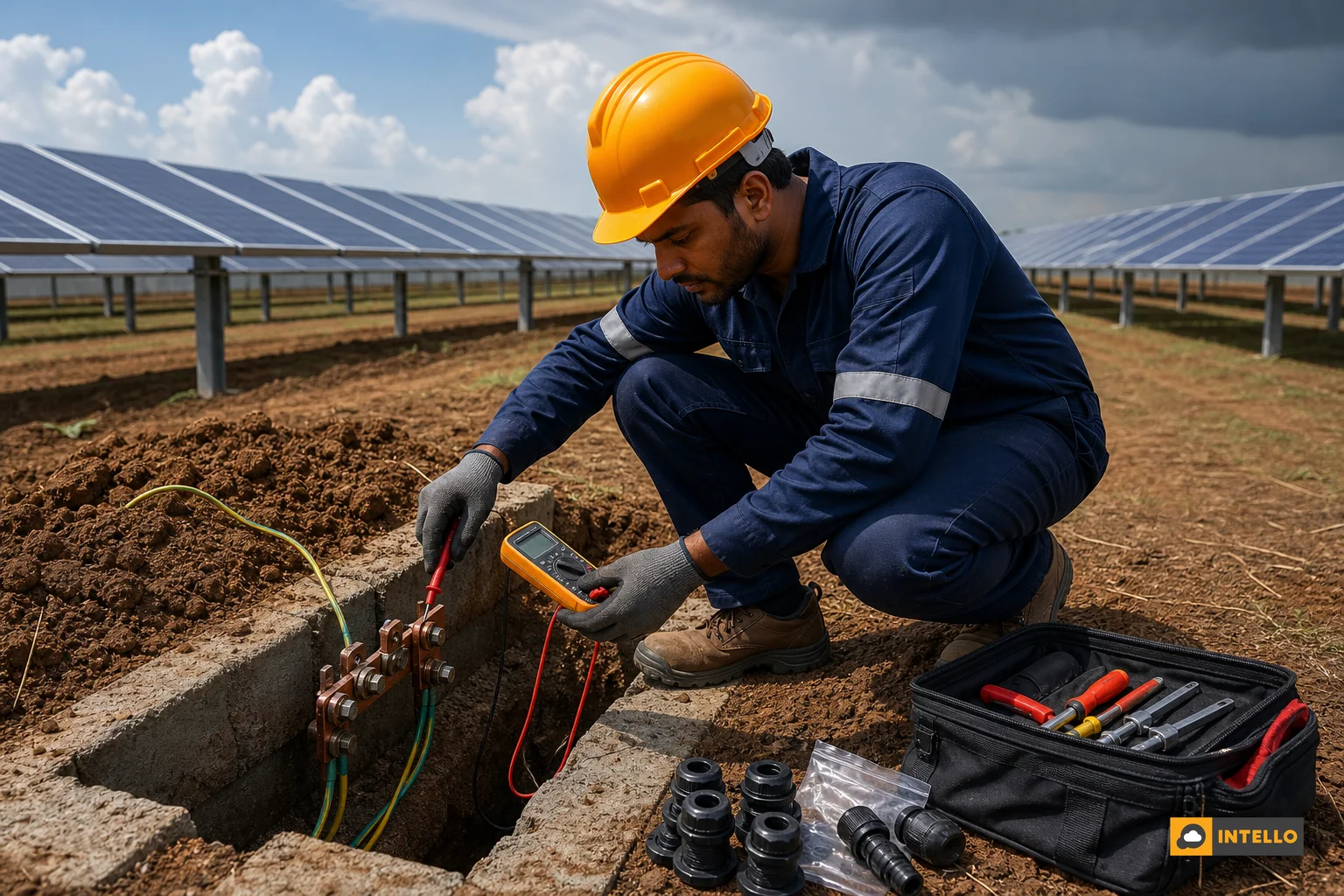
Ground-mounted plants carry extra pre-monsoon items, including trench regrading and cable route checks; our ground-mounted solar plant maintenance checklist covers the mistakes site teams make most often when they skip these steps.
3. Mid-Monsoon Monitoring: What to Watch For
Once the rains start, physical site visits become harder and riskier for technicians. This is where remote monitoring earns its cost. A dashboard that flags a string current drop within minutes lets a provider dispatch a technician only when there is a confirmed fault, rather than waiting for a scheduled visit that might be days away.
During heavy rain, watch for three specific signals: sudden insulation resistance (IR) faults after a downpour, which usually point to water ingress at a junction box or cable joint; unexplained string underperformance during cloud breaks, which can indicate a connector starting to corrode; and inverter trips tied to humidity spikes rather than actual grid or load issues. Sites running backup generators alongside solar also need active checks on DG-PV synchronisation during monsoon outages, since grid instability is more common in this season and improper synchronisation risks damaging both systems.

Our detailed explainer on how IoT sensors detect solar faults before they cost you walks through exactly how string-level sensors flag these mid-season issues before they show up as a generation shortfall on the bill.
4. Post-Monsoon Checklist: Cleaning and Recovery
The work does not end when the rains stop. Weeks of moisture leave behind algae, moss, and silt deposits that dust alone never causes, and several electrical checks need repeating because monsoon conditions can shift values that were fine in April.
- Panel cleaning for algae and silt: Standard dry wiping will not remove moss growth. Post-monsoon cleaning generally needs water-based washing, sometimes with a soft brush, to fully restore panel transmittance.
- Connector and terminal inspection: Check MC4 connectors and busbar terminals for green-tinged corrosion, a telltale sign of moisture exposure. Corroded connectors increase resistance and generate localized heat, which accelerates further damage if left unaddressed.
- Re-torquing electrical connections: Vibration and thermal cycling during the wet season can loosen terminal screws. Re-torque all DC and AC connections to the manufacturer’s specified value.
- Earthing resistance re-test: Soil moisture content changes earthing performance. A pit that measured 3 ohms in May might read differently in October once the ground dries out; re-testing confirms it is still within spec.
- Drainage system inspection: Check for silt accumulation in drains that could block water flow during the next season’s early showers.
- Vegetation and structural checks (ground-mount): Weeks of rain accelerate plant growth around ground-mounted arrays. Clear vegetation that could shade panels or foundations that may have shifted from waterlogged soil.

For a region-specific breakdown of how soiling and cleaning frequency needs differ across India’s climate zones, see our regional guide to solar cleaning by climate zone.
5. Common Monsoon Faults and Their Root Causes
Most monsoon-related complaints trace back to a handful of root causes rather than a wide variety of unrelated problems.
- Earth faults from moisture ingress: Water entering cable trays or combiner boxes creates a path to ground that trips protection devices, sometimes intermittently, which makes diagnosis harder without continuous monitoring.
- String faults from junction box water entry: A cracked gasket lets water reach terminal connections, corroding contacts and reducing the string’s effective output well before it fails outright.
- Inverter trips from humidity and condensation: Even sealed inverters can accumulate internal condensation if temperature swings between day and night are large during the rains, triggering unnecessary shutdowns.
- Arcing at corroded MC4 connectors: Corrosion increases contact resistance, generating heat at the connection point. In extreme cases, this becomes a fire risk, not just a performance issue.
Owners who want a deeper technical breakdown of how these faults show up in field data should read our guide on RTU vs datalogger solar monitoring comparison, since the type of monitoring hardware installed directly affects how quickly a monsoon fault gets detected versus discovered weeks later on a bill.
6. Building a Monsoon-Ready Maintenance Schedule with O&M Support
A one-off cleaning visit before the rains rarely covers earthing tests, gland sealing, and SPD checks in the same trip. These require different tools, different technicians, and a schedule that is planned weeks in advance, not squeezed in reactively once the forecast turns dark. This is exactly the gap that an AMC is designed to close: a written schedule that specifies pre-monsoon and post-monsoon visits as separate line items, not generic “quarterly maintenance.”
Remote monitoring plays an equally important role here. Instead of scheduling blind site visits every few weeks during the rains, a monitoring platform flags exactly which sites and strings need attention, cutting unnecessary travel while making sure real faults get a technician on-site quickly. Intello’s field teams also log every visit with location, timestamp, and photographic evidence through a mobile app, which matters when a fault needs to be documented for a warranty claim later. If you are unsure how thorough your current AMC actually is on this front, our checklist on what should be included in a solar AMC contract is worth a read before your next renewal.
For sites managing multiple locations across different rainfall zones, a centralized view matters even more during monsoon, since prioritizing which site needs a technician first often comes down to comparing live data across the portfolio. Our guide on centralized solar monitoring for multiple sites covers how to set this up practically.
A monsoon checklist only works if it is followed on a calendar, not remembered when the first storm warning appears on the news.
FAQs on Monsoon Solar Maintenance in India
How often should earthing resistance be tested during monsoon season?
Test earthing resistance once before the monsoon onset and again after the season ends, since soil moisture directly affects resistance readings. Sites with a history of borderline values should test a third time mid-season if feasible.
Can solar panels be cleaned during active rainfall?
Light rain does clean off loose dust naturally, but it will not remove algae, moss, or silt deposits that build up over weeks. Deeper cleaning is best scheduled once the season eases and panels can dry properly afterward.
What usually causes inverter trips during monsoon?
Humidity-driven condensation inside the enclosure, grid instability from local power fluctuations, and moisture reaching internal components through a compromised seal are the most common causes. Persistent trips warrant an enclosure inspection rather than a simple reset.
Is monsoon-specific maintenance usually covered under a solar AMC?
It depends entirely on the contract’s fine print. Many AMCs list generic “preventive maintenance” without specifying earthing tests or gland resealing as separate deliverables. Review the schedule of visits and deliverables closely, or compare it against our guide on solar AMC vs O&M contract differences before assuming monsoon prep is included.
Monsoon does not have to mean unpredictable downtime for your solar assets. A structured monsoon solar maintenance checklist, backed by earthing tests, sealed connections, active drainage, and continuous remote monitoring, keeps faults from turning into costly repairs or missed generation targets. If your current maintenance routine has never specifically separated pre-monsoon and post-monsoon tasks, now is the time to fix that before the next season catches your site off guard. Request a quote from Intello’s O&M team to get a monsoon-ready maintenance plan in place, or check live site performance anytime through the Portal Login. To see how Intello’s monitoring and maintenance platform works end-to-end, visit our About page, or simply contact us to discuss your site’s specific monsoon risks.