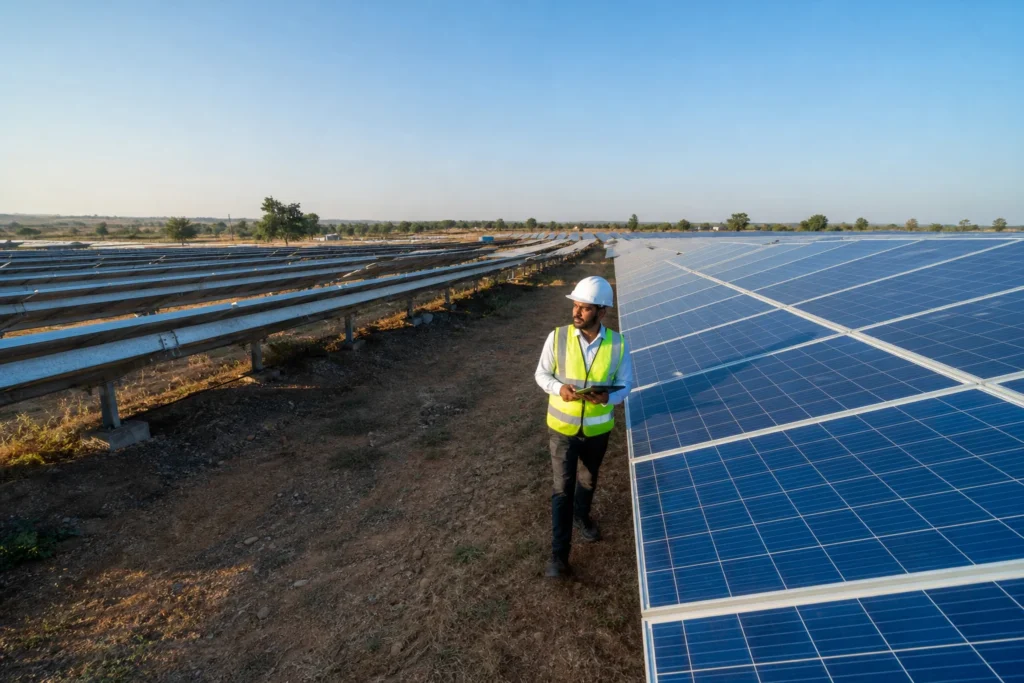
A string inverter that trips once a week isn’t broken, it’s talking to you. Most solar inverter problems announce themselves through fault codes, overheating shutdowns, or a quiet drop in daily generation long before they cause a total outage, and asset owners who read those signals early avoid the repair bills that come from ignoring them.
Key Takeaways
- Inverters cause outsized losses: A single inverter fault can take down an entire string or array, unlike a soiled panel that only shaves a few percent off output.
- Overheating is the top failure trigger: Clogged vents, ambient temperatures above 45°C, and dust ingress account for a large share of shutdown events in Indian commercial installations.
- Monitoring catches problems days earlier: Dashboards with string-level data and real-time alerts flag generation dips before a technician would ever notice on a manual site visit.
- DIY has a hard limit: Checking display codes and cleaning external vents is safe; opening the DC compartment or resetting internal firmware is not, and it can void your warranty.
- Preventive servicing beats breakdown repair: Scheduled inverter servicing, string balancing, and hardware tightening under an AMC cost far less than emergency callouts and lost generation days.
At a Glance: Common Solar Inverter Problems
| Problem | Typical Symptom | Root Cause | Action |
|---|---|---|---|
| Overheating shutdown | Inverter powers off mid-day, restarts at cooler hours | Blocked vents, high ambient temperature, overloading | Clean vents, check ventilation clearance |
| Ground/earth fault | Fault code, partial or full output loss | Cable insulation damage, moisture ingress | Insulation resistance test by technician |
| Grid tripping | Frequent disconnects and reconnects | Voltage/frequency fluctuation from DISCOM supply | Check grid parameters, adjust inverter settings |
| DC/AC mismatch fault | Underperformance vs rated capacity | Oversized array, string imbalance | String-level audit, rebalancing |
| Communication/display error | Dashboard shows no data or stale readings | Faulty dongle, SIM/network drop, RTU issue | Check solar dongle and m2m SIM connectivity |
| DG-PV sync fault | Inverter fails to sync with generator power | Synchronisation controller misconfiguration | Professional recalibration |
Why Solar Inverter Problems Cause Bigger Losses Than Panel Issues
Dust on a panel might cost you 3-5% of that panel’s output. An inverter fault can cost you 100% of an entire string’s output, sometimes for days, because it sits at the single point where all your DC power gets converted to usable AC. That concentration is exactly why solar inverter problems deserve faster attention than most other maintenance items.
For a commercial asset owner in India running a 500 kW rooftop system, a single string inverter down for three days during peak summer sun can mean a measurable dent in monthly generation and a direct hit to solar ROI. The math is unforgiving: inverters have no redundancy unless the plant is designed with multiple units, so one failure isn’t spread thin, it’s concentrated.
This is also why solar downtime tracking matters more for inverters than for any other component. A panel degrading 0.5% a year is predictable. An inverter that trips without warning is not, and that unpredictability is what erodes confidence in a solar investment faster than slow panel degradation ever will.
What Are the Most Common Solar Inverter Problems Asset Owners Face?
Across commercial and residential installations in India, six problems account for most service calls: overheating shutdowns, earth faults, grid tripping, DC/AC mismatch, communication failures, and synchronisation errors with diesel generators. Each shows up differently on the display or the monitoring dashboard, and each has a different urgency level.
Overheating and communication faults are often the earliest warning signs and the cheapest to fix if caught in week one. Earth faults and grid tripping usually need a technician on site with test equipment. Synchronisation errors are the most specialised and typically require an O&M provider familiar with DG-PV controllers rather than a general electrician.
How Do You Read a Solar Inverter Fault Code?
A solar inverter fault code is a short alphanumeric string on the display or dashboard that maps to a specific error category, such as overvoltage, earth fault, or grid disconnect, listed in the manufacturer’s manual. Every brand uses its own numbering, so the first step is always matching the code to that specific inverter’s documentation, not a generic troubleshooting chart.
Most modern inverters push these codes automatically to a monitoring dashboard, which is far more reliable than checking a physical display that may sit on a rooftop or in a locked electrical room. This is one reason IoT-enabled monitoring has become standard for commercial solar in India: it turns a fault code from something a technician discovers on a weekly visit into something an O&M team sees within minutes.
Why Does a Solar Inverter Overheat and Shut Down?
An inverter overheats and shuts down when its internal temperature sensors detect heat beyond safe operating limits, usually caused by blocked ventilation, direct sun exposure without shade, dust accumulation inside the cabinet, or the unit running near its maximum rated load during peak generation hours.
Indian summers push ambient temperatures past 45°C in states like Rajasthan and Gujarat, and inverters installed without adequate clearance or shading hit their thermal ceiling faster than manufacturer specs assume. The unit protects itself by shutting down, which is a safety feature, not a failure, but repeated thermal shutdowns still mean lost generation hours every single day it happens.
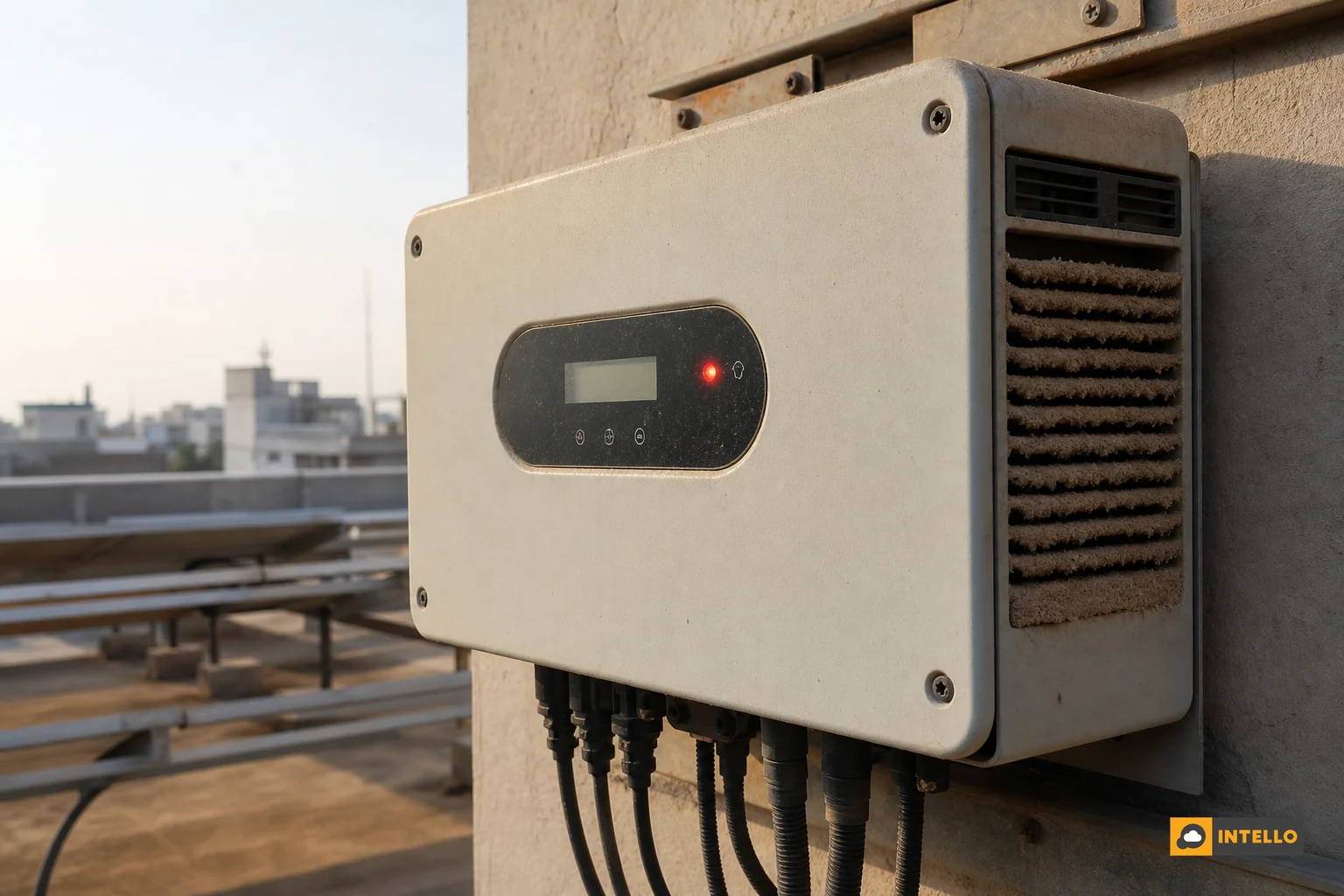
Dust ingress compounds the problem. In regions with high soiling rates, the same airborne dust that dulls panel output also settles inside inverter enclosures and clogs the fans meant to pull heat away. A technician cleaning vents during a routine visit prevents most of this, which is why inverter servicing belongs in every solar AMC scope, not just panel cleaning.
How to Spot Inverter Problems Early Using Monitoring Data
The fastest way to spot a developing inverter problem is a real-time alert triggered by a drop in generation compared to the expected output for that time of day and weather condition, delivered through a dashboard rather than discovered on a monthly bill.
A solar dongle or custom RTU pulls string-level and inverter-level data continuously and pushes it over an m2m SIM connection to a centralized platform. That data stream is what separates a plant owner who catches a fault on day one from one who catches it thirty days later on an electricity bill that looks wrong. Solar IoT India adoption has grown specifically because manual meter checks simply cannot match that response time.
Owners running multiple sites benefit even more. A centralized solar monitoring setup flags an underperforming inverter at one location against the portfolio average, which is often the only way to notice a slow-developing fault that isn’t dramatic enough to trip an alarm on its own.
Solar Panel Maintenance Service: What Regular Inverter Servicing Should Include
A proper solar panel maintenance service treats the inverter as its own checklist item, not an afterthought to panel cleaning. Regular servicing should include vent and fan cleaning, insulation resistance testing, terminal tightening, firmware update checks, and string balancing to confirm every input is contributing evenly.
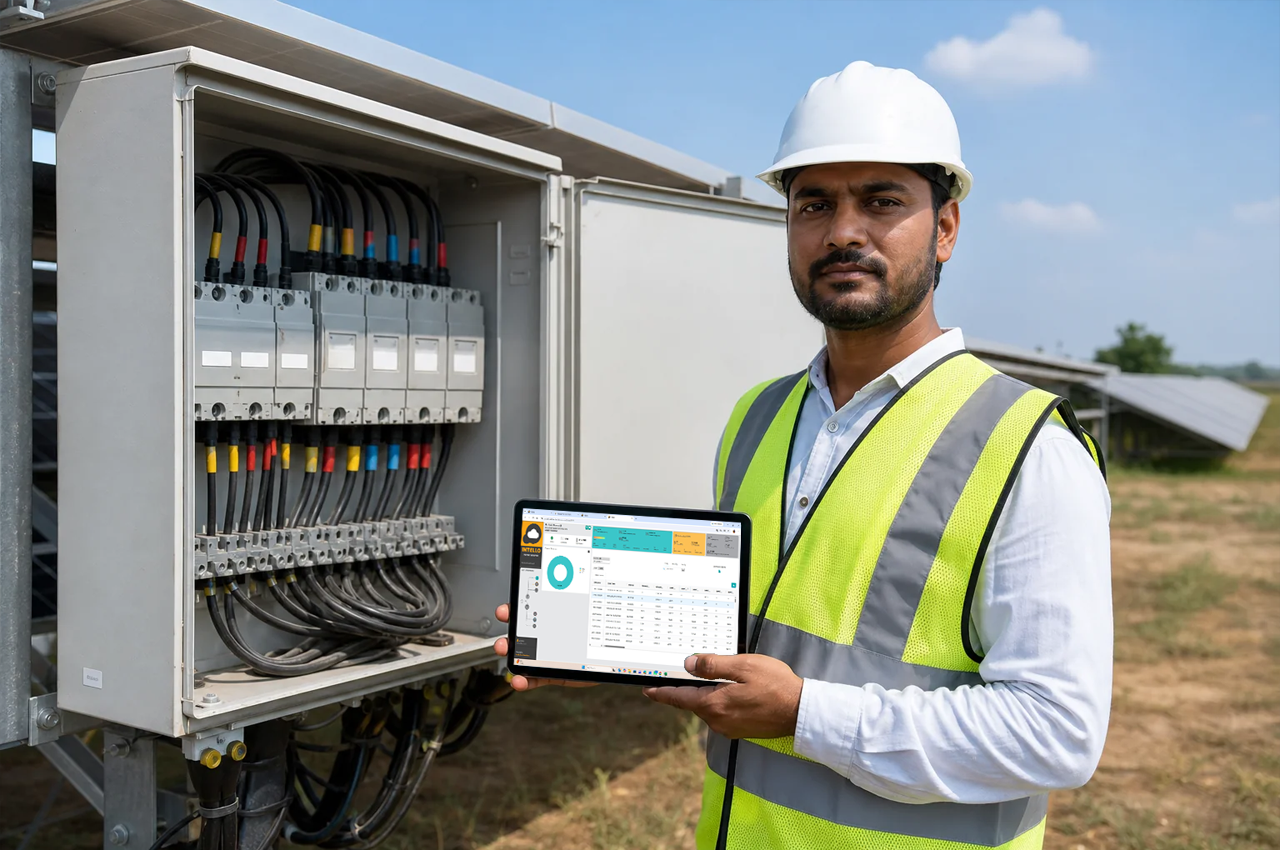
Loose terminals are an underrated cause of trouble. Vibration and thermal cycling loosen electrical connections over months, and a loose terminal generates localized heat that eventually trips a fault or, worse, becomes a fire risk. Hardware tightening during a scheduled visit is a five-minute job that prevents a much larger one later.
String balancing matters just as much. When one string underperforms relative to others feeding the same inverter, it drags down the whole unit’s output, and a technician checking string-level current during a routine visit is the only reliable way to catch this before it shows up as a generation drop on the dashboard.
None of this is complicated work, but it needs to happen on a schedule, not reactively. That is the core argument for preventive maintenance solar programs over pay-per-visit repair calls.
When Should You Attempt a Fix Yourself vs Call a Professional O&M Team?
You can safely check the display for a fault code, note the time it occurred, and clear visible external dust or blockage around the vents. You should not open the inverter’s DC compartment, attempt an internal reset, or touch wiring, because inverters carry lethal DC voltage even after the AC side is switched off.
Beyond safety, there’s a warranty argument too. Most manufacturers void coverage the moment an unauthorised person opens the enclosure. A professional O&M provider carries the test equipment, the manufacturer certifications, and the documentation trail needed to keep a warranty claim valid if the fault turns out to be a manufacturing defect.
As a rule, escalate to a professional the moment a fault code repeats more than once in a week, or if the inverter fails to auto-restart after a thermal shutdown. Those two patterns almost always indicate a component-level issue rather than a passing environmental blip.
How to Check Solar Meter Reading in Mobile
You check your solar meter reading in mobile by opening your O&M provider’s monitoring app, which pulls live generation and consumption data directly from the inverter or meter over the connected dongle, no rooftop visit required. Cross-checking this figure against the inverter’s own physical display once a week is a good habit for catching a communication fault early.
Special Cases: DG-PV Synchronisation and Zero Export Related Inverter Faults
Sites running solar alongside a diesel generator or under a zero export mandate see a category of faults that pure grid-tied systems never do. A DG-PV synchronisation controller that’s misconfigured can cause the inverter to reject power sharing entirely, showing as a sync fault rather than a hardware error.
Similarly, a zero export device solar setup that loses communication with the inverter can cause the plant to curtail output unnecessarily, which looks identical to an underperformance fault on a dashboard but has a completely different fix. These cases almost always need a technician who understands both the inverter and the synchronisation hardware, since misdiagnosing one as the other wastes a site visit.
Choosing the Right Solar O&M Provider for Inverter Care in India
The right provider for inverter-related issues combines string-level monitoring, technicians on payroll rather than subcontracted labour, and a written response SLA that specifies how fast a fault gets acknowledged and resolved. India’s climate variation, from monsoon humidity in Kerala to dust storms in Rajasthan, means a provider’s regional experience matters as much as their technology stack.
Intello has serviced solar installations across India for over 5 years with a team of 150+ solar experts on payroll, combining IoT-enabled monitoring with on-ground preventive maintenance to keep inverters running and generation predictable.
Asset owners evaluating a provider should ask specifically how inverter faults are logged, how quickly alerts reach a human, and whether the AMC includes inverter servicing as a line item or treats it as a billable extra. These details, more than the sales pitch, determine whether a provider actually protects your generation numbers.
Frequently Asked Questions
How often should a solar inverter be serviced?
A solar inverter should be professionally serviced at least twice a year, with vent cleaning and terminal checks done more frequently in high-dust or high-humidity regions. Sites under an active AMC typically get this scheduled automatically as part of preventive maintenance visits.
Can I ignore a fault code if my generation still looks normal?
No, you shouldn’t ignore any fault code even if generation looks stable, because some faults, like a developing earth leakage or a partial string issue, don’t drop total output enough to notice immediately but indicate a problem that worsens over time.
Does a solar AMC cover inverter replacement?
Most AMCs cover inverter servicing, diagnostics, and minor repairs, but full replacement usually falls under the manufacturer’s warranty rather than the AMC itself. Check your specific solar AMC contract for exactly where that line is drawn, since terms vary by provider.
Solar inverter problems rarely arrive without warning signs, whether that’s a fault code, a heat-triggered shutdown, or a quiet dip on your dashboard. Catching them early is the difference between a five-minute fix and a multi-day outage that eats into your solar ROI. If your current setup leaves you checking meters manually or guessing at fault codes, request a quote from Intello’s O&M team to get proper monitoring and preventive inverter care in place. Existing customers can check live generation and fault status anytime through the Portal Login, and anyone wanting to understand Intello’s full approach to solar asset care can learn more about the company or simply contact us to discuss your site’s specific inverter history.