DG synchronization with solar is how a diesel generator and a solar inverter coordinate automatically. They match voltage, frequency, and phase before sharing a common power bus. When it works, a site draws diesel and solar power together without a trip. When it fails, the usual cause is simple. The diesel generator’s governor and the solar inverter react at different speeds. And nobody has told the protection relays how to referee the mismatch.
Key Takeaways
- Two different clocks: A diesel generator’s governor reacts to load changes in a few seconds. A solar inverter reacts in milliseconds. That gap causes most synchronization trips.
- Anti-islanding is not optional: Grid-tied inverters shut off the moment they sense a dead grid. This happens even during a legitimate DG-backed outage, unless a synchronization controller says otherwise.
- Load-sharing failures look like breaker faults: Repeated nuisance trips, DG “hunting” (surging and settling), and unexplained solar curtailment are field symptoms. They point to a synchronization problem, not equipment defects.
- Diesel savings depend on stability: Sites report 30-50% daytime diesel savings from proper synchronization. But this only holds when ramp rates and reverse power protection are correctly tuned.
- Monitoring catches drift before it trips: Real-time voltage, frequency, and load data from an RTU-based monitoring system flags a drifting controller. It can warn hours before a breaker opens.
At a Glance: DG-PV Synchronization Basics
| Parameter | Typical Requirement / Behavior |
|---|---|
| Voltage matching tolerance | Within ±5% before closing the sync breaker |
| Frequency matching tolerance | Within ±0.2-0.5 Hz |
| Phase angle tolerance | Within ±10-15 degrees |
| DG governor response time | 2-5 seconds to stabilize after a load step |
| Solar inverter response time | Milliseconds to a few seconds |
| Typical daytime diesel savings with synchronization | 30-50% of daytime fuel consumption |
| Common failure trigger | Cloud transient or grid outage causing a rapid solar output swing |
| Preventive fix | Ramp-rate limiting plus real-time monitoring alerts on the controller |
What Is DG Synchronization With Solar?
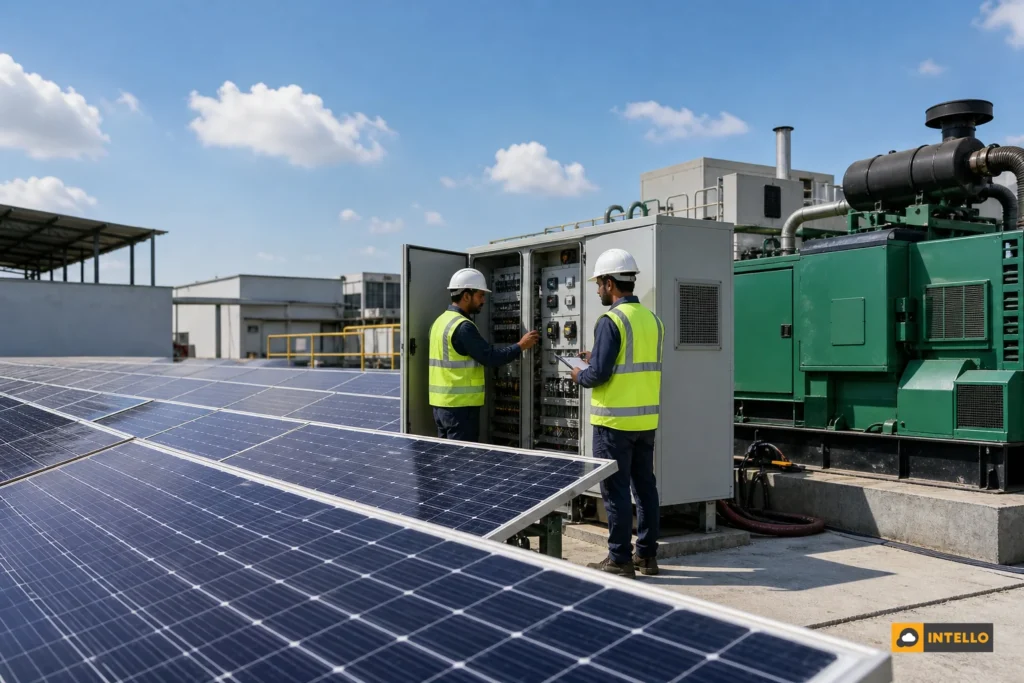
DG synchronization with solar is the electrical and control coordination that lets a diesel generator and a solar system feed the same bus. This matters at industrial and commercial sites. Indian factories often run captive diesel generator (DG) sets alongside rooftop or ground-mounted solar to cut grid dependence and diesel spend, according to a 2026 study on real-time solar-diesel coordination for industrial loads.
Without synchronization, the two sources cannot safely share a load. A DG set produces AC power at a fixed frequency set by its governor. A solar inverter must match that frequency, voltage, and phase angle exactly before a breaker can close between them. Get any one of those three wrong, and the breaker either refuses to close or trips almost immediately after closing.
This isn’t a residential rooftop concern. It’s a factory, warehouse, or campus problem. Diesel keeps production running through grid outages, and solar is expected to offset diesel cost during daylight hours. The synchronization controller is the piece of hardware that makes both goals work together instead of against each other. Here’s how to work through the process step by step, from how the coordination actually runs on site to setting up a system that won’t trip on you.
1. Understand How the Coordination Actually Works on Site
A synchronization controller sits between the DG’s control panel and the solar inverter’s output. It constantly measures voltage, frequency, and phase on both sides. It closes the interconnection breaker only when all three fall inside tolerance. Then it manages how much load each source carries as conditions shift.
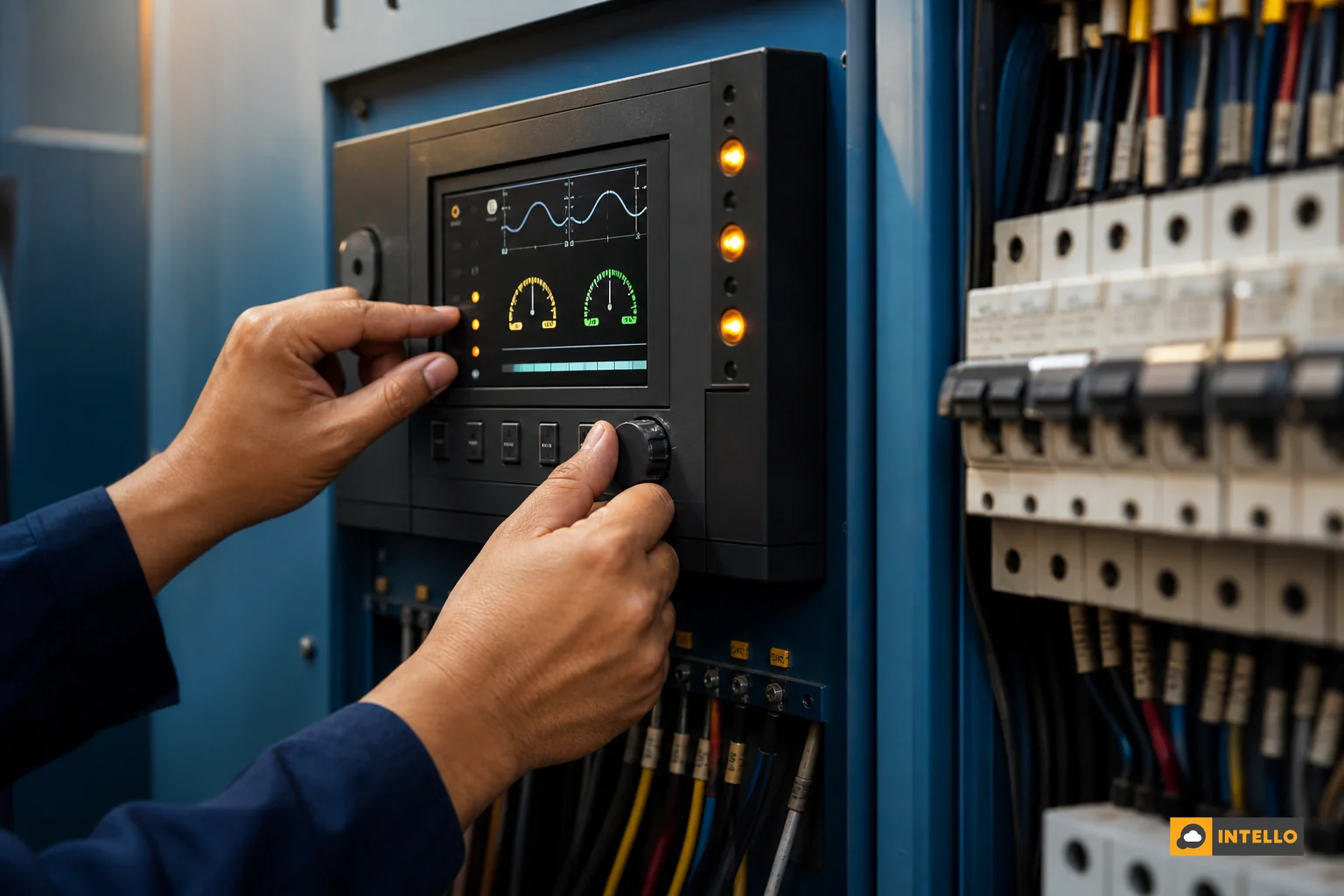
Most controllers also enforce a ramp rate. This is a limit on how fast solar output can rise or fall on the shared bus. Force-V’s technical writeup on PV-DG synchronization as a bridge between the two power sources describes this coordination as one-directional in practice. The DG’s governor sets the reference frequency, and the solar side is throttled to stay within what the generator can absorb without stalling or overspeeding.
That throttling matters because a diesel governor cannot instantly shed or accept load the way an inverter can. Say a cloud passes and solar output drops by 40% in two seconds. The DG has to pick up that difference immediately, or the frequency sags. A well-tuned system anticipates this. A poorly tuned one trips.
2. Identify Why DG-PV Synchronization Fails
Synchronization fails when the DG governor and the solar inverter respond to the same event on different timescales. And the protection relays aren’t set up to bridge that gap. This shows up as reverse power trips, frequency swings, or a breaker that refuses to re-close after a fault.
Four failure points account for most incidents Intello’s field teams see on commercial and industrial sites:
- Governor-inverter timescale mismatch: The DG needs seconds to stabilize. The inverter reacts in milliseconds. A sudden solar swing outpaces the governor’s ability to catch up.
- Anti-islanding disconnection during a legitimate outage: Grid-tied inverters shut off the instant they detect a dead grid. This is a required safety feature, so they don’t feed power back into a line a lineman assumes is dead. Heaven Green Energy’s explainer on why solar shuts off during power cuts lays out exactly this scenario. Panels keep generating DC power, but the inverter refuses to convert it. It can’t tell a DG-backed island from an unsafe backfeed, unless a synchronization controller tells it otherwise.
- Load-sharing imbalance: Solar and DG try to carry proportional shares of a shifting load. Without a controller actively managing setpoints, one source gets overloaded while the other idles. This trips overcurrent protection.
- Poor communication between the controller and site SCADA: If the synchronization controller isn’t feeding data into the site’s monitoring platform, drift in voltage or frequency tolerance goes unnoticed. Nobody catches it until a breaker opens on its own.
For a deeper breakdown of each failure mode and its fix, see our companion piece on why DG synchronization with solar fails and how to fix it.
3. Recognize How Load-Sharing Problems Show Up in the Field
Load-sharing failures rarely announce themselves as a clean “synchronization fault” on a breaker readout. Instead, they show up as repeated nuisance trips. A DG that surges and settles (“hunting”) instead of holding steady load. Solar output that gets curtailed for no obvious reason during clear-sky hours.
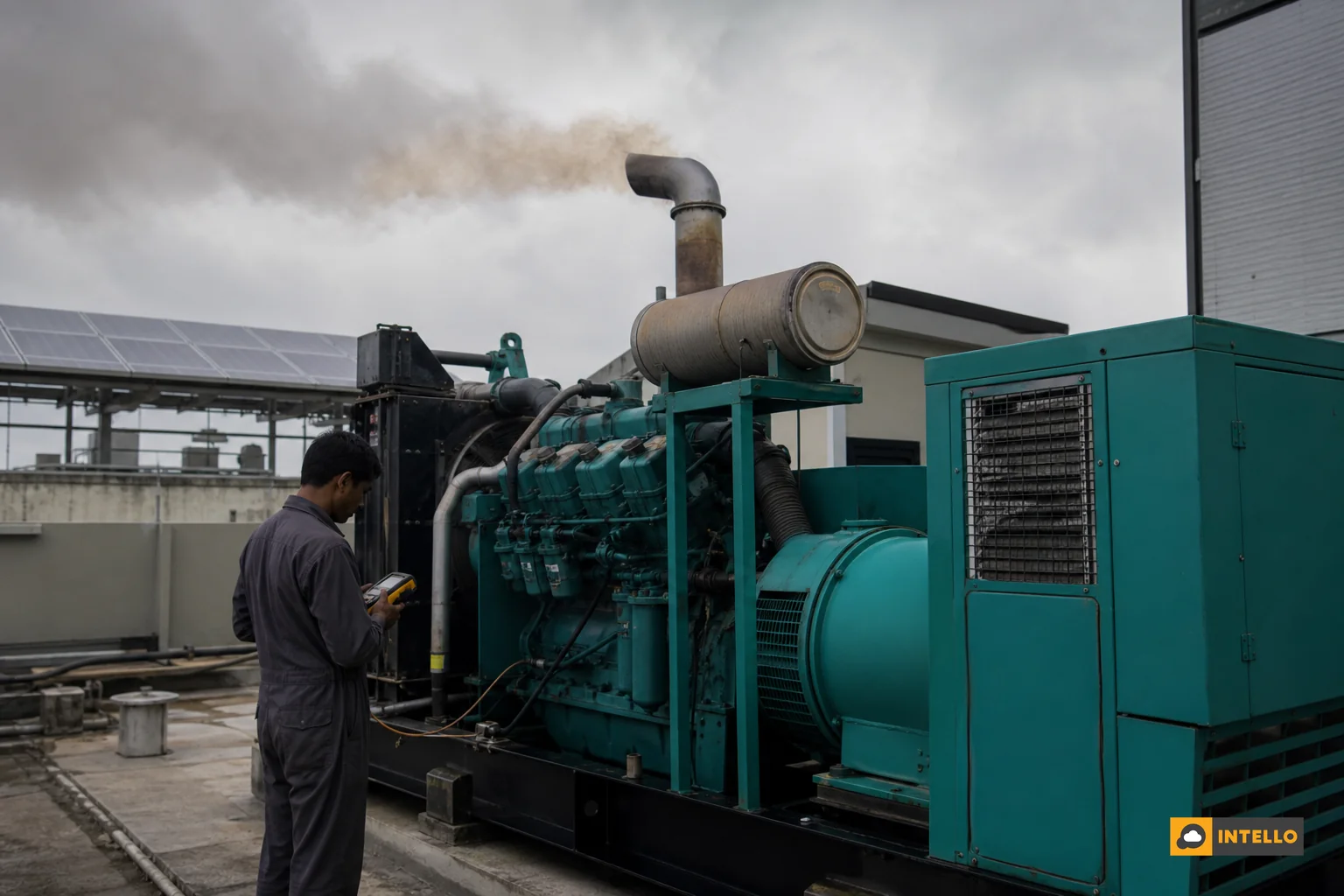
Site teams often mistake these symptoms for a bad inverter or a failing generator. In reality, the hardware is usually fine. The controller’s setpoints or relay coordination are off, and every fault clears once the sync parameters get fixed. Datoms’ overview of real-time energy intelligence in hybrid solar-DG management frames this as a continuous evaluation problem. The system has to keep reassessing solar availability and load demand, not just synchronize once at startup.
Does Solar Work During a Grid Power Cut?
Solar panels keep producing DC power during a grid outage. But a standard grid-tied inverter won’t convert that power, because its anti-islanding protection shuts it down for safety. Solar only keeps supplying the site during an outage if a DG-PV synchronization controller and the right inverter mode are already in place to manage the island safely.
This is the single most common misunderstanding among facility managers. Many assume solar automatically backs up a grid failure the way a battery would. Without synchronization hardware, a power cut takes the entire solar contribution offline right when the DG needs help most.
4. Use Monitoring to Prevent Synchronization Failures
Continuous monitoring catches voltage, frequency, or load drift while it’s still in a correctable range, before it crosses the threshold that trips a breaker. A synchronization controller alone reacts to a fault after it happens. Monitoring gives a technician the chance to step in before it happens.
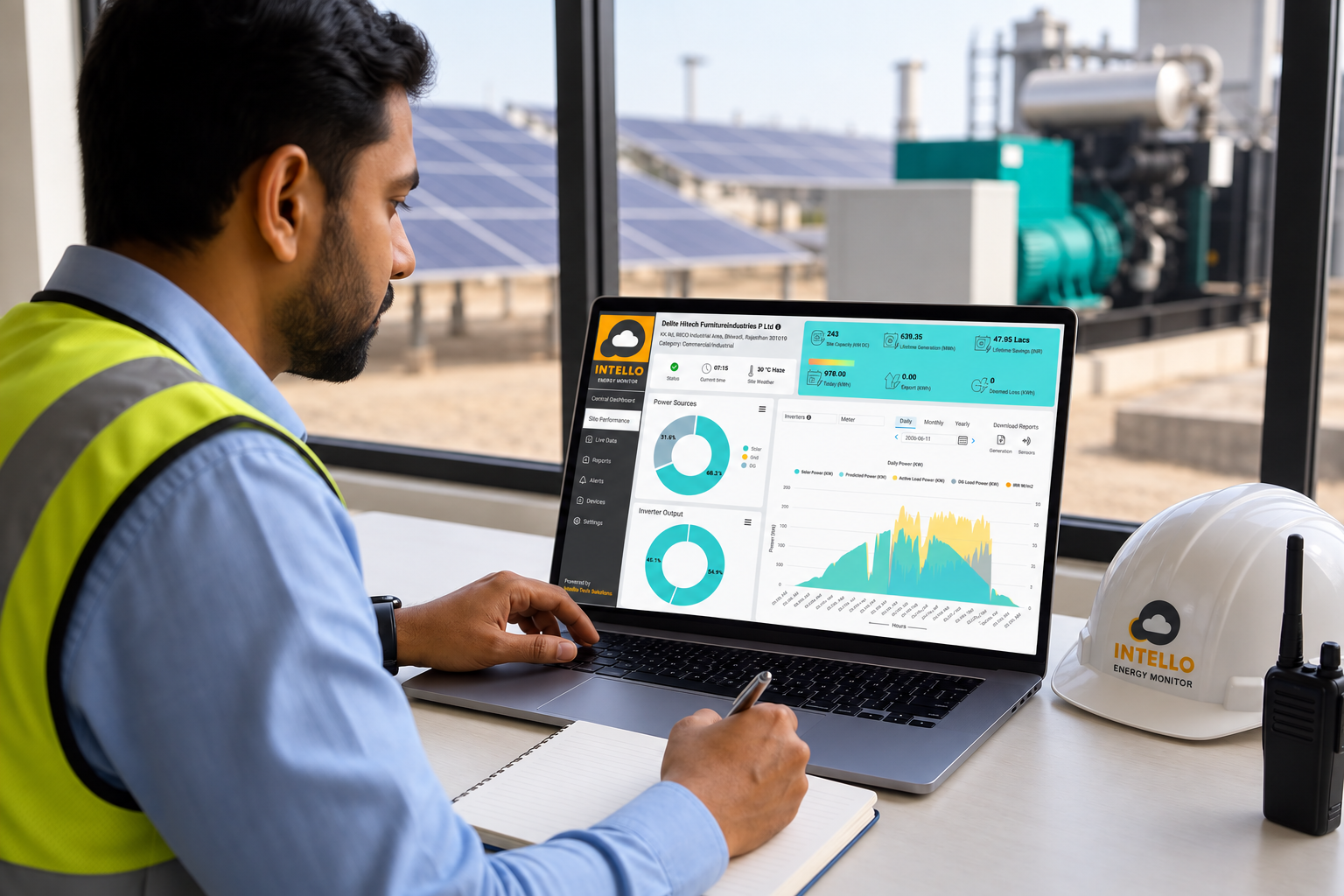
Huijue Solar’s explainer on DG-PV synchronization systems and grid stability describes the controller’s job as matching voltage, frequency, and phase angle in real time. That real-time requirement is exactly why standalone controllers without a data layer struggle. They can run the sync logic, but nobody sees the trend leading up to a failure.
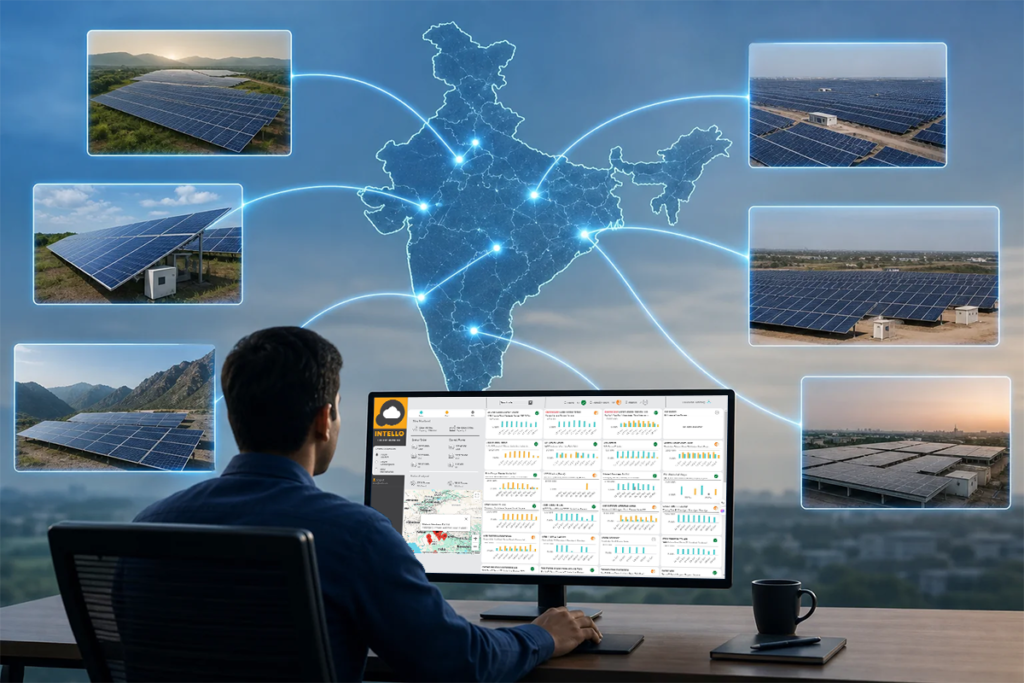
Intello’s IoT-enabled monitoring platform closes that gap. Custom RTUs (remote terminal units) installed at the synchronization panel log voltage, frequency, and load-share data continuously and push it to a central dashboard. When a parameter starts drifting outside tolerance, a real-time alert reaches the maintenance team before the protection relay decides to act on its own. That’s the difference between a scheduled adjustment and an unplanned production stoppage.
This is the same monitoring discipline Intello applies across preventive maintenance more broadly. See what a well-built system should surface daily in our guide on what a solar dashboard should show you daily, and how to weigh the sensor layer that feeds it in how IoT sensors detect solar faults before they cost you.
5. Set Up a Reliable DG-PV Synchronization System
A reliable setup starts before the equipment goes in the ground, not after the first trip. Facility teams evaluating a new hybrid installation, or troubleshooting an existing one, should work through this checklist:
- Size the synchronization controller to the actual load profile, not just the nameplate capacity of the DG and solar plant. Undersized controllers can’t manage rapid transients.
- Confirm ramp-rate settings match the DG governor’s real response curve. This usually requires field testing, not just factory defaults.
- Coordinate protection relay settings between the DG panel and the solar inverter. This keeps reverse power and overcurrent thresholds from conflicting with each other.
- Run a commissioning test under simulated cloud-transient and load-step conditions, not just a static synchronization check.
- Add the controller’s output to your remote monitoring feed so drift is visible on a dashboard, not just on a local panel meter.
- Put the system under a preventive maintenance schedule that includes relay calibration checks, not just panel cleaning.
Sites shopping for the controller hardware itself should start with our DG-PV synchronization controller buyer’s guide for India. It walks through the specification questions worth asking a vendor before signing.
Facilities weighing whether to manage this in-house or hand it to a specialist O&M partner should also read our comparison of in-house versus outsourced solar O&M in India. Synchronization tuning is exactly the kind of specialized task that benefits from a provider who sees the same failure pattern across multiple sites.
Frequently Asked Questions
Can solar and DG run together without a synchronization controller?
No. Without a controller matching voltage, frequency, and phase, closing a breaker between an active DG and a solar inverter risks equipment damage and an unstable bus. The controller is what makes running both together safe. It isn’t optional add-on hardware.
How much does DG-PV synchronization save on diesel?
Industrial sites in India typically report 30-50% savings on daytime diesel consumption once synchronization is properly tuned. Solar carries a meaningful share of daytime load instead of leaving the generator to burn fuel alone.
What causes repeated synchronization trips on an otherwise healthy system?
Repeated trips on healthy hardware almost always trace back to controller setpoints, not equipment failure. Common culprits include ramp-rate limits set too aggressively, protection relay thresholds that conflict between the DG and inverter, or a monitoring gap that lets drift go uncorrected until a fault triggers.
Does DG synchronization apply to residential solar systems?
Rarely. This coordination is built for industrial and commercial sites running captive DG sets alongside solar, where load sizes and diesel costs justify the controller investment. Residential systems typically pair solar with grid backup or batteries instead.
A synchronization controller executes the sync logic. Monitoring is what tells you it’s about to need to.
Has your site been living with unexplained trips, DG hunting, or solar curtailment nobody can explain? The fix usually isn’t new hardware. It’s visibility into what the existing hardware is actually doing minute to minute. Intello’s monitoring platform and on-ground maintenance teams are built to catch exactly this kind of drift before it becomes a production stoppage. Request a quote to have our team assess your current DG-PV setup, or log into the Intello portal if you’re already a client and want to review your site’s synchronization data. To understand more about how Intello’s approach differs from a standard O&M contract, learn more about our team and platform.