DG synchronization with solar fails most often because the diesel generator’s governor and the solar inverter’s output are reacting to load changes on two different timescales, and nobody has told the protection relays how to referee that mismatch. The result is a tripped breaker, a generator that hunts for frequency, or solar power that gets curtailed even though the sun is out and the load could use it.
Key Takeaways
- Root cause is timing, not equipment quality: A DG’s governor responds to load changes in seconds, while a solar inverter reacts in milliseconds, and without a synchronization controller bridging that gap, breakers trip on frequency or reverse-power faults.
- Zero export devices and sync controllers are not the same thing: A zero export device stops solar from feeding the grid; a DG-PV synchronization controller manages how solar and generator share a load bus at the same time.
- Most failures trace back to commissioning shortcuts: Missing CT/PT calibration, mismatched relay settings, and load-sensing units installed but never tuned account for the majority of nuisance trips on Indian commercial and industrial sites.
- Unplanned downtime costs more than the diesel saved: Repeated breaker trips wear out contactors, force manual restarts, and can push a site back to 100% diesel operation for hours while a technician is called out.
- Remote monitoring catches drift before it becomes a trip: Frequency deviation, ramp-rate breaches, and DG-to-PV output ratio anomalies are visible on an IoT dashboard well before a protection relay decides to act.
At a Glance: DG-Solar Synchronization Failure Points
| Failure Point | Typical Symptom | Usual Root Cause | Preventive Fix |
|---|---|---|---|
| Frequency instability | Generator hunting, voltage flicker | Governor droop setting mismatched to solar ramp rate | Governor tuning + controller coordination |
| Nuisance breaker trips | ACB/VCB trips within minutes of solar ramp-up | Protection relay settings too tight for combined load profile | Relay coordination study |
| Reverse power fault | DG trips when solar output exceeds site load | No real-time load sensing feeding the sync controller | Install/recalibrate load sensing CTs |
| Wasted solar generation | Inverters curtailed despite clear skies | Sync controller set conservatively to avoid DG trips | Controller retuning with actual load data |
| Communication dropout | DG and inverter act independently | Faulty RS485/Modbus link between controller and devices | Cable and protocol audit |
| Delayed fault detection | Trip discovered hours later, DG runs on full diesel | No remote monitoring or alerting on the sync panel | IoT-enabled monitoring with real-time alerts |
Why Does DG Synchronization With Solar Go Wrong on Commercial Sites?
It goes wrong because a diesel generator and a solar inverter are fundamentally different machines pretending to share one job. The DG’s governor adjusts fuel flow over one to two seconds to hold frequency steady; the solar inverter’s output can swing by 20-30% in under a second when a cloud passes overhead.
Without a controller managing that gap, the generator’s protection relays see a sudden load or frequency shift and interpret it as a fault, not a cloud. That’s when the breaker trips.
On many commercial and industrial sites in India, this problem shows up in the first monsoon season after commissioning. Intermittent cloud cover creates exactly the rapid ramp conditions that expose a poorly tuned DG-PV synchronization setup. A site that ran fine on clear winter days suddenly trips twice a week once the weather turns variable.
Solar EPCs handing over a project without a dedicated commissioning phase for the synchronization controller are the most common source of this problem. The panels work, the inverter works, the DG works, but nobody tested how they behave together under a fast-changing cloud pattern. For a deeper walkthrough of how the underlying control logic is supposed to function, see our DG-PV synchronization controller buyer’s guide.
The Most Common Root Causes of Failed Synchronization
Six issues account for nearly every synchronization failure we see across commercial and industrial rooftops and captive-DG plants in India.
1. Missing or Misconfigured Synchronization Controller
Some sites run solar and DG on the same bus with only a manual changeover switch, expecting the plant operator to manage transitions by hand. Others have a controller installed, but its default factory settings were never adjusted to the site’s actual load profile, ramp behavior, or DG capacity.
2. Poor Communication Between DG Controls and PV Inverter
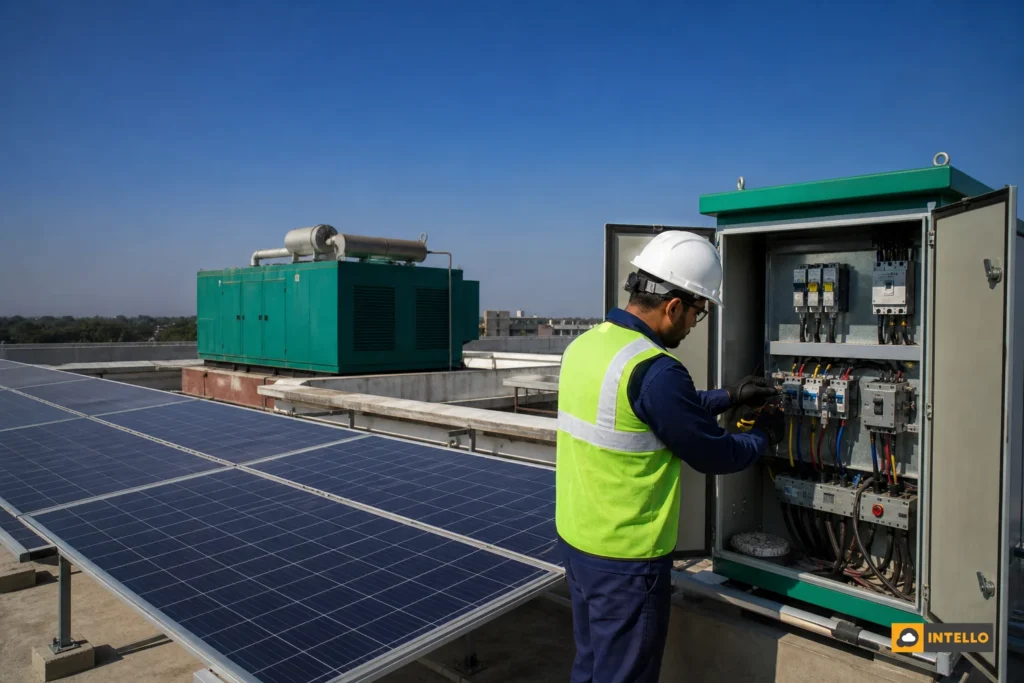
A synchronization controller only works if it can talk to both the DG’s AVR/governor and the solar inverter in real time. Loose RS485 wiring, wrong baud rate settings, or a corroded terminal block silently breaks this link, and the two systems start acting independently.
3. Load Fluctuation Exceeding DG Ramp Rate
Every diesel generator has a maximum rate at which it can safely accept or shed load. When solar output rises faster than the DG can ramp down its own output to compensate, the excess trips a reverse power or over-frequency relay.
4. Wrong CT/PT Sizing or Protection Relay Settings
Current transformers and potential transformers sized for the DG alone, without accounting for combined DG-plus-solar current flow, give the protection relay inaccurate readings. The relay then trips at thresholds that were never correct for the actual site conditions.
5. Zero Export Device Not Coordinated With the DG Controller
A zero export device prevents solar power from flowing back to the grid, but on a site running a captive DG, that device also needs to talk to the synchronization controller. If the two systems were installed by different vendors without a shared communication protocol, they can send conflicting commands to the inverter.
6. No Real-Time Load Sensing
Static synchronization settings assume load stays roughly constant. Factories with shift-based production, cold storage with compressor cycling, or hospitals with variable HVAC load need a controller that reads actual site load continuously, not one calibrated once at commissioning and left alone for years.
How Tripped Breakers and Wasted Generation Actually Cost You
A single nuisance trip rarely shows up as a dramatic outage. It shows up as diesel consumption that never dropped as much as the solar investment promised, and as a maintenance log full of unexplained “DG restart” entries.
Every time a breaker trips because of a synchronization fault, the site typically falls back to 100% diesel operation until someone manually restarts and resynchronizes the system. On an unmanned or lightly staffed site, that can mean hours of full diesel cost stacked on top of the fuel the solar plant was supposed to offset.
Repeated switching also accelerates wear on contactors, relays, and the DG’s own control electronics. A breaker rated for occasional switching that trips several times a week ages far faster than its design life assumes, pulling forward a replacement cost nobody budgeted for.
The fuel savings promised in a DG-solar hybrid business case only materialize if the synchronization actually holds under real, variable cloud cover, not just the clear-sky conditions used for the initial sizing calculation.
Preventive Checks That Prevent Unplanned Downtime
Preventing synchronization failure is largely a discipline problem, not a technology problem. The controllers and relays available in the Indian market today can handle the variability; they just need to be commissioned and re-checked properly.
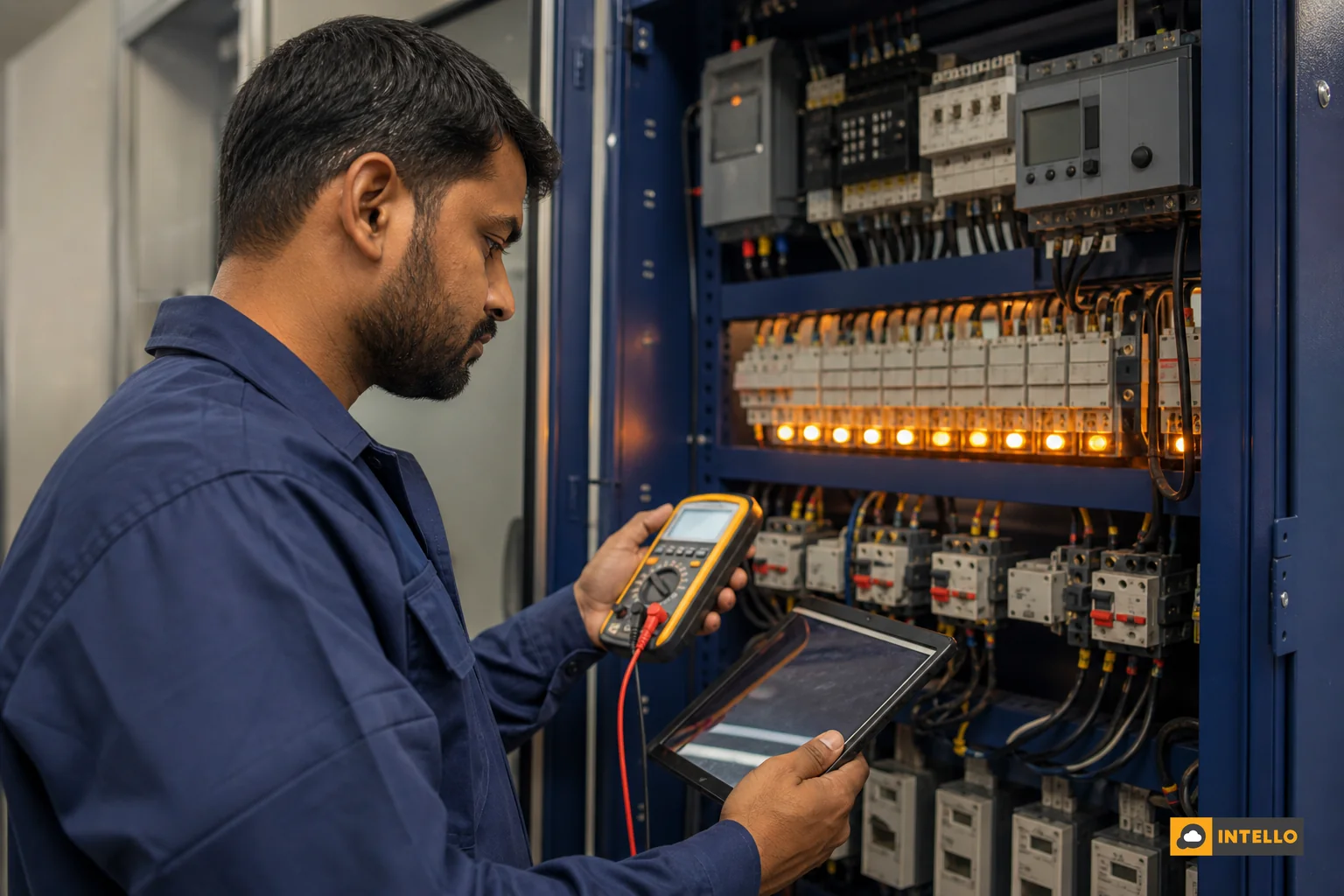
- Commissioning validation under variable load: Test the sync controller against a simulated cloud-pass scenario, not just steady-state generation, before sign-off.
- Relay coordination study: Have protection settings reviewed against actual combined DG-plus-solar fault current, not the DG’s original standalone settings.
- CT/PT calibration check: Confirm current and potential transformers are sized and calibrated for the combined system, repeated annually.
- Communication link audit: Physically inspect RS485/Modbus wiring and confirm baud rate and addressing match across the DG controller, inverter, and sync panel.
- Load sensing recalibration: Re-verify load sensing accuracy whenever the site’s load profile changes, such as after adding new machinery or shifts.
- Seasonal re-testing: Re-run the cloud-pass validation test before monsoon season, when rapid irradiance swings are most frequent.
Our ground-mounted solar plant maintenance checklist covers several of these checks in more detail for larger installations where DG hybrid setups are common.
DG Synchronization vs Zero Export vs Net Metering: Which Setup Fits Your Site?
The right configuration depends on whether your site runs a captive diesel generator, how strict your DISCOM’s export rules are, and how much backup power you actually need during outages.
| Setup | Best For | Handles DG Backup? | Handles Grid Export Rules? | Relative Complexity |
|---|---|---|---|---|
| DG-PV synchronization | Sites with frequent power cuts and a captive generator | Yes, manages parallel operation | No, needs separate export control | High |
| Zero export device | Grid-tied sites barred from exporting to the DISCOM | No | Yes, caps export to zero | Medium |
| Net metering | Sites allowed to export and get billing credit | No | Yes, allows bidirectional flow | Low to medium |
| DG sync + zero export combined | Industrial sites with both DG backup and export restrictions | Yes | Yes | Very high |
Many industrial sites in India, particularly in states with unreliable grid supply, end up needing both DG synchronization and a zero export device working together. That combination raises the commissioning bar considerably, which is exactly where most of the failures documented earlier tend to originate. For a direct comparison of export options alone, see Zero Export vs Net Metering India.
Should You Retrofit an Existing DG-Solar Setup or Install New?
Retrofit an existing setup if the DG, inverter, and relays are less than seven years old and the trips are isolated to the synchronization controller itself; replace the whole panel if the underlying protection relays predate the solar installation.
Older DG protection relays, especially electromechanical ones installed before the solar array was added, often lack the communication ports a modern sync controller needs. In that case, a retrofit means adding a translation layer that can itself become a new point of failure.
Sites built with solar and DG synchronization designed together from day one rarely see this problem, because the relay specifications accounted for combined operation from the start. If your site added solar to an existing DG years after commissioning, budget for a proper relay coordination study rather than assuming the original DG protection settings still apply.
How Remote Monitoring Catches Synchronization Faults Before They Trip a Breaker
Remote monitoring catches these faults by watching frequency deviation, ramp rate, and the DG-to-solar output ratio continuously, then flagging drift toward an unsafe zone minutes or hours before a protection relay would actually trip.
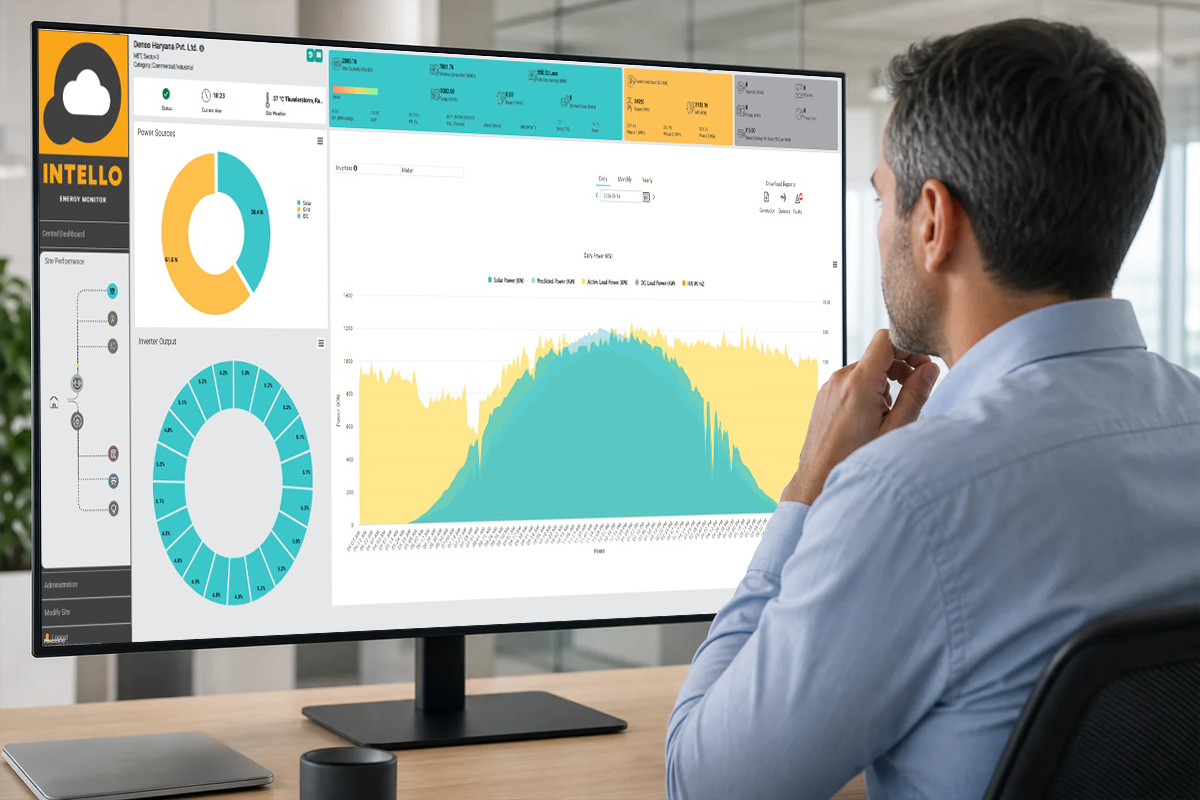
A relay is a last line of defense. By the time it trips, the fault has already happened and the site has already lost generation or diesel efficiency. An IoT-enabled monitoring system reading data from the sync controller, the DG, and the inverters can spot the early signs, a widening gap between expected and actual DG load response, a communication link that’s gone quiet, a controller output that’s drifted from its calibrated setpoint.
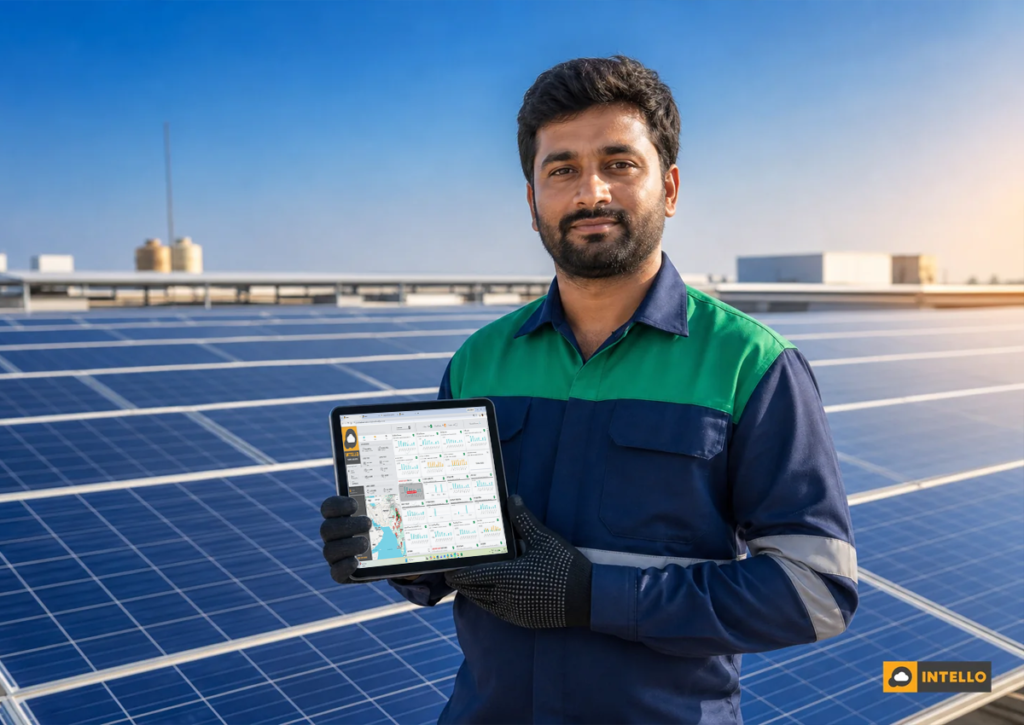
Intello’s centralized dashboard pulls this data from custom RTUs installed at the synchronization panel and pushes real-time alerts to the O&M team’s mobile app, with location, timestamp, and photo documentation once a technician resolves the issue. For multi-site industrial owners running DG hybrids across several states, this kind of visibility is the difference between catching a drifting controller on a Tuesday afternoon and discovering it after a week of elevated diesel bills. Our guide on centralized monitoring for multiple sites walks through how that setup actually gets built.
Building a Preventive Maintenance Routine for DG-PV Sites
A synchronization-specific AMC should go beyond generic panel cleaning and inverter checks. It needs line items for relay testing, communication link verification, and load sensing recalibration on a fixed schedule, not just when something trips.
Ask your O&M or AMC provider whether their scope explicitly covers the synchronization controller and DG interface, or only the solar array and inverters. Many standard AMC contracts in India stop at the inverter and treat the DG synchronization panel as the client’s separate responsibility, which is exactly the gap where problems go unnoticed.
Field technicians should carry the relay settings and last calibration date for the sync panel on every visit, logged through a mobile app with photographic proof, the same way they’d document a string inspection. That paper trail matters when a warranty claim or an insurance question comes up after a trip-related equipment failure.
FAQs
Can any diesel generator be synchronized with solar?
Most modern diesel generators with an electronic governor and a compatible AVR can be synchronized with solar, but older mechanical-governor units often cannot without a costly retrofit. The deciding factor is whether the DG’s control system can accept the fast, variable load adjustments a sync controller needs to send.
What causes a DG to trip when solar comes online?
A DG trips when solar comes online most often because of a sudden reverse power or frequency reading caused by unsynchronized load sharing between the two sources. Poor relay coordination, missing load sensing, or an untuned controller are the usual root causes, not a fault with the DG itself.
Is a zero export device the same as a synchronization controller?
No, a zero export device only prevents solar power from flowing back into the grid, while a synchronization controller manages how a diesel generator and solar inverter share load on the same bus in real time. Sites with both a captive DG and grid export restrictions typically need both devices working together.
How often should synchronization settings be reviewed?
Synchronization settings should be reviewed at least once a year, and again whenever the site’s load profile changes, such as adding new machinery, shifts, or expanding the solar array. Pre-monsoon re-testing is particularly important given how much cloud-driven irradiance swings increase during that season.
Failed DG-solar synchronization is rarely a hardware defect; it is almost always a commissioning and maintenance gap that compounds quietly until a breaker trip forces the issue. Getting ahead of it means treating the synchronization controller as its own maintenance item, not an afterthought bolted onto the solar AMC.
If your site has seen repeated DG trips since adding solar, or you suspect your generator and inverters are running without proper coordination, request a quote from Intello’s O&M team for a synchronization health check. Existing Intello customers can review live DG and solar performance data anytime through the Portal Login, and you can read more about our monitoring and maintenance approach on our About page. For sites anywhere in India dealing with unplanned diesel-solar downtime, contact us to talk through your specific setup before the next monsoon exposes a gap you didn’t know you had.