Your solar panels get dirty so fast because Indian rooftops sit low to the ground where dust settles easily, and the glass surface picks up pollen, soot, and bird droppings between rains far quicker than most owners expect. In dry regions, a panel can look visibly hazy within a week of a monsoon clean.
Key Takeaways
- Low panel tilt traps dust: Most Indian rooftop installs sit at 10-15 degrees, a slope too shallow to let dust and pollen slide off on their own.
- Soiling cuts output fast: Even a light dust film can reduce generation by 5-15%, and a heavy coating in dry regions like Rajasthan or Gujarat can go well past that.
- Bird droppings do more damage than dust: A single dropping can create a hotspot that shades cells and stresses the module long after the mess is wiped away.
- Cleaning frequency depends on your city, not a fixed calendar: Dusty, dry zones need cleaning every 2-3 weeks in peak season; coastal and monsoon-heavy regions can stretch to 6-8 weeks.
- Monitoring catches soiling before your eye does: A dashboard comparing expected versus actual generation flags soiling loss days before panels look visibly dirty.
Solar Soiling At A Glance
| Factor | Typical Impact | Worst-Affected Regions |
|---|---|---|
| Dust and construction debris | 5-20% output loss | Rajasthan, Gujarat, Delhi-NCR |
| Bird droppings | Localized hotspot, cell stress | Sites near trees, warehouses, open fields |
| Pollen | Thin sticky film, 3-8% loss | Spring season, tree-lined campuses across India |
| Vehicle and industrial soot | Grey film, harder to wash off | Delhi-NCR, industrial belts near Pune, Chennai |
| Coastal humidity and salt | Sticky grime, faster re-soiling | Mumbai, Chennai, Kochi coastal belts |
| Recommended cleaning frequency (dry season) | Every 2-4 weeks | Rajasthan, Gujarat, interior Maharashtra |
| Recommended cleaning frequency (monsoon) | Every 6-8 weeks | Kerala, coastal Karnataka, Northeast India |
What Exactly Is “Soiling” on a Solar Panel?
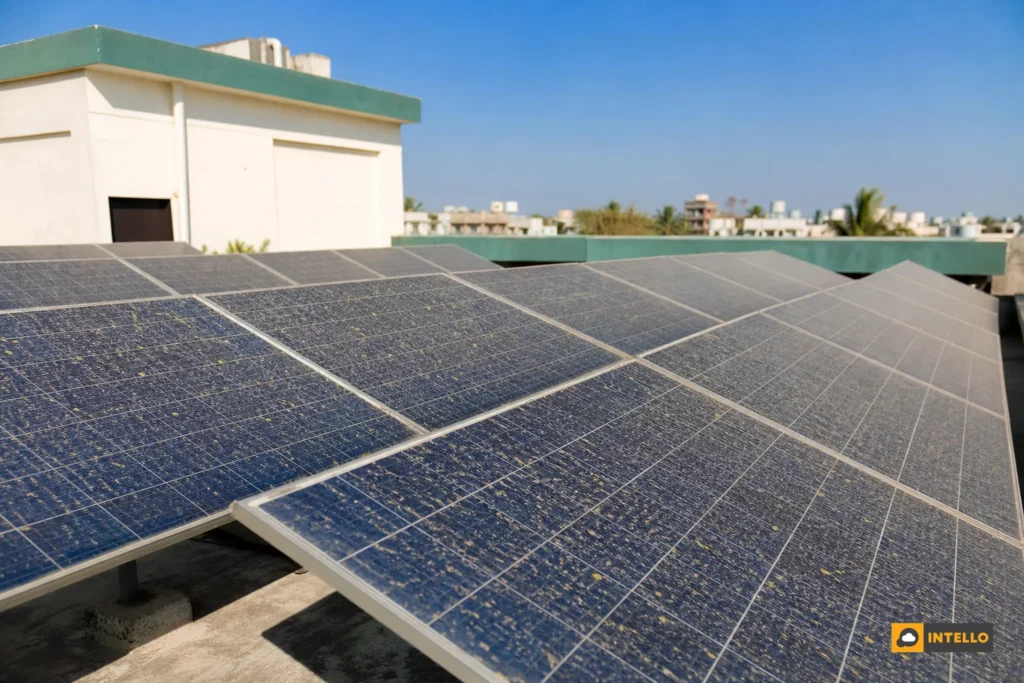
Soiling is the general term for any layer of dust, pollen, soot, salt, or bird droppings that settles on a solar panel’s glass surface and blocks sunlight from reaching the cells underneath. It is not the same as physical damage. It is a film, and it builds faster than most first-time owners assume.
A panel that looks spotless after a professional clean can pick up a visible haze within days in a dusty city. That is not a sign something went wrong with the installation. It is simply how airborne particles behave on a flat, static-charged glass surface exposed to open sky all day.
Why Do Solar Panels Get Dirty So Fast in India?
Solar panels get dirty fast in India mainly because rooftop and ground-mount installs use a low tilt angle, which lets dust settle instead of sliding off, combined with high ambient dust levels, seasonal pollen, and bird activity that hits panels harder than most other outdoor surfaces.
Several factors compound at once, and they rarely act alone:
- Low tilt design: Panels tilted at 10-15 degrees for maximum annual yield don’t shed dust the way a steep roof sheds rain. Particles land and stay.
- Regional dust load: Dry, arid states carry far more suspended particulate matter than coastal zones, so panels there accumulate grime faster between cleanings.
- Nearby construction or agriculture: Sites near active construction, unpaved roads, or farmland pick up dust kicked up by traffic and tilling.
- Bird roosting nearby: Trees, transmission towers, and warehouse eaves near a solar array attract birds, and droppings land directly on the glass.
- Pollen season: A short window each spring deposits a sticky film that dust then clings to, making the panel look dirtier than dust alone would explain.
- Static charge on glass: Tempered glass holds a slight static charge that actively attracts fine airborne particles, the same way a screen attracts dust indoors.
Does Location in India Change How Fast Panels Get Dirty?
Yes, location changes soiling speed significantly. Dry interior states like Rajasthan and Gujarat see the fastest buildup because of dust storms and low humidity, while coastal cities face slower but stickier grime from salt and moisture.
In Delhi-NCR, soot from vehicles and industry adds a greyish film that plain water often can’t fully remove. Post-monsoon periods in central India bring another problem: mud splatter from the last few rains dries into a hard crust rather than washing away cleanly.
For a full regional breakdown, our climate zone cleaning guide maps out expected soiling rates city by city, which is worth checking before you set a fixed maintenance calendar.
What Does Soiling Actually Do to Your Solar Output?
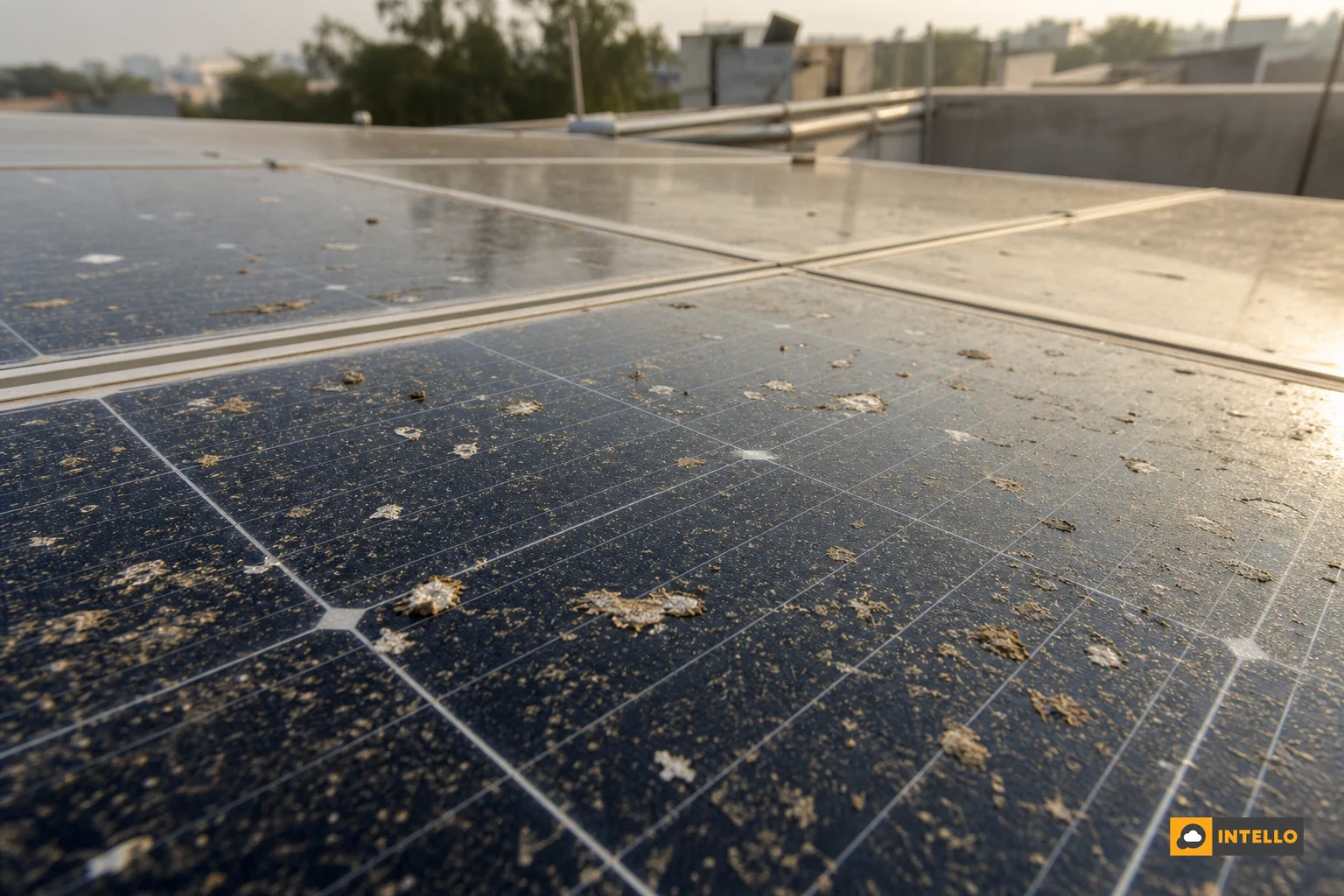
Soiling reduces solar output by physically blocking sunlight from reaching the photovoltaic cells, and the loss scales with how thick and even the dirt layer is. A light dust film can cut generation by 5-15%, while heavy, uneven soiling in dry regions has been measured well beyond that.
The damage isn’t always evenly spread across a panel. A patch of bird droppings sits on one part of the cell string and creates a hotspot, a small area that heats up because it’s shaded while the rest of the panel keeps generating. Over time, repeated hotspot stress can shorten a cell’s working life, not just its daily output.
This is where soiling quietly compounds into a bigger ROI problem. A 10% generation loss on a 100kW commercial system, left unaddressed for two or three months, adds up to real revenue that never shows up in the monthly bill savings an owner expected. It’s one of the most common reasons behind the complaint we cover in why your solar bill is still high after installation.
How to Check Solar Meter Reading in Mobile to Spot Soiling Loss
You can spot soiling-related loss by checking your solar meter reading on a mobile monitoring app and comparing today’s generation against the expected output for that weather and season. A gap of 10% or more, sustained over several days, usually points to a dirty panel surface rather than cloud cover.
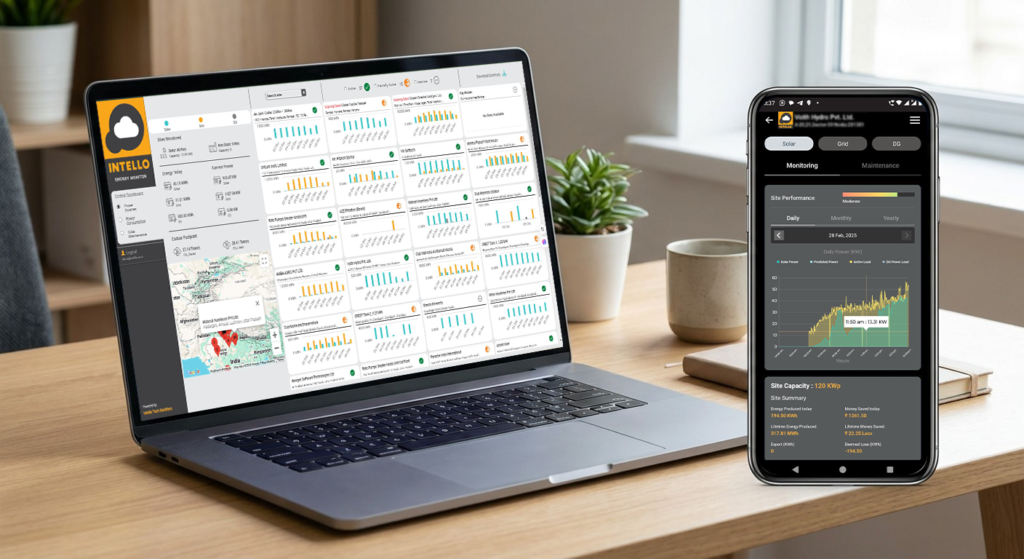
Most modern monitoring dashboards, including Intello’s IoT-enabled platform, plot expected versus actual yield automatically. That means you don’t have to guess whether a dip is soiling, shading, or an inverter fault. Learn more about what a good dashboard should surface daily in our guide on what your solar dashboard should show you.
How Often Should You Clean Solar Panels? (By Season and City)
Solar panels in dusty, dry Indian cities should be cleaned every two to four weeks during peak dust season, while coastal and monsoon-affected regions can go six to eight weeks between cleanings without major loss. There is no single national schedule that works everywhere.
Think of cleaning frequency in three broad bands:
- High-frequency zones (every 2-3 weeks): Rajasthan, Gujarat, interior Maharashtra, and any site near unpaved roads or active construction.
- Moderate zones (every 4-6 weeks): Delhi-NCR, Punjab, Haryana outside dust storm season, and most inland cities with mixed weather.
- Low-frequency zones (every 6-8 weeks): Kerala, coastal Karnataka, and other high-rainfall regions where monsoon showers do natural cleaning for several months a year.
Pollen season is the exception that cuts across all three bands. Wherever you sit, expect to shorten the interval for two to three weeks during peak flowering season, because pollen film doesn’t rinse off as easily as loose dust.
Solar Panel Cleaning: DIY vs Professional Service
DIY cleaning works for small residential systems if done carefully with soft brushes and clean water, but it carries real risk of scratching glass, using hard or saline water that leaves mineral deposits, or working on a live rooftop without proper safety gear.
For commercial and ground-mounted installations, professional cleaning crews matter more than most owners assume going in. Trained technicians know which water quality avoids streaking, how to avoid thermal shock on hot glass, and how to document the job with timestamped photos so there’s a record of what was done and when.
A cleaning crew that leaves no photographic proof of the job leaves you with no way to verify the work actually happened, or that it happened on schedule.
Intello’s field teams log every cleaning visit through a mobile app that captures location, timestamp, and photo evidence, which removes that blind spot for asset owners managing sites they can’t visit weekly.
How Intello’s Preventive Maintenance Keeps Panels Clean and ROI Protected
Intello combines scheduled panel cleaning and wiping with IoT-based generation monitoring, so soiling is caught by the dashboard before it becomes a visible loss on your bill. Preventive maintenance visits are scheduled against actual regional soiling patterns rather than a generic calendar.
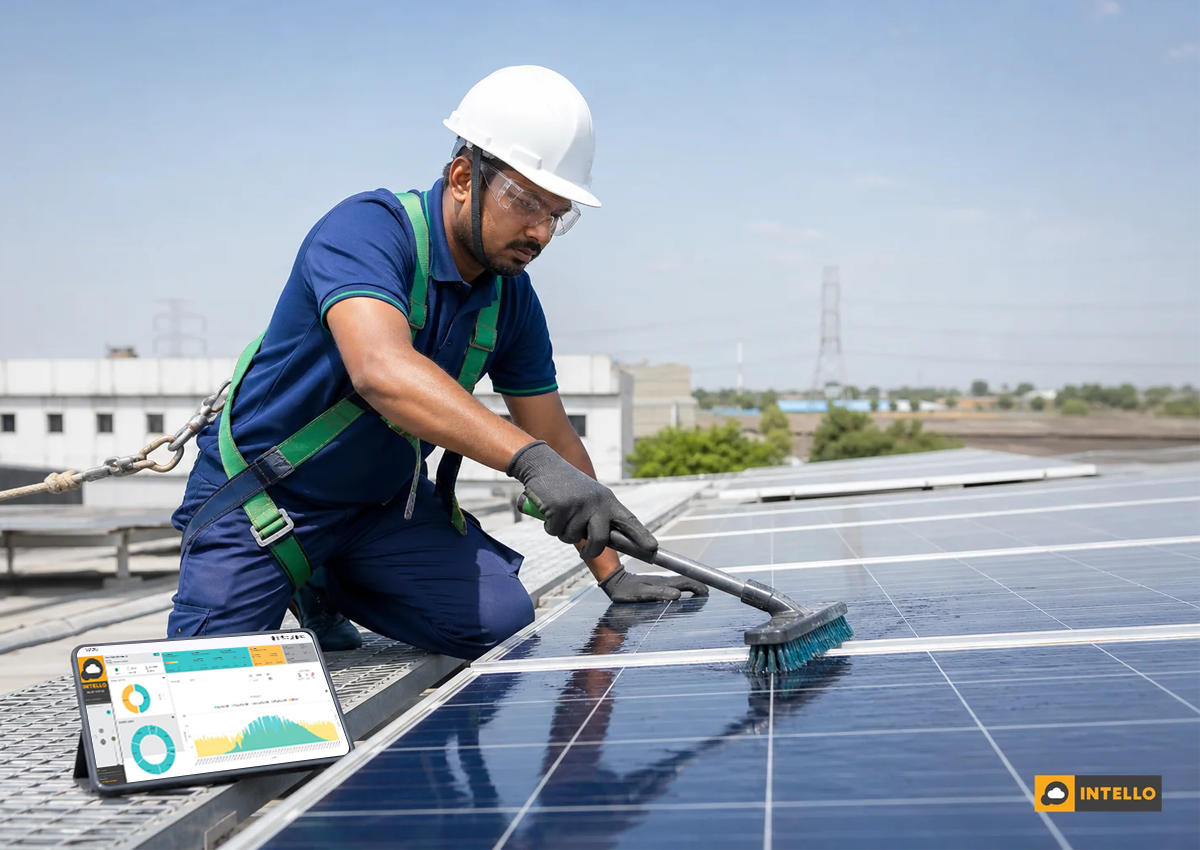
An AMC with Intello bundles panel cleaning, inverter servicing, string balancing, and hardware checks into one contract, backed by 150+ solar experts on payroll across India. That combination matters because soiling rarely shows up alone; a dusty panel and a slightly imbalanced string often develop side by side, and fixing one without checking the other leaves ROI on the table.
If you’re comparing how a structured AMC differs from routine servicing, our breakdown of solar AMC versus O&M contracts in India is a useful next read before signing anything.
For teams running assets across several cities, the case for outsourcing cleaning and monitoring gets stronger the more sites you manage. Our comparison on in-house versus outsourced solar O&M in India walks through the cost and staffing tradeoffs in detail.
Frequently Asked Questions
Does dust really reduce solar output that much?
Yes. A light dust film typically cuts output by 5-15%, and heavier soiling in dry regions can exceed that. The exact figure depends on dust density, panel tilt, and how long since the last clean or rain.
Can rain clean my solar panels?
Light rain often makes soiling worse by turning dust into a thin muddy film, while only heavy, sustained rain during monsoon reliably washes panels clean. Between monsoon months, don’t rely on rain as your cleaning plan.
How do I know my panels need cleaning?
The clearest sign is a generation dip on your monitoring app or mobile dashboard that doesn’t match the day’s weather. A visible dust layer or bird droppings on the glass is the obvious backup check if you can see the panels from ground level.
For background on external data, the U.S. National Renewable Energy Laboratory has published research on soiling losses across different climates, which is a useful reference point if you want to dig deeper into the science: NREL soiling research. India’s Ministry of New and Renewable Energy also tracks solar generation standards nationally, available at mnre.gov.in.
If your generation numbers have been quietly slipping and you’re not sure whether soiling, shading, or a string fault is behind it, don’t wait for the next bill to confirm it. Request a quote from Intello’s O&M team to set up a cleaning schedule matched to your city and rooftop, backed by monitoring that flags soiling before it costs you a full billing cycle. Existing customers can check live generation data anytime through the Portal Login, and you can read more about our approach on the Learn More page or reach our team directly via Contact Us.