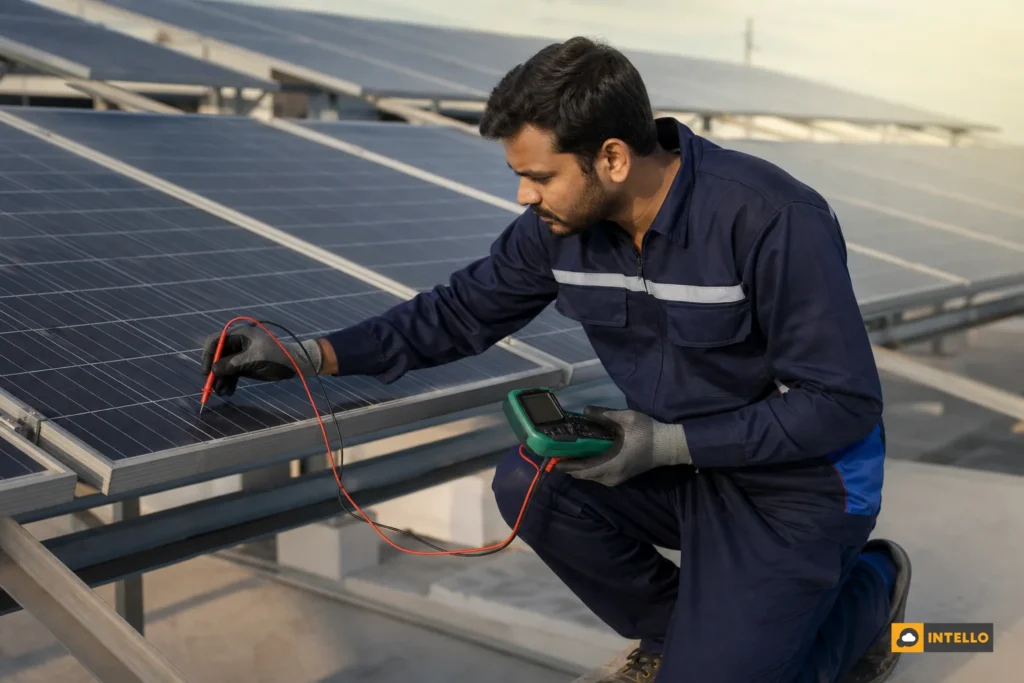
Repair a solar panel when it is under 10-15 years old, the damage is isolated (a cracked glass corner, a failed junction box, a single hotspot cell), and the repair cost sits under roughly 30-40% of what a new panel would cost. Replace it when the array is past 20 years, degradation is spread across multiple modules, or the panel is out of warranty and spare parts are hard to source. Everything in between depends on documentation and remaining plant life.
Key Takeaways
- Age threshold: Panels under 10 years old are almost always worth repairing; past 20 years, replacement usually wins even if the panel still produces some power.
- Cost ratio rule: If a repair costs more than 30-40% of a replacement panel’s price, most O&M teams recommend replacing instead.
- Warranty status matters most: A panel still inside its 10-year product warranty or 25-year performance warranty may cost nothing to fix through a manufacturer claim.
- Isolated damage favours repair; spread damage favours replacement: One cracked cell is a repair job. Discolouration across a whole row usually is not.
- Monitoring data settles arguments that eyeballing can’t: A string-level output trend tells you whether a panel is degrading gradually or has genuinely failed.
At a Glance: Repair vs Replace
| Factor | Lean toward Repair | Lean toward Replace |
|---|---|---|
| Panel age | Under 10-15 years | Over 20 years |
| Warranty status | Still in product or performance warranty | Warranty expired, manufacturer defunct or unresponsive |
| Damage type | Isolated crack, connector, junction box | Widespread delamination, discolouration, hotspots |
| Output loss | Moderate, single-panel or single-string | Severe, multiple strings or whole array |
| Repair cost vs new panel | Under ~30-40% of replacement cost | Above ~40%, or spare parts unavailable |
| Failure history | First occurrence | Recurring failures on same panel or string |
The Three Filters O&M Teams Use to Decide
Field teams don’t debate this case by case from scratch. They run every damaged or underperforming panel through three filters, in this order: age against expected lifespan, warranty status, and the ratio of repair cost to replacement cost. A panel that fails any one filter badly usually gets replaced regardless of what the other two say.
The logic is simple. A panel’s economic life doesn’t end the day it stops working perfectly. It ends when the cost of keeping it running exceeds the value of the electricity it still generates. That crossover point is what the three filters try to estimate quickly, without a full financial model for every single module on a plant. The steps below walk through those filters in the order most O&M teams actually apply them, followed by the warning signs and checklist that settle the borderline cases.
1. Check the Panel’s Age Against Its Expected Lifespan
Most crystalline silicon solar panels are rated for a working lifespan of 25 to 30 years, and many keep producing usable power well past that mark. But “still producing power” and “still worth fixing” are different questions.
Under 10 years old, a panel almost certainly has decades of useful life left. Repairing a crack, a bad connector, or a junction box failure at this stage is close to a no-brainer, since you’re protecting a long remaining revenue stream for a small outlay.
Between 10 and 20 years, the decision gets murkier. Degradation has usually eaten into output by this point, and the panel’s remaining value is lower even if it looks fine. Here, the repair cost ratio (covered in step 3) starts to matter more than age alone.
Past 20 years, most O&M teams lean toward replacement unless the fix is trivially cheap. The panel is close to end-of-life anyway, spare parts for older models are harder to find, and newer panels typically deliver better output per rupee of roof space. This aligns with plant-level thinking too: if you’re already planning centralized monitoring across sites, an ageing panel dragging down one string skews your whole performance dashboard.
2. Check Whether the Panel Is Still Under Warranty
Check the product warranty first, then the performance warranty; they cover different things and expire at different times. In India, module manufacturers typically commit to a 10-year product warranty against manufacturing defects and a 25-year performance warranty guaranteeing a minimum output threshold, so a panel can be within one and outside the other.
A product warranty claim usually covers manufacturing faults like delamination or a defective junction box, provided you have the invoice, serial number, and photographic proof of the defect. A performance warranty claim, by contrast, kicks in only when output falls below the manufacturer’s guaranteed curve, which needs monitoring data to prove.
This is where a lot of homeowners lose money they didn’t need to. If your panel is within warranty, a manufacturer replacement or repair should cost little beyond labour and logistics. Our detailed solar panel warranty claim process guide walks through the documentation you’ll need and the typical claim timelines.
3. Compare the Repair Cost Against Replacement Cost
The rule of thumb used across most Indian O&M contracts is this: if repairing a panel costs more than roughly 30-40% of buying a comparable new one, replace it instead. Below that threshold, repair almost always makes financial sense, since you avoid the labour and mounting cost of a full swap.
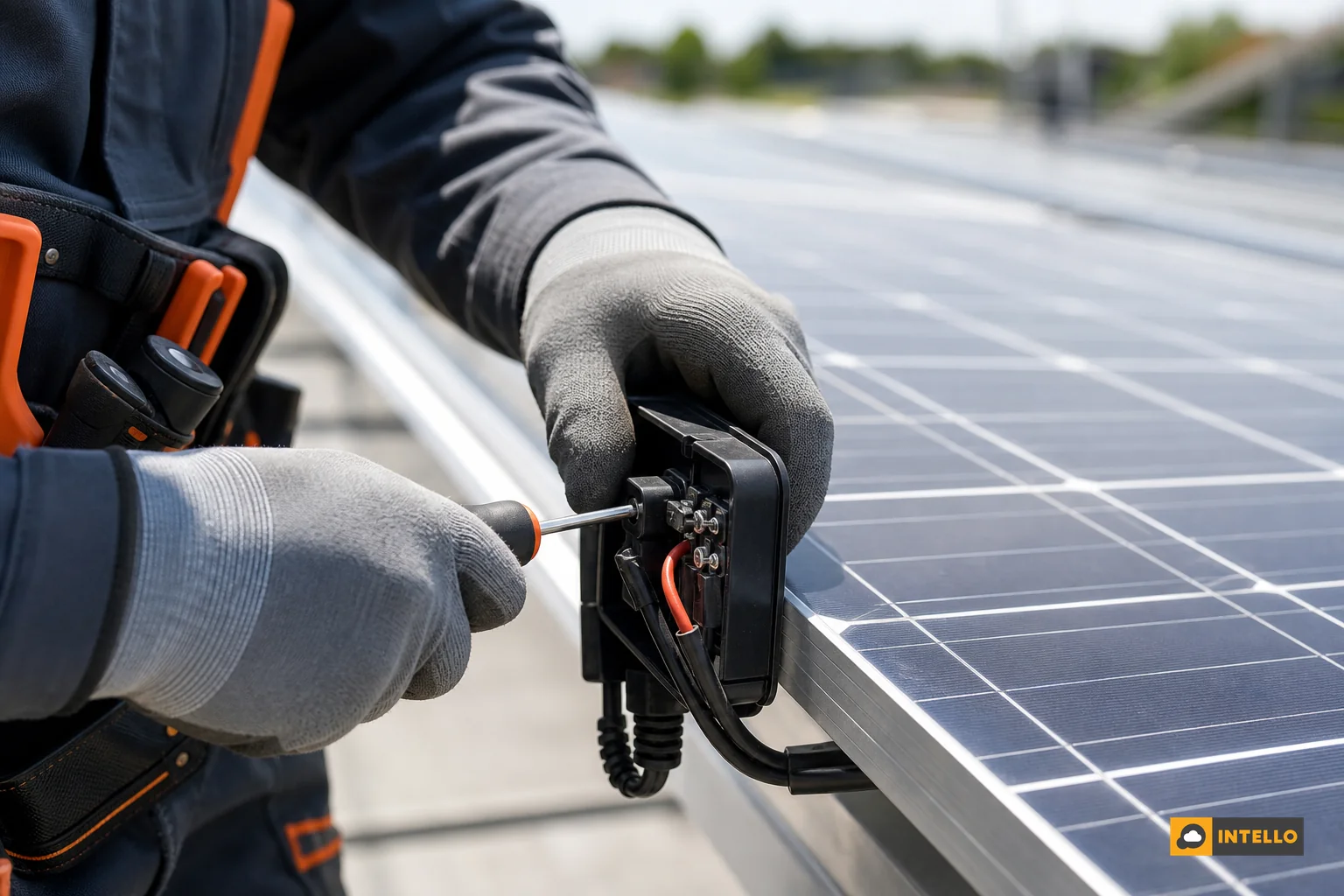
Common repairs that stay well under this threshold include a cracked junction box, a corroded MC4 connector, a loose frame fastener, or resealing a minor edge chip in the glass before moisture gets in. These are inexpensive fixes, usually resolved in a single site visit.
Repairs that push closer to or past the threshold include a hotspot cell caused by internal cell damage, significant glass cracking across the panel face, or backsheet failure that’s let moisture into the laminate. At that point, the labour plus part cost of attempting a fix often approaches what a replacement panel would cost anyway, especially once you factor in the risk that the repair doesn’t fully restore output.
One caveat worth stating plainly: repair cost estimates vary a lot by region, panel wattage, and who you call. Get a written quote before assuming either option, and if a technician can’t tell you the expected post-repair output, treat that as a red flag, not a rounding error.
4. Watch for Warning Signs That Point Toward Replacement
Certain symptoms are reliable tells that repair won’t hold, even when the panel technically still generates some power. Watch for these:
- Discolouration or browning across multiple cells, not just one, which usually signals encapsulant degradation that spreads over time.
- Output loss beyond roughly 20-25% of the panel’s rated capacity that doesn’t recover after cleaning, string checks, or an inverter reset.
- Recurring failures on the same panel after a repair, which tells you the root cause wasn’t actually fixed.
- Unavailable spare parts for an older or discontinued panel model, which makes even a simple repair impractical.
- Delamination visible across several panels in the same batch, which usually points to a manufacturing issue affecting the whole installation, not one unit.
5. Run the Final Repair-or-Replace Checklist
A panel is worth repairing when it’s under 15 years old, still within warranty or close to it, the damage is confined to one component, and the repair quote stays under roughly a third of a replacement panel’s cost. If any of those fail badly, get a second opinion before spending on the fix.
Run through this checklist before signing off on a repair quote:
- Pull the panel’s age and serial number, and check remaining warranty coverage.
- Confirm the damage is isolated to one panel or component, not spread across a string.
- Get a written repair quote and compare it against current replacement panel pricing.
- Ask what output the panel is expected to deliver after the repair, and for how long.
- Check whether the same fault has recurred on this panel before.
Repair or Replace: A Side-by-Side Comparison
Real decisions rarely fit neatly into one column. Here’s how four common scenarios typically play out on Indian rooftop and ground-mounted sites:
| Scenario | Typical age | Recommended action | Why |
|---|---|---|---|
| Single cracked glass corner, panel producing near-rated output | Any age under 15 years | Repair or reseal | Low cost, isolated damage, no structural risk yet |
| String underperforming 15-20%, no visible panel damage | 5-12 years | Diagnose first (see shading loss diagnosis), then repair the actual cause | Cause could be shading, soiling or a connector, not the panel itself |
| Whole array showing 20+ years of service, generation trending down for two years | 20+ years | Replace | Approaching end of rated life; new panels deliver better output per rupee |
| Isolated hotspot cell with visible burn mark | Any age, out of warranty | Replace that panel | Hotspots rarely resolve with repair and pose a fire risk if ignored |
A Regional Note for Indian Solar Owners
Where you operate in India changes how fast panels reach the repair-or-replace decision point in the first place. Coastal plants in states like Gujarat or Tamil Nadu see faster connector corrosion from salt air. Northern plains sites face heavier dust loading, and Rajasthan or parts of Madhya Pradesh push panels through wider daily temperature swings that stress solder joints over time.
None of this changes the three filters, but it does change how often you should be inspecting panels closely enough to catch damage before it escalates. If you’re unsure how often your region needs a physical check versus a clean, our regional cleaning guide by climate zone breaks this down city by city, and the monsoon maintenance checklist covers the seasonal damage pattern most owners miss until a bill spikes.
Where Preventive Maintenance Fits Into This Decision
The cheapest repair is one caught before it becomes a repair at all. A quarterly inspection that finds a loose connector or an early hotspot lets you fix it for a fraction of what a neglected version costs six months later, when the same fault has spread or triggered a bigger failure.
This is the real argument for scheduled O&M over reactive callouts. Our breakdown of preventive versus breakdown solar maintenance puts real numbers against this comparison, and the pattern holds across most plant sizes we’ve serviced: waiting for a failure almost always costs more than catching it early.
How Intello Helps You Decide, Not Just Fix
Intello’s IoT-enabled monitoring dashboard tracks string-level and panel-level output continuously, so a gradual decline shows up as data weeks before it’s visible to the naked eye. When a technician visits, they document the fault with geo-tagged photos, timestamps, and a signed report through our mobile app, giving you the paper trail a warranty claim or an insurance case actually needs.
Our field teams don’t push replacements by default. They flag the repair-or-replace call transparently, based on age, warranty status, and cost ratio, the same filters covered in steps 1-3 above, and they manage the warranty claim process on your behalf where the panel qualifies. For plants running on an AMC, minor repairs are typically bundled into the contract rather than billed as surprise call-outs.
If you’re weighing whether an annual contract or a one-off repair makes more sense for your situation, our comparison of Solar AMC vs O&M contracts in India lays out the trade-offs plainly.
Frequently Asked Questions
How long do solar panels typically last in India?
Most crystalline silicon panels are rated for 25 to 30 years of service, though real-world output declines gradually the whole time. Heat, dust, and monsoon stress in Indian conditions can push degradation slightly faster than in milder climates, which is why regular inspection matters more here than the rated lifespan alone suggests.
Can a cracked solar panel still be used safely?
A hairline crack that hasn’t reached the cell layer can often keep working safely for a while, but moisture ingress over time raises the risk of a hotspot or electrical fault. Get it inspected and resealed promptly rather than waiting for output to visibly drop.
What does solar panel servicing usually include?
Routine servicing covers panel cleaning, visual and thermal inspection for hotspots or cracks, connector and wiring checks, inverter servicing, and string-level output verification against the monitoring dashboard. Most AMC plans bundle these into quarterly or half-yearly visits.
Is it cheaper to repair or replace a solar inverter versus a panel?
Inverters and panels follow different economics: inverters have a shorter typical service life (often 8-12 years for string inverters) and a repair is usually only worthwhile if the fault is a minor component failure still under warranty. Panels, by contrast, are built for a much longer life, so isolated panel damage is more often worth repairing than a comparable inverter fault.
Whether you’re staring at one cracked panel or trying to decide the fate of an ageing array, the fastest way to get a straight answer is a proper inspection backed by real output data, not a guess from a rooftop photo. Request a quote from Intello’s O&M team for a repair-or-replace assessment on your system, or explore what our monitoring and maintenance platform tracks day to day by visiting our about page. Existing customers can check live panel and string performance anytime through the Intello portal login.